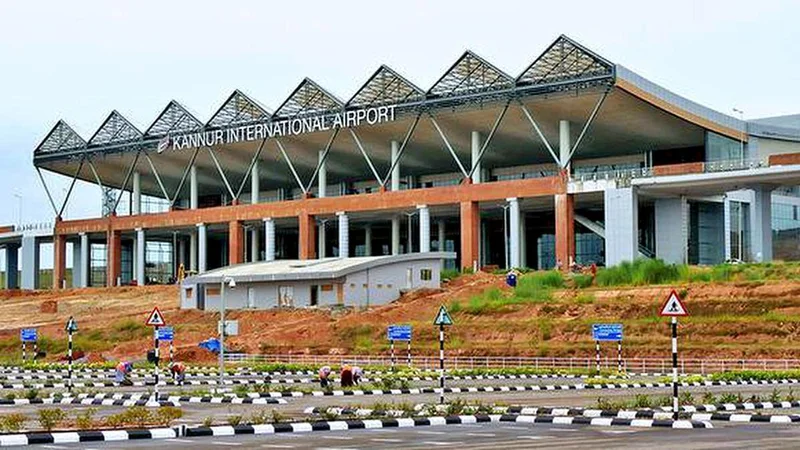
The Kannur International Airport Limited (KIAL) has proposed setting up a 100-megawatt (MW) solar power project on land acquired for a future second runway, with officials saying the project could help meet Kerala’s peak-hour power requirements while generating revenue from land that is unlikely to be needed for runway expansion for at least the next 25 to 30 years.
Speaking to The Hindu, KIAL Chief Operating Officer Aswani Kumar said the airport had proposed the project after assessing passenger traffic and the likely requirement for a second runway. The proposal is now at a stage where an Expression of Interest (EoI) is expected to be invited, subject to government approval.
He said the proposed project could generate about 100 MW. KIAL has about 483 acres earmarked for the second runway, which is currently largely unusable. Rough calculations indicate that around 4.5 acres are required for 1 MW of solar power generation.
“The land is ideally suited for solar power generation as it slopes towards the south, which is favourable for maximum generation,” Mr. Kumar said. He added that the project could eventually generate around 130 MW, though the undulating terrain could limit the practical capacity to about 100 MW.
“Several major companies, including National Thermal Power Corporation [NTPC], Bharat Petroleum Corporation Limited [BPCL], Indian Oil Corporation Limited [IOCL], and Neyveli Lignite Corporation [NLC], have reportedly shown interest in investing in the project. The existing solar contractor, Oriana Power, is also interested,” he said. However, the project faces regulatory and financial hurdles, particularly over the tariff at which the electricity can be sold.
KIAL has received an informal indication from the Kerala State Electricity Board of a tariff of less than ₹3 a unit, which officials say could make a battery-backed project financially unviable. A final tariff could be determined only after the bidding process and identification of the agency that would purchase the power.
Mr. Kumar said that under the proposed model, an investor would build the solar plant with battery storage and sell the power to a designated buyer under a long-term agreement. The proposed project could require more than ₹500 crore, with the total investment potentially reaching ₹700 crore, including battery storage. The estimated benchmark for solar generation without battery storage is around ₹5 crore per megawatt, he added.
The airport is also working to make its existing 4-MW solar project fully operational. The project, which began trial operations in June, comprises 2.25 MW of ground-mounted solar panels and 1.75 MW of solar panels installed over the car parking area.
According to KIAL Head of Engineering M.K. Abdul Zalam, the 4-MW system is designed primarily to meet the airport’s daytime electricity requirements. The airport currently consumes about 4.88 lakh units a month, with roughly half of its total consumption occurring during the daytime. “The idea is to neutralise our daytime consumption with solar power,” Mr. Zalam said.
“The airport has already begun trial generation using its internal system. Final the KSEB approval for grid connectivity and a banking agreement are pending. Once the required documentation and testing are completed, surplus daytime power can be exported to the KSEB grid,” he said.
Mr. Salam said the airport’s tariff structure makes the issue more complex. Electricity supplied during peak hours, from 6 p.m. to 10 p.m., attracts a tariff about 1.5 times higher than the normal rate. Simply matching the airport’s physical consumption would not make it tariff-neutral. The airport estimates that it would ultimately require around 8.5 MW of solar capacity to neutralise its electricity bill, including tariff differences.
The present electricity bill is around ₹90 lakh a month, and the 4-MW project is expected to reduce it by approximately ₹35 lakh a month, Mr. Zalam said. He said KIAL has already created infrastructure to support the expansion of solar generation to about 10 MW at the airport, though additional battery storage would be required.
For the larger 100-MW project, technical challenges include power evacuation and grid capacity. Mr. Zalam said the airport land has a major advantage, as a 110-kV single-circuit transmission line passes through it. KSEB would, however, need to strengthen the transmission system, potentially by converting it to a double-circuit line, and a suitable substation would also be required.
“KSEB has conducted a preliminary technical assessment and indicated that about 100 MW could be generated on the 500-acre area identified for future expansion. Another advantage is the proximity of an existing KINFRA substation,” Mr. Zalam said.
He said the project could provide locally generated power for northern Kerala and help address voltage and power shortages in the State. However, its viability would depend on securing buyers and a commercially feasible tariff through the regulatory process.
KIAL has also considered leasing the land to a major power company, allowing the investor to build and operate the solar project. Companies such as NTPC, NLC and BPCL have the financial capacity, but regulatory approvals and a guaranteed long-term buyer remain critical.
“Making the project viable is the challenge,” Mr. Salam said, adding that government and KSEB-level support would be necessary to move the proposal forward.
KIAL officials said the solar project would allow the airport to make productive use of land acquired for a second runway, while the expansion is unlikely to be required in the foreseeable future. Solar panels have an expected operating life of about 25 years, allowing the land to be used temporarily without permanently compromising the airport’s future expansion plans.
Published - August 16, 2026 08:54 pm IST