Who knew that all I needed to be interested in maths was the command of a five-thousand-tonne artillery battery? If only my secondary school teacher had known. Turns out that the ticking clock of exam pressure is a hell of a lot less motivating than the boom of artillery shells growing ever closer, as enemy gunners zero in on your position, trying to blast your colossal cannon to kingdom come before you blast them.
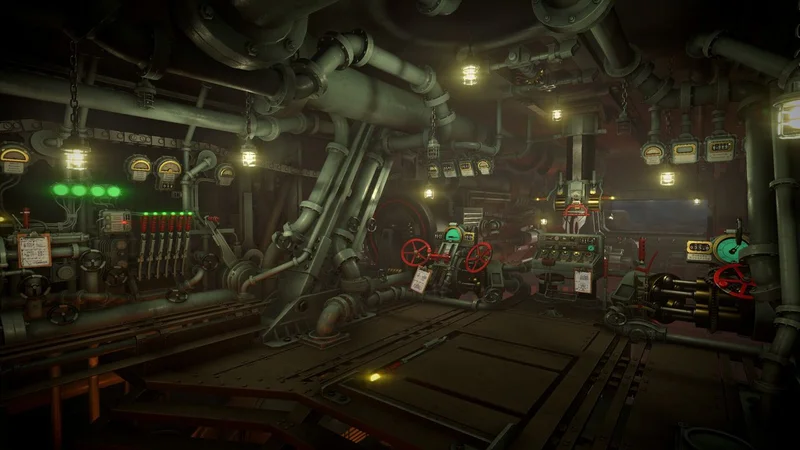
But Iron Nest is a similar test of mental endurance. You hustle and bustle around your one-man gun emplacement, triangulating degrees and distances, praying that your next shell won't sail clear over the target, leaving you scratching your head as to which vital calculation you somehow messed up. It's an addictive challenge, bolstered by an array of wonderfully tactile gadgets and gizmos.
Sure, it's an artillery simulator of sorts, but it's more like one of the best versions of Battleship you'll ever play. It's about employing what you know and learn through each shot, to track down enemy positions and destroy them, often before they destroy you. And it's hard to overstate how satisfying it is when you land a shell squarely on-target, especially when it's the payoff for 10 minutes spent messing about with machines and the map table.
So who are you shooting? Iron Nest is set in an alternate-history version of 1920s Spain in which the Kingdom of Castille somehow got their mitts on a gigantic, city-levelling artillery piece, and is using it to maintain their grip on power. That's your job: shoot what they tell you, or don't. As the lone denizen of the Iron Nest—save for one presumably very deaf cat—your job is operating the battery by yourself.
You have to read the teleprinter and note vital info on your clipboard. Use the map table and its elaborate array of markers, coloured pencils, and measuring devices to triangulate enemy positions. You're inputting distance into a machine to calculate barrel elevation—which prints off a cute little firing solution ticket—and wheeling the gun on its axis to the correct bearing. And when all is prepared, you're flipping switches as if arming a nuke, and pulling the handle to take your shot.
There's just so much gravity to Iron Nest, in fiddling with its tactile machines and gadgets, but also in the methodical step-by-step that plays out before each firing. Despite its initial learning curve, before long the pre-shot preparation becomes a bit of a ritual, a process you refine through repetition and gain mastery with. It's strangely relaxing for a game about obliterating enemies with explosive ordinance.
And as you gain mastery, Iron Nest unfurls even more. You unlock a requisition station that lets you satisfyingly stamp cards to buy recon plane flyovers and different shell types, but it adds a new challenge element as you try to spend the bare minimum possible, relying on your smarts to bridge the gap.
Keep up to date with the most important stories and the best deals, as picked by the PC Gamer team.
You unlock a second barrel, letting you hit two targets in quick succession. That is, if you're able to juggle the calculations and tweaks you have to make between each firing without your brain melting. And thanks to its procedurally-generated objectives, with enemy positions changing even when you replay a mission, plus medals for performance, Iron Nest has a lot of replayability.
The only thing Iron Nest is lacking is co-op. It would be ridiculously fun to run around the gun with a friend, but the game is already a pretty incredible achievement considering it was built by one guy. It'd also be a great candidate for a Battleship-style head-to-head mode, where two Iron Nests try to triangulate and destroy each other, but multiplayer is listed on Iron Nest's roadmap, so maybe we can look forward to that.
While I'm still very excited for next year's PVKK: Planetenverteidigungskanonenkommandant (gasps for breath) which sees you commanding an orbital defense cannon, Iron Nest is the best artillery game I've tried. Its playground of tactile tools and machines makes it appealing to simulation fans of all stripes, while its smart yet addictive gun-prep formula feels almost endlessly repeatable, as you strive for that elusive yet satisfying sense of mastery.
Sean's first PC games were Full Throttle and Total Annihilation and his taste has stayed much the same since. When not scouring games for secrets or bashing his head against puzzles, you'll find him revisiting old Total War campaigns, agonizing over his Destiny 2 fit, or still trying to finish the Horus Heresy. Sean has also written for EDGE, Eurogamer, PCGamesN, Wireframe, EGMNOW, and Inverse.