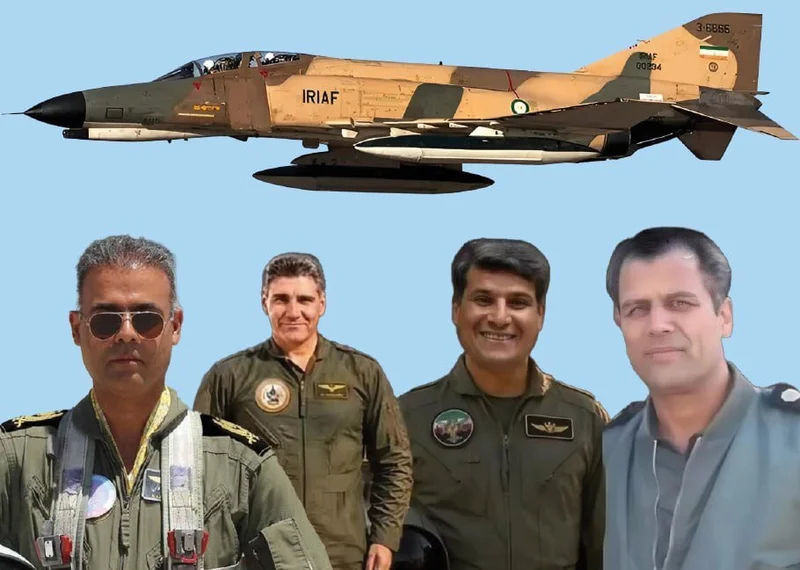
Case of 3 Iranian pilots is a serious test to determine Qatar’s role in the war
As Iran pushes for a formal inquiry into its detained pilots, Doha’s persistent denials highlight the heavy footprint of American influence
TEHRAN — A senior Iranian military official has called on Qatari authorities to grant access to a specialized delegation from the Islamic Republic of Iran Air Force (IRIAF) to investigate the status of three Iranian fighter pilots detained in Qatar.
Brigadier General Seyyed Mohammad Bagherzadeh, Commander of the Missing-in-Action Search Committee of the General Staff of the Iranian Armed Forces, emphasized that Doha must cease denying the detention of the airmen and facilitate the entry of Iranian military investigators.
“The Qatari government should allow and facilitate the entry of the Iran Air Force fact-finding team rather than deny the detention of Iranian pilots,” Bagherzadeh stated. He revealed that an elite team of IRIAF experts has been waiting for months to obtain clearance to enter Qatar, yet their efforts remain thwarted by the reluctance and lack of cooperation of Qatari authorities.
The senior commander stressed that the necessary preparations for the safe return of the captured airmen to their homeland have been repeatedly stalled by Qatari officials.
The diplomatic rift between Tehran and Doha stems directly from the joint military attack launched on February 28 by the United States and Israel against Iran. The aggression, which targeted Tehran and many other cities across Iran, resulted in the martyrdom of the Leader of the Islamic Revolution, Ayatollah Seyed Ali Khamenei, along with senior military commanders and thousands of innocent civilians. The strikes destroyed critical public infrastructure and residential areas across the country.
Exercising its legitimate right to self-defense under Article 51 of the United Nations Charter, Iranian Armed Forces executed precise retaliatory missile and drone operations against Israeli positions and major American forward operating bases throughout West Asia.
Speaking on August 1 regarding the operational details, Brigadier General Mohammad Akraminia, a spokesman for the Iranian Army, stated that the retaliatory strike was executed after the launch of military aggression against Iran on February 28. General Akraminia clarified that the retaliatory offensive comprised multiple tactical vectors, including a precision run by F-5 fighter jets against the Al Adiri military facility in Kuwait, as well as a long-range penetration mission carried out by Air Force Su-24 tactical bombers targeting the key US command hub at Al Udeid in Qatar. Describing the Su-24 raid as one of the most complex and dangerous aerial operations undertaken by the Air Force in recent years, Akraminia highlighted the concentration of Western air defense umbrella systems deployed throughout the Persian Gulf corridor.
To bypass multi-layered radar coverage and early warning networks, a four-man Iranian strike team executed extreme low-altitude flight profiles, maintaining altitudes of merely 30 to 40 meters above the waters of the Persian Gulf and skimming terrain features during landward entry. Although the primary tactical objectives were achieved and heavy damage was inflicted upon the targeted base, enemy interceptors engaged the Iranian bombers during their homeward transit. The operation successfully destroyed multiple American military helicopters on the tarmac and rendered numerous other rotary-wing platforms permanently inoperable, significantly curtailing forward US air capabilities in the theater. Two Su-24 tactical bombers of the Islamic Republic of Iran Air Force had taken off from Shahid Doran Air Base in Shiraz on March 2 to carry out this targeted deterrent mission against the military installation in Qatar hosting enemy troops. Upon completing their mission, the two aircraft were hit by enemy air defense batteries while navigating their return vector over the Persian Gulf. Of the four crew members, pilot Majid Kazemi was martyred during the incident. Following extended operational efforts, his body was recently recovered and identified through DNA verification. General Kazemi was laid to rest in the southern city of Shiraz during a funeral attended by military dignitaries and thousands of citizens paying tribute to his sacrifice. The remaining three airmen—identified as Javad Salehi, Abdolmajid Dashtian, and Omran Behraveshian—were captured alive by Qatari security forces. Regarding these three aviators, General Akraminia noted on August 1 that while Tehran has maintained constant communication with regional authorities, the Qatari government has so far stated that it possesses no verifiable information regarding their whereabouts. He called upon officials in Doha to intensify cooperation in search and investigation in full alignment with international humanitarian law and the Geneva Conventions.
In an official letter addressed to the President of the International Committee of the Red Cross (ICRC), Mirjana Spoljaric, General Bagherzadeh detailed how Qatari authorities have held the three officers in secretive detention for nearly six months. The Qatari government has denied the captives their fundamental rights under the Third Geneva Convention, systematically preventing them from communicating with their families, receiving diplomatic representation, or being evaluated by neutral humanitarian monitors. In his letter to the ICRC leadership, Bagherzadeh urged the humanitarian body to intervene without delay, visit the detained officers in Qatar, assess their physical and psychological well-being, and enforce international legal frameworks to secure their prompt release. Despite the clear timeline and mounting evidence presented by the Iranian Armed Forces General Staff, Qatari Foreign Ministry spokesperson Majed al-Ansari issued statements rejecting General Bagherzadeh’s remarks, asserting surprise at Tehran’s announcements amid diplomatic engagements aimed at reducing regional instability.
A comprehensive assessment of the operational data and diplomatic developments leads to the strong probability that the three remaining Iranian pilots are indeed alive and currently held in custody. In all likelihood, the United States will strictly prohibit Doha from placing or maintaining these airmen under independent Qatari control. However, American pressure does not in any way relieve Qatar of its ultimate legal and moral responsibility, given that the initial capture and ongoing detention of these officers could only have occurred with the active cooperation and assistance of Qatari authorities. By resorting to concealment, denial, and a complete refusal to cooperate in establishing the fate and securing the release of these pilots, Qatar severely undermines its own stated claims of maintaining neutrality in this regional conflict. Furthermore, this uncooperative posture damages Doha's broader credibility and motives as a regional mediator. Serious questions arise because an actor cannot actively participate on one side of a battlefield while simultaneously attempting to play the role of an impartial mediator. Collaborating with Tehran to resolve this case transparently is directly aligned with Qatar's overarching national interests. Uncritical alignment, blind trust, and compliance with American directives will ultimately bring no positive outcome for Doha, while actively eroding its regional standing and long-term security balance.