A manufacturer believes local companies are more than capable of filling orders for New Zealand's defence drones.
At the end of a winding, gravel road in the far north of Auckland - overlooking a valley of native bush, and beyond to Hauturu in the Hauraki Gulf - sits a simple building full of high tech secrets.
"We like to think of ourselves as the Skunk Works of robots," says Philip Solaris, chief executive of Obsidian Systems and owner of this workshop.
He's talking about aerospace firm Lockheed Martin's innovation arm that "tries crazy things" with aircraft.
Solaris is taking The Detail on a tour of his space, that has floor-to-ceiling glass doors opening out to his spectacular view. It is an insight into the world of drones and their makers, how they're used in conservation and disasters, and what our defence force plans to do with them.
Last month, the government announced it is starting the process to purchase long-range one-way strike drones. It's calling for information from the local industry.
It aims to review, trial and select a strike drone by the end of March next year.
Asked how it will use the drones, the New Zealand Defence Force (NZDF) responded in an email to The Detail that it will "depend on a number of factors such as manufacturing, delivery, integration of various sub-systems and the time to train NZDF personnel to operate the new drones".
Defence is also doing market research this week on unarmed long-range uncrewed aircraft systems that can conduct maritime surveillance tasks, starting with a request for information from businesses.
In a media statement announcing the modernisation of Defence, the then-minister Chris Penk said both investments have $100 million to $300 million allocated.
Solaris, who has worked on robotic systems for nearly two decades, says New Zealand companies like his are capable of filling the orders for drones.
"I believe all the capability is within New Zealand to be world leaders in this realm, I really do, I've seen it," he says. "It's not just our company, there's a whole lot of companies in New Zealand that can all be part of that.
"We can't manufacture huge frigates but we can manufacture thousands of small craft."
He says he was approached several years ago to supply drones to Ukraine for the war against Russia.
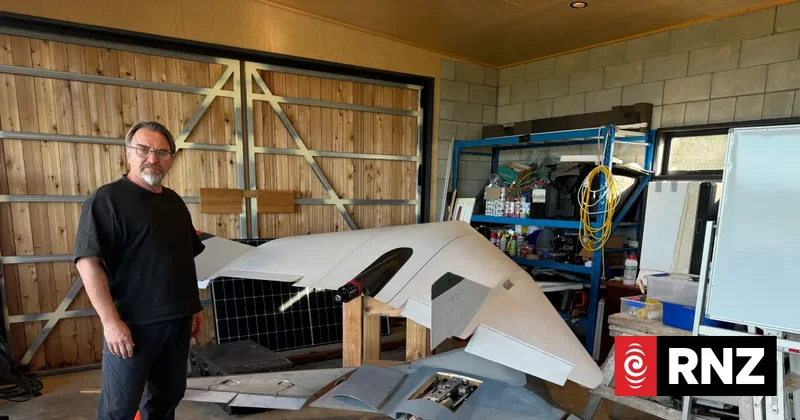
He points to an eight-year-old winged craft in the room that was operating in New Zealand well before the Ukrainian war.
"We were testing them out here and could conduct just that capability," Solaris says.
"They wanted them. The Labour government at the time was very reticent to have what they call 'dual use capability'. Of course all our craft are dual use because we want to do humanitarian and environmental operations as well as defence."
He says the dual use restrictions were lifted but by then the Ukrainian company was making its own drones.
Solaris' workroom is full of drones of all shapes and sizes, mainly made of composite materials including carbon fibre and a "few other bits and pieces that I can't talk about".
They're made in New Zealand but he can't reveal where.
Next to the 3D printer is a drone that looks like a model of an America's Cup boat but The Detail can't photograph it and Solaris won't say who the client is.
What he can talk about is the half metre-sized robot with eyes called Bob, who wears a cap on his rotating head.
"Bob was made about five years ago and because we couldn't find anybody else in the world manufacturing a system like this. He's used on boats and he's got a long vision eye and a short vision eye and he takes photos of what he sees."
Bob can identify different kinds boats and relay the information to the auto pilot on board the vessel carrying him. Together the robotic systems know to stay away from non-fishing boats.
"The auto-pilot can go, 'Hold on, we're in a zone where there shouldn't be fishing boats so my command is that I follow that fishing boat and take photos of it'. Bob is the lookout," says Solaris.
Now companies are making versions of Bob to scale for surveillance work.
Solaris says robotic systems are widely used in search and rescue work but the use of drones in disaster zones does have downsides.
He cites last year's destructive earthquake in Tibet when drones were sent to remote areas to survey the damage and search for people.
"Everybody ran in there with drones. Now, it sounds like it would be a good idea but no it wasn't and one of the sad side effects is that it showed all of the destruction of all the temples and basically turned off people visiting them.
"It had huge economic impacts. And you also had people being real cowboys, going out there recording stuff they shouldn't have. The professionalism wasn't part of it."
You can also get in touch with us by emailing thedetail@rnz.co.nz