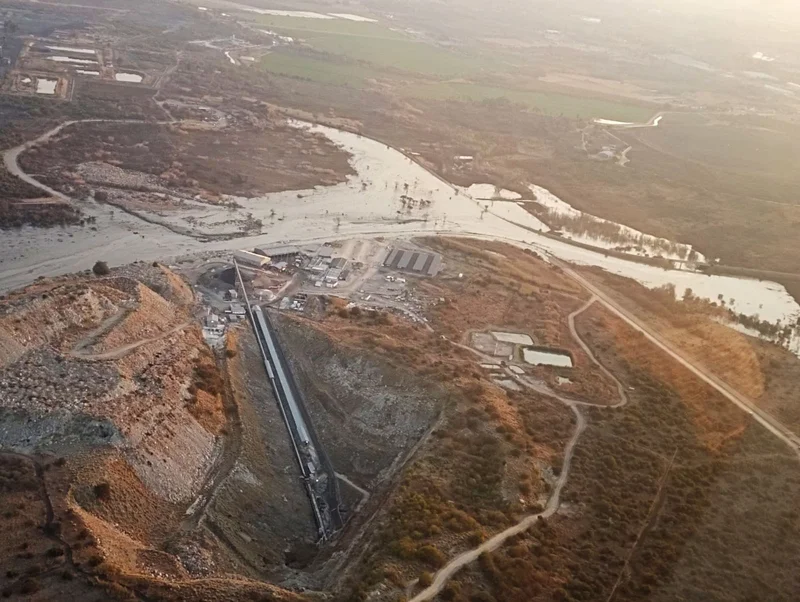
On Thursday, 13 August, the wall of a dam belonging to Samancor Dikwena Tailings Facility collapsed, unleashing mining sludge across the R566 towards the nearby Eland Mine owned by Northam Platinum near Brits in North West.
The sludge flood interrupted access to an Eland Mine access road but was later cleared up.
Daily Maverick understands the tailings storage facility (TSF) is on Samancor land, but the operator is an unlisted company, One Chrome.
Aerial footage provided to Daily Maverick shows a trail of sludge extending for several kilometres, sparking concerns of potential contamination. A mining expert who viewed the footage said it was worrying that another tailings facility had water on top of it that was ânot supposed to be thereâ.
A dam wall at the Samancor Dikwena tailings storage facility near Brits collapsed on Thursday, 13 August, allowing mineral waste to spill into the surrounding Elands Mine. (Video: Iaan Myburgh)
The sludge flood also damaged Eskom infrastructure in the area, resulting in power interruptions in Brits, Hennops and surrounding areas.
Daily Maverick contacted the Madibeng Local Municipality to seek clarity on the extent of the damage and the relief effort put in place by the local government. However, we had not received a response by the time of publication.
The SABC reported that Eskom, with the help of Samancor Dikwena Chrome, was working to restore power to the affected areas.
âEskom can report that, with the assistance of the mine, it is currently preparing to gain access to the affected poles so that our technical teams can commence with the necessary repair work. The area is very muddy and slippery, which is slowing down the restoration time and efforts. At the moment, we do not have an estimated time of restoration, but this process can take some hours,â said Eskom spokesperson Ezekiel Baruti.
Investigations still under way
While the cause of the dam wall failure is still under investigation, a report seen by Daily Maverick used satellite imagery to evaluate possible triggers.
Geostationary imagery captured clear, cloudless skies directly over the facility during the reported hour of failure, ruling out immediate rainfall as a trigger.
Precipitation data shows the site received 4.2â4.8 mm of rain between August 10 and 12. While small, this equals the entire average monthly norm for August, and occurred two to three days before the collapse. Analysts note this could have caused delayed water infiltration and heightened internal pore pressure.
Satellite archives are being analysed to determine whether active hydraulic re-mining took place on the failed wall.
Tailings expert Alastair Bovim noted that, based on discussions with industry specialists and engineers, the wall probably weakened over time due to over-deposition.
âWhat we believe occurred is that the original TSF was re-mined between 2019 and 2022 and then in 2022 a new facility was designed, which then started operation in 2024,â said Bovim.
He said that from 2022 to 2024, historical satellite imagery shows new dams and walls being constructed.
Tailings contamination concerns
Tailings storage facilities â used to store the discarded byproducts of mining operations in a dam-like setting â have been in the global spotlight in the wake of the collapse of the Brumadinho dam operated by Vale in Brazil in 2019.
The toxic sludge unleashed by that disaster killed 270 people and triggered a concerted effort by the mining industry to create global standards for the design and performance management of tailings facilities.
This has been spearheaded by the London-based International Council on Mining and Metals, and its members have committed to implementing its Global Industry Standard on Tailings Management.
The standard was published in August 2020 by the Global Tailings Review, an independent process co-convened by the UN Environment Programme, the Principles for Responsible Investment, and the International Council on Mining and Metals (ICMM).
In South Africa, the issue was thrown into sharp relief in 2022 when the Jagersfontein tailings dam burst, killing at least one person and displacing scores of others.
As in this case, the company was unlisted and does not belong to a wider professional association such as the ICMM or the Minerals Council South Africa. Such memberships are not immediate badges of transparency, but signing up to membership compacts and the like â even if they are not zealously enforced or vaguely worded â confers a level of credibility to a company.
âThere are lots of parallels with Jagersfontein. Material was not mined on site, and it was sold by a listed mining company to an anonymous private company. And the TSF fails under new ownership,â noted a mining analyst. DM