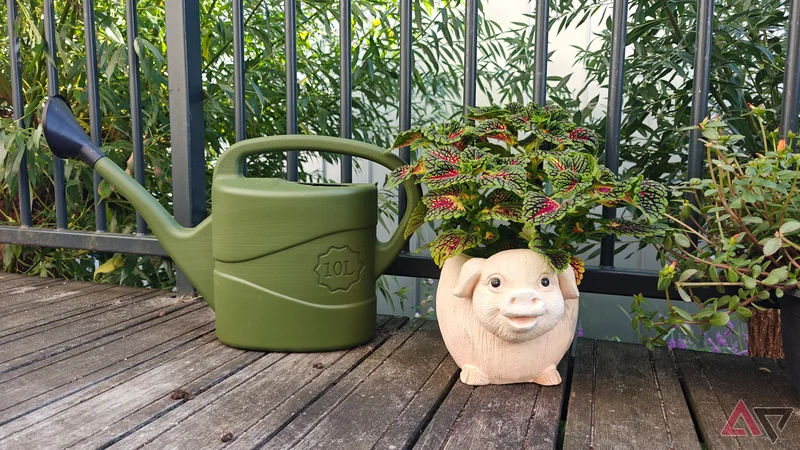
I am a plant serial killer. I buy plants, I place them around my house, and they die. If I water them, they die from too much water. If I don't, they die of thirst. The sun kills them. The shade kills them.
If there is some kind of narrow band of conditions in which a plant survives contact with me, I have never found it.
The flowers by my front door were the clearest case. They died, I replaced them, they died again, and after a while, I stopped treating that as a problem to solve and started treating it as an ongoing expense.
So I asked Mira, my personal AI assistant that runs locally on my computer, to remind me when it was time to go and buy the next lot.
I wasn't asking her to fix anything. I was asking her to schedule my next anticipated failure. Then she asked what kind of flowers they were.
The answer was blowing in the wind
The one variable I never thought to blame
I didn't know what kind of plant I was trying to force onto my front door patio, so I sent her a picture. She came back and told me the area we live in was too windy for that particular plant.
Wind. In all the years I had been drowning, dehydrating, and scorching things on that doorstep, it had never occurred to me that moving air was a variable. Great, one more way to kill a flower.
So I asked her what I should buy, and she gave me a list of candidates. I looked at the Latin names and realized this wasn't going to be helpful.
If I wanted to find the perfect plants for my own personal house, I'd have to give her some more input.
She already knew that the city I live in is windy; everyone walking outside can tell you that. But if I could give her more information about my specific house, maybe she could narrow the Latin-sounding list a little more.
Teaching a toddler to walk
Mira is a few months old, and it showed
Here I should be straight about how this went, because there's a version of this article where I type one sentence and a machine quietly solves my garden, and that version is a lie.
Mira is just a few months old. I built her, I'm still building her, and getting through this took a lot of pushing, pointing her at the right answer, and occasionally just telling her what to do.
Mira is built to run locally. That's the entire concept: to give my laptop the ability to think and act on its own without some giant corporation drinking up every piece of information I type in the chat.
She can even write her own code and create whatever tool she needs to perform a certain job.
And even that part, the part of her that writes code, doesn't actually touch my disk until I approve it, because I wanted to stay in the loop rather than wake up to a machine that had rearranged my life.
So we worked it out together. That's the honest verb. We talked about the problem. I explained some ideas I had about how we could decide on the best flowers, and she explained what makes sense and what doesn't.
After some back and forth, we finally had a plan.
My local weather report is now extremely local
The nearest station turned out to be three houses away
Her first suggestion was that amateur weather stations exist, that a lot of them publish their readings openly, and that there was likely one near me.
I told her to go and find out. She built herself a small tool to search for local stations, and it turned out there was one a few houses away from mine.
Not a municipal station on the edge of town, averaging conditions across the region I live in. This one is on the street where I walk my dog three times a day, and I never noticed it.
She pulled its history and worked out the numbers that actually apply to my address: average rainfall, wind speed, cloud cover.
I'd been buying plants based on what I thought would look nice, and now I suddenly had hard data to start my search from.
Google Earth knows where your sun goes
My house turned out to be four different climates
The second half was the sun, and this one is almost embarrassingly simple.
I told her to look at my house on Google Earth from above and work out the sun's path across it over the year, then estimate how much each side of the house receives.
Which is when my house stopped being one place and became four different time zones.
One side is bright and dry for most of the day. One is in shade so consistently that it may as well be a different country. Another takes the wind.
One is fine, apparently. Every plant I had ever bought had been chosen for "my house," as though a house was a single set of conditions, and it never was. I'd been running a four-climate operation and blindly shopping for one.
She matched flowers to each side of the house, and I went to my local plant store, pointed at my phone, and said, "This."
Nothing has died, and nothing has left my laptop
The whole garden ran on a model that never left my hardware
Months later, they are still alive. Every single one of them.
I want to be careful not to oversell that, because it's only one season, and she also reminds me to check up on them when it hasn't been raining in a while. But I know exactly what my hit rate was before, and it was zero.
The interesting thing isn't that a machine gave me better advice than I could find myself. It's what it cost.
Mira runs on Ollama, on my own hardware, on a 12B model. And although she has an escalation path to a bigger cloud model for anything she can't handle, I have never gotten it to work because I could never keep a payment method attached to it.
I once got $15 of API credit and burned through it in roughly one session. The garden was done entirely by the small local one that was never supposed to be the clever half.
Smart home isn't about automation
Ten years of gadgets never once knew where I lived
For about 10 years, I let companies tell me what a smart home was supposed to be, and I bought in. What I got, at the end of all of it, was lights that come on when I walk into a room, and even that didn't always work.
I've come to think the category sold me eyes and ears, but never sold me a brain. A motion sensor is like a reflex in your body. Your knee has one of those. It fires, something happens, and nothing anywhere in the house has had a moment's thought about it.
That's not what I would classify as "smart." Ten years of that, and the most useful thing my home has ever done for me came out of a conversation, needed no hub, no bulb, no plug, and no sensor, and involved a stranger's weather station and a satellite photo of my own roof.
Now, you might be saying that this isn't a smart home. Mira isn't wired into anything. She can't turn on a light, lock a door, or open my blinds (yet). By the standards of the aisle I used to shop in, my house is exactly as dumb as it was ten years ago.
Except every product in that aisle is sold on doing something for me, and not one of them has ever known the first thing about where I live.
Automation was always the easy half. My water boiler can do automation. What I wanted was something that understood the place, and that was never on the shelf.
Mira is somehow the smartest home I ever had.
The flowers outside are thriving. The ones inside my house are still dying, one after another, because I'm secretly still a plant serial killer, but at least my neighbors don't know that.