- See more Daily Mail on Google - save us as a Preferred Source
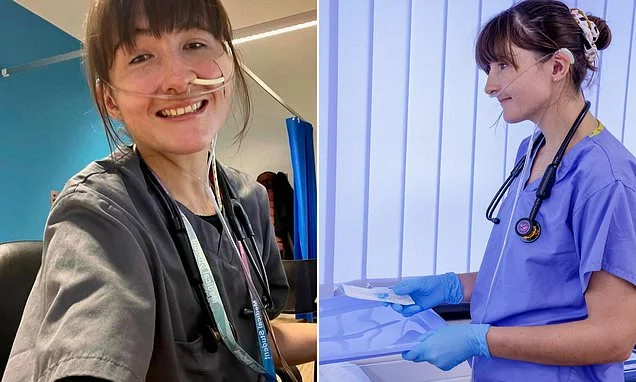
Britain's first deafblind doctor has revealed how the disabilities she was told would stop her becoming a medic have instead made her a better one.
Dr Alexandra Adams, 32, says her heightened sense of touch has helped her find veins after other medics had failed.
She also uses a Bluetooth stethoscope linked to her hearing aids, which has even enabled her to pick up a subtle heart murmur missed during a consultant ward round.
But she believes her greatest strength comes from years spent as a patient herself.
The newly qualified doctor said that experience helped her realise an elderly woman thought to be refusing treatment simply could not hear because her hearing aids had been left in a cupboard.
After fixing the hearing aids and putting them back in, the woman was able to hold a normal conversation with medics and discuss her wishes for the end of her life.
'She wasn't not being cooperative. It was because nobody had thought, "Oh, maybe this patient's just deaf",' she said.
'If anything, because I have a lot more insight over eyesight. I use my empathy as a tool to help make patients feel more comfortable.'
Dr Alexandra Adams (pictured), 32, says her heightened sense of touch has helped her find veins after other medics had failed
She also uses a Bluetooth stethoscope linked to her hearing aids, which has even enabled her to pick up a subtle heart murmur missed during a consultant ward round
Dr Adams said her own experiences in hospital had fundamentally changed the kind of doctor she wanted to become
Dr Adams said her own experiences in hospital had fundamentally changed the kind of doctor she wanted to become.
'What I do know is that it absolutely sucks to be stuck in a bed have all your independence and your dignity taken away from you.
'I understand all the holistic stuff and the psychosocial elements of being a patient. So I try wherever I can to really take that into consideration when I'm working with patients.'
Dr Adams, who last month began work in Dorset, was born deafblind and has just under five per cent central vision in her left eye alongside severe to profound hearing loss.
She said her sight loss has sharpened her sense of touch, helping her perform procedures that rely more on feel than sight.
'As someone with sight loss, my sense of touch and feel is naturally heightened,' she said.
'I've had a number of occasions where multiple people have attempted to get a cannula into a really unwell patient who's obviously really swollen and difficult to cannulate.'
Dr Adams said her Bluetooth stethoscope connects wirelessly to her hearing aids, allowing her to adjust the volume, replay recordings and display a visual representation of heart sounds on her phone.
She said it had even helped her identify 'a really subtle and faint murmur that the consultant ward round hasn't picked up".
Before pursuing medicine, Dr Adams was a promising para-swimmer who trained with the Great Britain swimming team towards the London 2012 Paralympics.
But her sporting ambitions were cut short after complications from what should have been routine stomach surgery left her in hospital for more than a year when she was 16.
Pictured: Dr Adams as a child with a toy doctors kit
Before pursuing medicine, Dr Adams was a promising para-swimmer who trained with the Great Britain swimming team towards the London 2012 Paralympics
As she recovered, one doctor's compassion transformed the course of her life.
'She asked me probably the three most important words anybody wants to ever hear. And they were, "Are you okay?"'
The doctor then lifted her top, showed Dr Adams a scar across her abdomen and said: 'I know how you feel.'
'Perhaps empathy was going to be my superpower and my tool to be able to help other people in the future,' she said.
Her resilience was tested again during the Covid pandemic when she spent 17 months in hospital suffering multiple pulmonary embolisms, aspiration pneumonia and sepsis.
She described the ordeal as 'horrific' and said: 'The trauma from that is something that will probably stay with me for the rest of my life.'
Despite the setbacks, she never abandoned her ambition of becoming a doctor.
'I don't think I've ever lost hope because I've always been. I've been very lucky to always have self-belief,' she said.
Her journey to becoming Britain's first deafblind doctor was not without prejudice.
On her first clinical placement, she said a consultant approached her and, before introducing himself, asked: 'Imagine you're a patient. Would you want a disabled doctor treating you? Absolutely not.'
She said she was then sent home.
'At the end of the day, it wasn't my disabilities that were the obstacle. It was the perception of other people,' she said.
Now beginning her NHS career, Dr Adams hopes her story will encourage others to challenge assumptions about disability.
'I really do hope that my story will change attitudes open minds a little bit encourage people to be a little bit more innovative and stand up for themselves,' she said.
Although she has now achieved her lifelong ambition, she admits it still feels surreal.
'As a writer, I have no words,' she said. 'I'm proud of myself.'