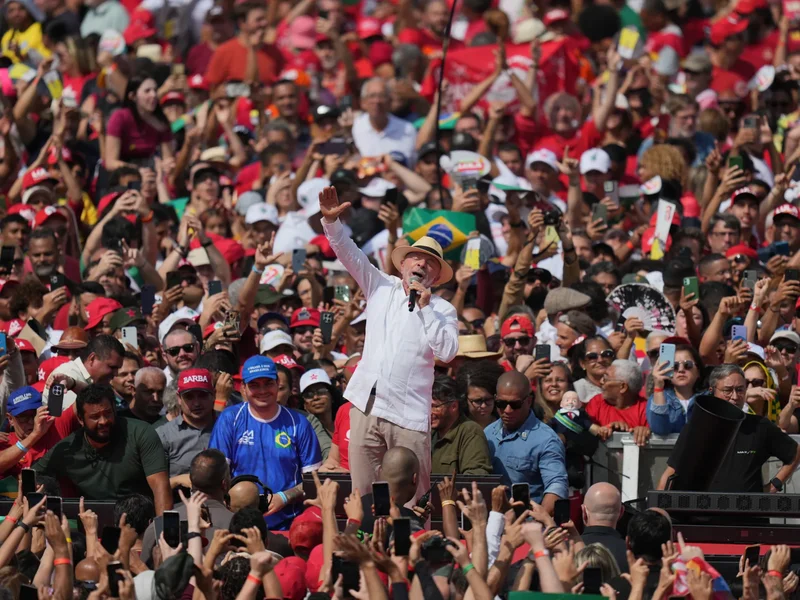
Brazil’s two main presidential candidates have inaugurated their campaigns by mustering supporters in their political strongholds ahead of what is expected to be a fierce October election.
President Luiz Inacio Lula da Silva spoke with nostalgia to more than 10,000 supporters on Sunday at the Vila Euclides Stadium outside Sao Paulo – a city where he rose to political fame 47 years ago as a metalworkers’ union leader during the country’s 1964-1985 military dictatorship.
The 80-year-old, wearing a hat after a skin cancer diagnosis, insisted Brazil needs more of his policies.
Senator Flavio Bolsonaro, age 45 and one of the sons of former President Jair Bolsonaro, gathered with thousands of voters on Copacabana Beach in Rio de Janeiro. His father, under house arrest following his conviction for an attempted coup, did not attend the rally.
Lula echoed his own earlier comments denouncing foreign interference in Brazil’s politics. His allies have accused the United States government of seeking to boost Flavio Bolsonaro’s bid with measures such as raising tariffs on Brazilian exports and revoking the visa of Brazil’s ambassador to Washington.
Speaking about Brazil’s vast reserves of rare minerals, Lula said, “No one [abroad] will tap our minerals. We are going to tap them for the benefit of the Brazilian people.”
Bolsonaro argued that he is “the only one who can sit with the United States, with China, with Israel, with the Middle East, with India and with Argentina to make the best and biggest trade deals for our nation.”
His party’s convention was attended by Argentina’s President Javier Milei. Israeli Prime Minister Benjamin Netanyahu and several members of the Trump administration have expressed support for him.
Both top candidates appeal to women voters
Women account for nearly 53 percent of Brazil’s 158 million eligible voters, according to the country’s electoral court.
Both Lula, who is seeking his fourth nonconsecutive term, and right-wing challenger Bolsonaro have used the fight against gender violence to appeal to voters.
Brazil registered nearly 400 femicides (the killing of a female because of her gender) in the first quarter of 2026, the highest number for the period since the country first began tracking the crime 11 years ago, according to Brazil’s Justice and Public Security Ministry’s database.
“Men need to learn from childhood that they are no better than women. We need to be equal,” said Lula, as First Lady Rosangela da Silva stood by his side, nodding. She was one of the event’s main speakers in Sao Bernardo do Campo, where Lula lived for many years.
The rally wasn’t the first time the president has confronted this heavily entrenched crisis. During his Workers’ Party convention to launch his re-election bid in early August, Lula had said that men who commit acts of domestic or gender-based violence must choose between supporting him or hitting a woman, declaring that if they choose violence, “they don’t need to vote for me”.
Lula said he would launch a platform within 10 days, noting that more details are still to come on his gender-responsive policies, including education initiatives and laws to further thwart and punish violence against women.
Femicide laws and legal protections for women in Brazil have only sluggishly improved over time. In 2024, femicide stopped being classified as an aggravated form of homicide and finally became a separate crime, punishable by 20 to 40 years in prison. Still, the grim trend has not abated.
Meanwhile, with his mother and wife by his side, Bolsonaro promised his supporters that he would also work to fight violence against women.
Brazilians will vote in the presidential election on October 4.