Life After... gastrointestinal stromal tumour: Battle with cancer helps entrepreneur get to the gist of life
AI generated
SINGAPORE – In June 2019, just six months after he got married, Marcus Chiang began experiencing severe pain in his abdomen.
Unable to bear the discomfort, the 40-year-old Singaporean – who was in Ipoh with his Malaysian wife and her family at the time – underwent an endoscopy and ultrasound at a hospital there, where doctors discovered a mass in his small intestine.
The entrepreneur opted to go home for medical treatment.
Following a visit to the Singapore General Hospital's accident and emergency department, Chiang was referred to the National Cancer Centre Singapore (NCCS), where he was diagnosed with a gastrointestinal stromal tumour (GIST).
GIST is a rare type of sarcoma – referring to cancers that arise in the bones and soft tissue – that starts in the stomach or intestine.
It is caused by genetic mutations, and usually occurs when the KIT gene changes, causing cells to produce the protein KIT CD117, which results in cells in the gastrointestinal tract multiplying and forming tumours.
Though GIST can be life-threatening, the chances of survival are high if the tumour is detected early. It affects about one in every 100,000 people, with NCCS seeing an average of 47 new cases of GIST each year.
GIST makes up just 1 per cent of cancers that arise in the digestive tract, said Nagavalli Somasundaram, who heads the lymphoma and sarcoma department at NCCS’ medical oncology division.
Nagavalli is also the co-lead for NCCS’ Specialised Programme for Advancing Rare Cancer Care, an initiative launched in July to provide improved diagnoses and care for patients here with rare cancers.
Defined as those with an incidence of fewer than six cases per 100,000 people, rare cancers cumulatively account for a quarter of all cancer diagnoses and 30 per cent of cancer deaths worldwide, according to a study published in medical journal Cancers in 2025.
In the early stages of GIST, there may not be any symptoms. However, as the tumour progresses, symptoms such as bloating, giddiness, fatigue or blood in the stool may arise, said Nagavalli.
Chiang’s case was an outlier as the tumours occur predominantly in those in their 60s or older, the oncologist said, adding that the reasons for such cancers manifesting in younger adults are still unclear.
Lost and confused
The diagnosis came as a shock, said Chiang, who is now 47. “I just knew something was wrong, but cancer didn’t come to my mind.”
In July 2019, he underwent surgery to remove the tumour from his small intestine.
Such surgery is the mainstay of treatment for GIST, said Nagavalli, who added that patients deemed to be facing a low risk of recurrence will undergo observation following the operation.
However, patients with genetic mutations, which put them at a higher risk of recurrence, will have to take imatinib – an oral medication that targets cancers – for three years to reduce the chances of a relapse, she said.
They included Chiang, who told The Straits Times he felt “lost and confused” at the time as the rarity of his condition meant it was difficult for him to find others he could share his experience with.
The Covid-19 pandemic hit not long afterwards, and amid the closure of Singapore’s land checkpoints and other travel restrictions at the time, Chiang’s marriage fell apart, and his divorce was finalised in 2022.
Still Chiang did not let his situation bring him down.
He received mental and other support from psychologists and medical social workers at NCCS, and continued with plans to further his education, graduating with a master’s degree in smart cities design from the Strate School of Design Singapore in January 2022.
“Fitness was the last thing on my mind,” Chiang said of the time before his GIST diagnosis.
However, his brush with cancer spurred him to focus more on his health. He began paying attention to his diet and exercise, reading and listening to podcasts to learn more about how to improve his health and fitness.
His newfound attention to fitness put him in the best shape he had been in for years. He lost 20kg, with his weight dropping to about 60kg as a result.
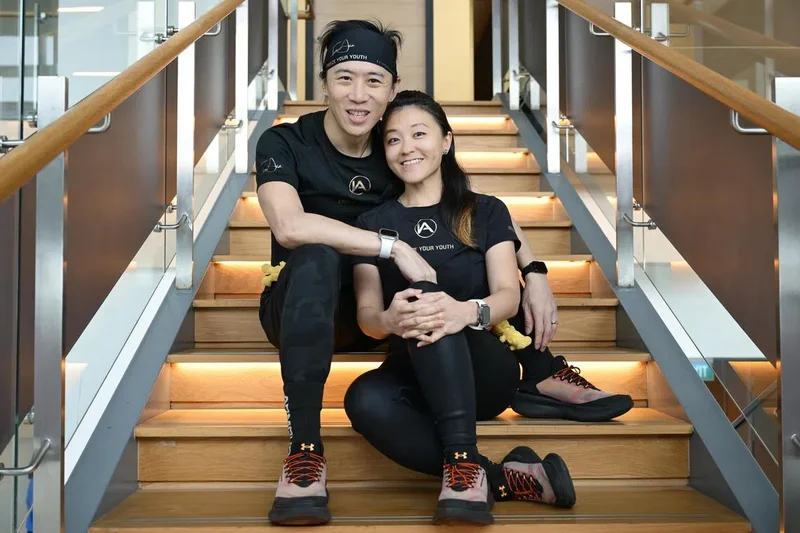
Chiang was encouraged on this journey by his girlfriend, Rachel Tan, whom he met in 2022 while they were both attending a content creation course.
In February 2023, about half a year after Chiang stopped taking imatinib, a 5cm tumour was detected in his small intestine during a routine scan.
Tan said that although she was aware of the risk of the tumour resurfacing, the news still shocked her.
“It’s like we’re just getting to know each other and then, three months later, oh, the cancer is back. I really didn’t know how to react,” said the 38-year-old. “I felt like I was caught in a Korean drama.”
In November that year, Chiang underwent surgery again to remove the tumour, and he began taking imatinib again.
Despite being placed on medication once again, in August 2024 a routine scan detected another tumour in the space between his liver and right kidney, known as Morrison’s pouch.
His imatinib dosage was increased, and the tumour was monitored closely for about nine months.
However, the tumour grew despite the higher medication dosage, and Chiang had to undergo a third operation in May 2025 to remove the 5cm tumour.
He is still taking imatinib and goes for routine follow-up scans every four months. His latest scan in April showed no detectable tumour.
Tan noted that while most couples talk about matters such as plans for children and living arrangements before getting married, she and Chiang were discussing wills and what to do if he died.
“I was told that he’d be selfish to be with me and I’d be stupid to be with him,” she said.
Despite the challenges, the couple got married in September 2025 and now run two businesses together – health food initiative Ice Age and Find X, which organises self-discovery workshops and masterclasses.
His battle with GIST has made him consider his own mortality and what he wants to do with his life, said Chiang. “You start to think about what you want to make of your time on earth, to make it much more valuable.”