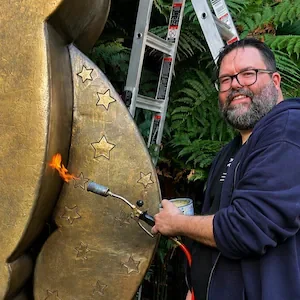
Objektcare founder Nate Savill is often hands-on, pictured here working on the Sanne Mestrom sculpture located at the entrance to The Cordis hotel in Auckland.
Nate Savill, founder of Objektcare, talks to Tom Raynel about restoring art and why he believes there’s plenty of work to do.
Every Monday, we interview a small-business owner. This is now a regular feature of NZME’s editorial campaign, On The Up, showcasing uplifting stories ofsuccess, inspiration and possibilities.
What is Objektcare?
Objektcare is an Auckland-based specialist business dedicated to the care, conservation, maintenance and installation of sculptures and other three-dimensional artworks.
When people or businesses buy sculptures, they’re putting them outside without necessarily being informed they might need cleaning, re-waxing, and the paint might get a bit awry because of the UV.
None of this is the fault of the sculptors, it’s just we live in such a harsh New Zealand environment. Anything that goes outside needs some maintenance, and that’s where we come in.
What inspired you to start the business?
I was an art school graduate, and I gave it a go. I told myself I was going to be an artist and make a living out of it, but of course it was much harder than I expected.
I ended up getting jobs working for other sculptors, then eventually working for well-known sculptor Terry Stringer, one of New Zealand’s pre-eminent bronze sculptors. He’s been around for a long time, and has been making sculptures since the late 1960s-early 1970s.
I was working for him in his studio a couple of days a week, and he would get phone calls that a flock of seagulls had made deposits over his work, or a gardener had got too close while working. He didn’t want to deal with it because he wanted to focus on creating new works, so he’d send me out to sort it. He suggested I turn that work into a business, and after I started, it snowballed.
What clientele do you work with?
About 90% of our work is with private collectors. We do work with universities, the Auckland Museum, and various other operators. The bread and butter is the art collectors who have a few sculptures in their gardens. They were the real unserved market.
The Auckland Council has some people to call on, and the museum has a team of art conservationists, but a private client in Remuera had no one to call.
Some of the art you work with must be quite valuable?
People would be amazed if they knew how much art was in people’s back gardens around Auckland. They are often owned by people who are private. In some cases I can’t even take photos, or there’s a level of security around them because they’re worth a lot.
One of the privileges of working on them is having that trust, but also getting to work on other artists’ work. I’m currently working on a sculpture by an English modernist artist, probably from the 1950s, called Barbara Hepworth. I don’t know if there would be two in New Zealand, so the rarity of it is highly regarded.
I think when someone contacts me and says we need someone to come by and keep this looking good, it also speaks to their respect for the artist and the fact they want it to look pristine as well.
What are your plans for the business?
I think there is a lot of room for growth in New Zealand. We’ve focused on Auckland, and, while we’ve done a little bit outside here and there, there’s a need for what we do across the country. We’ve got a good base now after building up through largely word of mouth and forming relationships, so it’s a good time to broaden out.
I’d also love the opportunity to take care of some big artworks and monuments around New Zealand. If I got to clean the massive shearer in Te Kūiti every now and then or repaint it, I would love that.
What would be your advice to a budding entrepreneur wanting to start a business?
I think if you’re passionate that goes a long way, but also don’t be afraid of something that no one else is doing. I’m not a natural business person, I’m an artist. There were massive learning curves through this, and many times where I questioned it. But if you’re doing what you love and it’s of value to people, it’s worth persisting in.
Tom Raynel is a multimedia business journalist for the Herald, covering small business, retail and tourism.
Stay ahead with the latest market moves, corporate updates, and economic insights by subscribing to our Business newsletter – your essential weekly round-up of all the business news you need.