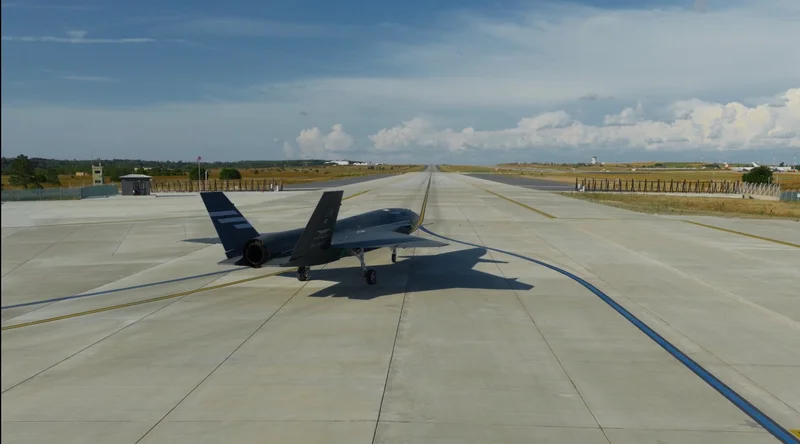
At a time when defense procurement and projects are gaining momentum, Türkiye has conducted a test that is set to resonate worldwide. The unmanned, jet-powered combat aircraft accurately struck designated targets using various types of munitions carried within its fuselage. While similar high-tech projects are being developed around the world, the Bayraktar Kızılelma remains a one-of-a-kind unmanned combat aerial vehicle (UCAV), thanks to its unique position and capabilities.
Through its investments in the defense industry, Türkiye is moving closer to achieving self-sufficiency in this field. As projects for land, sea, air and space systems continue in parallel, Kızılelma has demonstrated a key capability. During firing exercises using its internal weapon station, the unmanned fighter successfully struck designated targets, further demonstrating its capabilities.
Developed as a multi-role fighter aircraft, Kızılelma has been proven effective in both air-to-ground and air-to-air combat during the latest test. Previously, it detected and engaged an airborne target using its own radar and a first-of-its-kind air-to-air missile. More recently, it once again detected and destroyed ground targets using its internal weapon station.
Internal (fuselage-mounted) weapon stations are found on fifth-generation manned fighter jets as well as next-generation UCAVs. This feature is one of the key engineering characteristics that distinguishes these platforms from others. From the outset, the Kızılelma project has been designed to serve both as a UCAV and as a platform equipped with next-generation capabilities. During recent tests, the firing of smart munitions from the internal weapon bay helped validate and certify this capability. Carrying munitions inside the fuselage rather than on external pylons provides both tactical and operational advantages.
Elements on fighter jets’ external stations, such as fuel tanks, missiles and pylons, create a sort of “reflector” effect that reflects enemy radar waves. When munitions are housed inside the fuselage, however, the platform’s radar cross-section remains minimal. In short, this delays detection by enemy radars. Kızılelma’s existing low-radar-signature capability, combined with its combat role, has taken on a more strategic dimension.
Kızılelma also possesses a capability shared by next-generation fighter jets: an infrared search and track (IRST) system. This allows it to detect enemy targets at long ranges without activating its radar. At high speeds, externally mounted munitions and other systems can generate a thermal signature due to friction, potentially making them detectable by IRST systems and heat-seeking missiles. By carrying munitions internally, however, Kızılelma can reduce their thermal signature and make them less detectable. In other words, Kızılelma can more effectively conceal itself from platforms equipped with IRST capabilities while still detecting and tracking adversaries using its own IRST system.
The capability to carry and fire munitions from an internal bay is currently available on Turkish Aerospace Industries’ (TAI) Anka-III deep-strike unmanned combat aircraft. It is planned to be incorporated into the next-generation manned combat aircraft, the Kaan. The points mentioned above also apply here.
This capability is considered particularly critical for the Anka-III, which is designed specifically for “deep strike," that is, the destruction of strategic targets within enemy territory. The flying-wing design philosophy already reduces radar cross-section, and the addition of internal carriage capability further enhances both its deterrent effect and strategic gains.
The capabilities demonstrated by Kızılelma during its two separate test flights are significant. During the first flight, Roketsan’s Teber-82 smart munition was launched from the internal bay, and the target was successfully hit. In the subsequent test, Aselsan’s system was used not only for smart munitions but also for a multi-smart munition pod.
Aselsan developed a pod called the Sadak 4T for fighter jets, enabling an aircraft to carry four munitions on a single pylon instead of just one. During the Kızılelma test, the Sadak 4T was housed inside the aircraft’s fuselage. Kızılelma can carry two Sadak 4T launchers internally, demonstrating its capability to launch up to eight Tolun munitions from within the fuselage.
Tolun munitions, with their various capabilities, can be equipped with either armor-piercing or concrete-penetrating warheads. They may even possess the ability to conduct electronic warfare or counter such attacks. In short, the Kızılelma has become even more strategic with its internal multi-launcher system.
There are similar projects and initiatives underway around the world. For example, in manned fighter jets, air-to-air missile launches from the internal stations of the U.S. F-22 and F-35 aircraft are well-documented. In addition, B-2 bombers – which share the same design philosophy as the Anka-III and are deep-strike aircraft with a flying-wing configuration – recently demonstrated this capability during strikes on facilities in Iran where nuclear activities were taking place. Furthermore, China’s manned J-20 and J-35 fighter jets also feature similar internal launch stations.
Capability demonstrations have also been conducted on unmanned platforms, but the key difference is that Kızılelma is the only example of its kind. While the others are jet-powered unmanned aerial vehicle systems, Kızılelma is a jet-powered UCAV. It is equipped with advanced avionics, such as an active electronically scanned array (AESA) radar and an IRST sensor, that are not found in other systems. As a result, it can independently detect, track and engage targets just like a fighter jet. The U.S. X-47B project demonstrated the capability to fire from an internal bay. In Russia’s S-70B project, air-to-ground munitions were also fired from an internal bay.
In the future, Kızılelma will also be capable of firing air-to-air missiles from its internal station. This will provide a strategic deterrent as part of Türkiye’s air power. Adversaries will be aware that Türkiye can conduct activities such as air patrols using UCAVs. In particular, enemy pilots will feel the pressure of potentially facing a UCAV. You wouldn’t want a UCAV to see you, track you and strike you. Türkiye is very close to becoming the first country to achieve such psychological superiority with Kızılelma.
Kızılelma, Türkiye’s first UCAV developed entirely with domestic capabilities, features a design philosophy that incorporates canard wings for aggressive maneuverability. In its latest test, it demonstrated the ability to maintain a low radar signature through the use of internal stations. At the same time, it is equipped with highly advanced avionics, weapons and sensors. It features an advanced AESA radar, preferred in fifth-generation fighter jets, as well as an embedded electro-optical system (EOTS) and an infrared search and track (IRST) sensor. Additionally, capabilities such as internal weapon stations have been incorporated into Kızılelma. This is why it is described as a world first: there is no other UCAV that is as well-equipped and configured as a manned fighter jet.
A contract has been signed for the export of Kızılelma to Indonesia, marking its first international sale. Many countries are interested in Türkiye's capabilities. In fact, as has been reported in the media, there is significant demand to partner on the project. Baykar, however, will develop the project using its own resources and make it available first to the Turkish Armed Forces and later to Türkiye’s strategic allies.