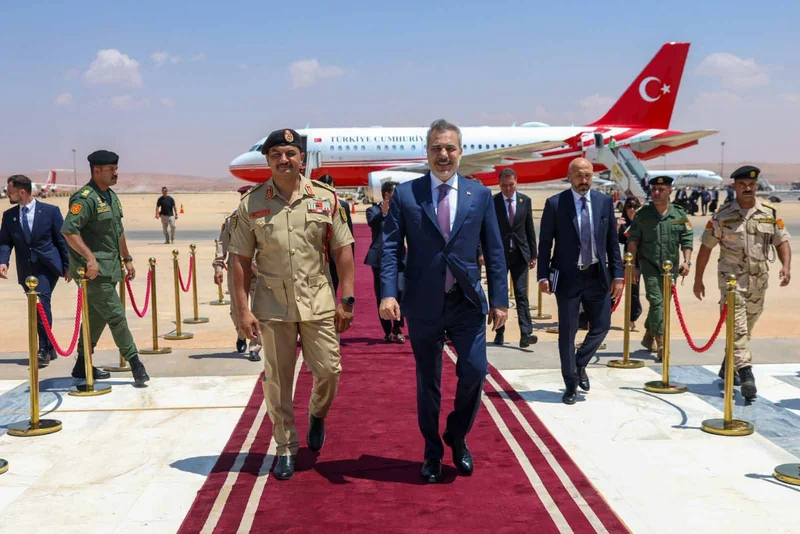
On Aug. 12, Foreign Minister Hakan Fidan landed in Benghazi and was met on the tarmac by Saddam Haftar, deputy commander-in-chief of the Libyan National Army. Within hours, Fidan was standing beside Khalifa Haftar beneath the emblem of the eastern command that once tried to capture Tripoli. Türkiye had helped stop Haftar’s 2019-2020 offensive, yet its foreign minister was now received at his headquarters for their first public meeting in the eastern city.
The timing gave the visit added weight. Two days earlier, a car bomb had killed Maj. Gen. Fawzi al-Mansouri, the director of military intelligence under Haftar’s command. The explosives detonated near his vehicle in Benghazi’s Sayyida Aisha district. No group claimed responsibility.
This was therefore more than a photograph marking the end of an old quarrel. It came during a struggle over Libya’s next political order, the future of its divided military and the distribution of oil and reconstruction revenue. Ankara appears determined to enter that process with working channels in both Tripoli and Benghazi.
Al-Mansouri was no ceremonial officer. As the head of military intelligence in the east, he belonged to the apparatus protecting Haftar’s command. His killing exposed a vulnerability in a system often presented as more tightly controlled than western Libya’s network of armed groups.
There’s no real point in guessing who did it. The guessing itself tends to crowd out the one thing that’s actually clear: even Benghazi, after all these years of Haftar tightening his grip, still isn’t fully secure. Yet the Benghazi leg went ahead as planned. Fidan arrived while the eastern command was still absorbing the loss of one of its most senior intelligence officers, signaling that Ankara’s engagement with the east was not contingent on calm.
Fidan offered condolences during his talks. His presence also carried the message that Türkiye can discuss intelligence cooperation, border surveillance, military training and institutional unification with an eastern command facing fresh security concerns.
His message came only days after Haftar’s forces signed a contract with a Turkish company on July 20 for the first phase of a land-border management system covering 275 kilometers (170 miles). The project was placed under the supervision of Saddam Haftar, Khalifa’s son and deputy commander. It was announced as part of efforts to counter arms and drug trafficking, irregular migration and cross-border crime. Cooperation had moved from meetings to a security project on the ground.
The channel had opened the previous year, when National Intelligence Organization (MIT) chief Ibrahim Kalın met Saddam Haftar and Khalifa Haftar in Benghazi. Kalın returned to the city on June 23, 2026, for another round of talks with Saddam Haftar, this time focused on preserving peace and bringing Libya’s rival administrations and military structures closer together. Then, Fidan received Saddam Haftar in Ankara on July 24, moving an intelligence-led relationship onto the diplomatic stage.
Fidan’s Aug. 12 visit was the latest step in building relations. He met Khalifa Haftar as the final authority, Saddam Haftar as the security and diplomatic interlocutor, Parliament Speaker Aguila Saleh as the head of the eastern legislature, and Belqasem Haftar, who heads the Development and Reconstruction Fund.
One absence was equally revealing. Fidan’s official program contained no meeting with Osama Hammad, prime minister of the parallel eastern government. Ankara engaged the institutions and individuals holding real power without granting Hammad’s cabinet the same standing it gives the Tripoli-based Government of National Unity.
He made one more stop before flying out of Benghazi: the tomb of Omar Mukhtar, the anti-colonial fighter both sides of Libya’s divide still claim as their own. It’s an easy thing to read too much into, but the timing wasn’t nothing. A day built almost entirely around one family’s hierarchy – Khalifa, then Saddam, then Belqasem – ended instead at a grave that belongs to no faction. Whether that was calculated or just good instinct is not important. It let the visit close on something bigger than the Haftars.
Ankara’s eastern outreach did not begin with a retreat from Tripoli. On Aug. 4, Fidan received acting Interior Minister Imad Trabelsi, acting Defense Minister Abdulsalam Zubi and national security adviser Ibrahim Dbeibah in Ankara. These are central figures in the western security structure that Türkiye has supported through its agreements with Libya’s internationally recognized authorities.
Fidan then started his Libya tour in Tripoli on Aug. 11. He met Prime Minister Abdul Hamid Mohammed Dbeibah, Presidential Council Chair Mohammed al-Menfi and High Council of State Chair Mohammed Takala. He also held talks with security officials and visited the Turkish military mission.
This sequence of visits is carefully calculated: go west first to reassure those who already trust you, then head east. It is the kind of sequencing that signals to Tripoli that it is not being replaced, while assuring Benghazi that nothing on the western side needs to be disrupted for this new relationship to take shape.
This balance serves both Libya's and Türkiye's interests. Libya’s eastern and southern regions contain much of the country’s oil infrastructure. Benghazi and Derna offer major reconstruction opportunities. Any lasting agreement on a unified army will require Haftar’s command, while the future of the 2019 maritime memorandum will be more secure if it gains acceptance beyond Tripoli.
However, the last point requires caution. The eastern-based House of Representatives has discussed the maritime agreement and created expectations of a vote, but no confirmed ratification followed Fidan’s visit. Nor was a new maritime accord signed in Benghazi. The handshake improved the political environment around the issue, but it did not settle it.
The Libya tour also fits Türkiye's wider diplomatic efforts. In July, military representatives from east and west held unification talks in Sirte, including discussions on joint operations against smuggling and irregular migration.
Fidan traveled from Libya to Egypt for meetings with Foreign Minister Badr Abdelatty on Aug. 13-14. He said the two countries’ views on Libya’s unity, sovereignty and territorial integrity overlapped and that they had decided to turn this understanding into “joint action.”
That phrase gives the Tripoli-Benghazi-El Alamein route its full meaning. Egypt remains the eastern camp’s most influential neighbor, while Türkiye retains the deepest external security relationship with Tripoli. If Ankara and Cairo can coordinate electoral arrangements, institutional unification and security guarantees, they may reduce the room for Libyan factions to play foreign patrons against one another.
So the photograph isn’t really about an old enemy turned guest of honor. It shows Ankara protecting what it already has in Tripoli while preparing for a political order in which the Haftars may carry greater national weight. Whether any of it holds together is still an open question. The border contract actually has to be built. The unification talks in Sirte have to withstand Libya’s habit of talking for years without reaching any decisions. The Parliament in Tobruk has to vote on the maritime deal rather than just discuss it. And Cairo has to want the same thing Ankara wants, for as long as it takes.
None of that was settled on Aug. 12. But few powers, if any, have built the kind of access Türkiye now has across Libya’s divide, with intelligence channels in the east, defense agreements in the west, and Türkiye’s foreign minister welcomed in both Tripoli and Benghazi within the same 48 hours.