Welcome to the Proof of Usefulness Hackathon spotlight, curated by HackerNoon’s editors to showcase noteworthy tech solutions to real-world problems. Whether you’re a solopreneur, part of an early-stage startup, or a developer building something that truly matters, the Proof of Usefulness Hackathon is your chance to test your product’s utility, get featured on HackerNoon, and compete for $150k+ in prizes. Submit your project to get started!
Today we are speaking with Cem Ozcelik, the innovator behind Visby. Visby addresses an increasingly critical problem for brands - Generative Engine Optimization (GEO) and AEO (Answer Engine Optimization) - by showing them exactly how they appear in AI-generated search results.
What does Visby do?
Visby helps brands track and improve how they appear across AI search engines like ChatGPT, Gemini, Claude and Google AI Overview. It automatically generates actionable SEO and GEO tasks to boost visibility, and shows marketing teams exactly which prompts trigger brand mentions in AI-generated answers. Now’s a good time for Visby to exist because AI search is rapidly becoming a primary way people discover brands, replacing traditional search engine strategies and creating an urgent need for companies to optimize their presence within generative engines.
What is your traction to date?
Visby currently reaches around 2,500 users, with approximately 1,800+ active weekly users engaging with the platform to track and improve their AI search visibility.
Who does your Visby serve?
Visby is built for marketing teams and brands of all sizes, from small businesses managing their own visibility to enterprise organizations running large-scale AI search strategies. Notable clients include enterprise brands across banking, retail, and holding companies working to strengthen their presence in AI-driven search.
What technologies were used in the making of Visby? And why did you choose ones most essential to your techstack?
To power its comprehensive web data collection, Visby relies heavily on Bright Data. Utilizing Bright Data's robust infrastructure ensures that the platform can reliably extract and synthesize necessary AI search engine results, which is essential for giving marketing teams accurate, real-time Generative Engine Optimization (GEO) insights.
Visby earned a 76 proof of usefulness score (https://proofofusefulness.com/report/visby) - how do you feel about that? Needs to be reassessed or just right?
A 76 feels like a fair starting point, not a finish line. It tells us the core value proposition is landing with real users, but there's clear room to push higher, especially as we deepen retention data and expand enterprise case studies. We'd rather be scored honestly today and show measurable improvement over the next few quarters than chase a number that doesn't reflect where the product actually is.
What excites you about this Visby's potential usefulness?
AI search is quickly becoming a primary way people discover brands, but most companies have no idea how they actually appear in ChatGPT, Gemini, Claude or Google AI Overview responses. Visby closes that blind spot by showing brands exactly where and how they're mentioned, then turning those insights into concrete tasks they can act on immediately. That combination of visibility and actionability is what makes it genuinely useful, not just another tracking dashboard.
Walk us through your most concrete evidence of usefulness.
The clearest proof is what happens after brands start acting on our tasks. On average, brands see close to a 20% increase in AI visibility within their first month on Visby. Some brands go much further, with visibility growth exceeding 240% within six months of consistent use. Just as important, for most of our brands we see a measurable shift in how AI engines talk about them, not just more mentions, but more favorable and accurate sentiment in how AI-generated answers describe the brand. That combination, more visibility and better positioning, is the data point that convinces us this isn't a vanity metric problem, it's a real gap we're closing.
How do you measure genuine user adoption versus "tourists" who sign up but never return?
AI visibility is a genuinely hyped topic right now, so users already arrive with high curiosity and intent, they're not casually browsing, they came looking for this. That shows in our onboarding: our flow makes it easy for users to set up a demo account in minutes, and because the value is visible almost immediately, retention from that first session is very high.
The moment a user adds their domain, Visby's crawlers start scanning the site, technical SEO and GEO tasks are generated automatically, and the first prompts are already being sent to the tracked LLMs to kick off initial analysis. Within that same session, users get brand and competitor visibility data, so they're not waiting days to see if the product works. That immediacy is what turns a curious signup into an active, returning user.
If we re-score your project in 12 months, which criterion will show the biggest improvement, and what are you doing right now to make that happen?
We expect the biggest improvement in real-world utility. Today we're deepening how many AI engines and query types we track, so the data itself becomes more complete and harder to dismiss as a narrow snapshot. On top of that, we're building more strategic, multi-step action plans instead of one-off tasks, so teams get a roadmap, not just a checklist. Broader coverage plus sharper strategy is the combination we're betting on.
How Did You Hear About HackerNoon?
We heard about HackerNoon through a referral, and it quickly became clear why the platform has such a strong reputation in the builder community. What stood out to us is how HackerNoon gives early-stage products a real voice, not just another press mention buried in a feed, but a space where founders can actually explain the thinking behind what they built. Since sharing our story here, the feedback we've received has been genuinely positive, from people who clearly read the piece rather than skimmed it. That kind of engagement is rare, and it's exactly what pushed us to want Visby featured on HackerNoon as soon as possible.
With 1,800 active weekly users engaging with the platform, how are enterprise and banking clients specifically using Visby differently than small businesses?
Enterprise and banking clients typically move onto our Enterprise plan, where they get direct support from a dedicated GEO expert, so their visibility strategy is more structured and consultative rather than self-serve. They're building longer-term roadmaps around brand and competitor positioning, often coordinated across multiple teams.
Small businesses, on the other hand, lean into how easy the tool is to use on their own, they can set up tracking and start acting on tasks without needing outside help. And agencies sit in between: they use Visby to easily generate reporting and analysis for their own clients' brands, turning Visby's data into deliverables they can hand off directly.
Considering you have 2,500 users without traditional SEO being the main focus anymore, what is your primary growth strategy for scaling enterprise client acquisition?
On the enterprise side, growth is already compounding through referrals, one strong result with a banking or retail client naturally opens doors to their peers and partners in the same sector, so each engagement fuels the next. We reinforce that with dedicated GEO expert support on the Enterprise plan, keeping the relationship consultative rather than purely self-serve.
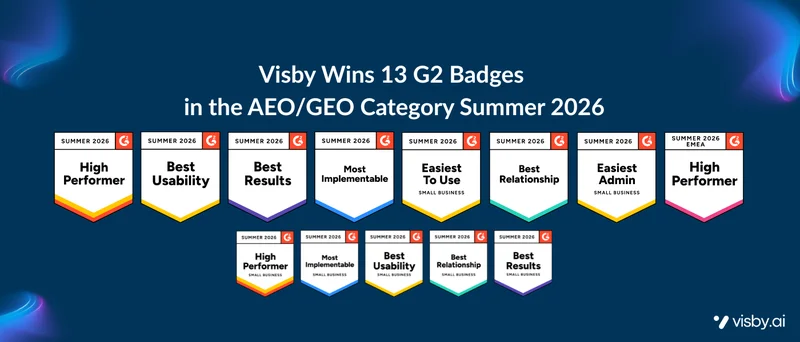
That momentum is backed by real proof: reviews from our global user base recently earned us 13 G2 Summer 2026 badges, including High Performer and Easiest to Use, which gives enterprise prospects independent validation before they even talk to us.
For small businesses, our focus is global expansion, paired with custom reporting, prompt-level support, and additional free tools that make it easier for smaller teams to get value without needing an expert on hand. Together, these two tracks let us grow enterprise accounts through trust and referrals, while scaling small business adoption through accessibility.
Visby scored exceptionally well in real-world utility (25.5). How does the platform actually translate raw AI mention data into the concrete SEO/GEO tasks that teams can act on immediately?
The key is that Visby doesn't estimate or guess, it actually crawls. When a domain or project is added, our system scans the site much like a Google bot or a ChatGPT-style crawler would, reading real content, structure, and technical signals rather than inferring them from surface-level metadata.
That real crawl data is then matched against how the brand actually shows up across tracked AI engines, so the gaps we surface, missing citations, weak topical coverage, technical SEO issues, structural problems, are based on what's genuinely on the page, not assumptions. From there, tasks are generated directly from those findings: concrete, specific actions tied to real technical and content gaps, not generic recommendations. That grounding in actual crawled data is what makes the tasks something teams can act on immediately, with confidence they're fixing a real issue.
Meet our sponsors
Bright Data: Bright Data is the leading web data infrastructure company, empowering over 20,000 organizations with ethical, scalable access to real-time public web information. From startups to industry leaders, we deliver the datasets that fuel AI innovation and real-world impact. Ready to unlock the web? Learn more at brightdata.com.
Neo4j: GraphRAG combines retrieval-augmented generation with graph-native context, allowing LLMs to reason over structured relationships instead of just documents. With Neo4j, you can build GraphRAG pipelines that connect your data and surface clearer insights. Learn more.
Storyblok: Storyblok is a headless CMS built for developers who want clean architecture and full control. Structure your content once, connect it anywhere, and keep your front end truly independent. API-first. AI-ready. Framework-agnostic. Future-proof. Start for free.
Algolia: Algolia provides a managed retrieval layer that lets developers quickly build web search and intelligent AI agents. Learn more.