Welcome to the Proof of Usefulness Hackathon spotlight, curated by HackerNoon’s editors to showcase noteworthy tech solutions to real-world problems. Whether you’re a solopreneur, part of an early-stage startup, or a developer building something that truly matters, the Proof of Usefulness Hackathon is your chance to test your product’s utility, get featured on HackerNoon, and compete for $150k+ in prizes. Submit your project to get started!
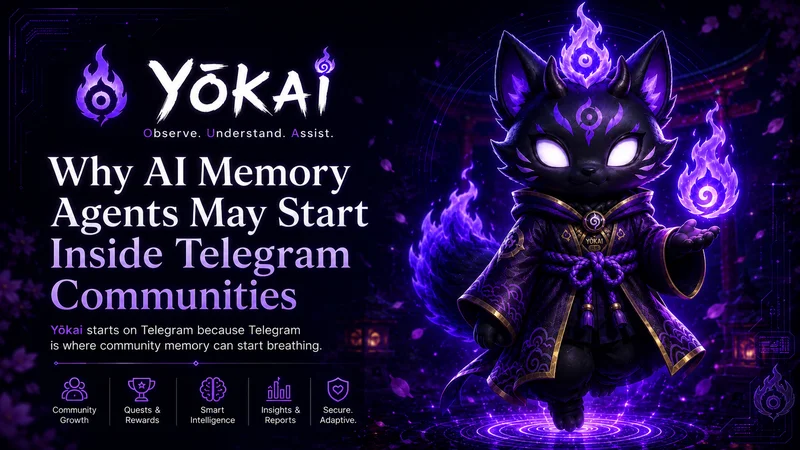
Today we are speaking with MuazXinthi, the founder of Yokai OS. Yokai OS is a Telegram-native AI community operating system that empowers Web3 projects to efficiently manage quests, referrals, airdrops, and community intelligence directly within their chats.
What does Yokai OS do? And why is now the time for it to exist?
Yōkai is a Telegram-native AI community operating system that helps projects manage quests, referrals, airdrops, project memory, and community intelligence. It gives founders and admins a safer way to grow, understand, and support their communities. Now’s a good time for Yokai OS to exist because Web3 communities are growing increasingly complex, and founders urgently need native, AI-powered tools to cut through the noise, secure airdrop campaigns, and build genuine community engagement directly where their users already are—on Telegram.
What is your traction to date?
Yōkai currently reaches a live Telegram community of 10K+ users through DigiMaaya, where the agent is being used during an active token launch and airdrop campaign. This gives Yōkai direct monthly exposure to real community members participating in referrals, quests, airdrop tasks, leaderboard activity, and project updates. Beyond DigiMaaya, Yōkai is also building its own early audience through its Telegram bot, website, and community intelligence feed.
Who does Yokai OS serve? What’s exciting about your users and customers?
Yōkai is built for Web3 projects, founders, community managers, launchpads, trading groups, creator communities, and campaign teams that need a smarter way to grow and manage Telegram communities. It helps teams run quests, referrals, airdrops, announcements, support, project memory, and community intelligence, while also helping users discover active projects and opportunities.
What technologies were used in the making of Yokai OS? And why did you choose ones most essential to your tech stack?
Yokai OS integrates Bright Data alongside a robust modern tech stack featuring the Telegram Bot API, Cloudflare Workers, Cloudflare D1, and Cloudflare Pages. We also utilized OpenAI/ChatGPT and TypeScript to build a custom intelligence ingestion layer, public X/news monitoring, and native quest/referral/airdrop infrastructure. These technologies were selected because they provide a highly scalable, low-latency, and intelligent foundation necessary for running complex AI operations efficiently within a real-time Telegram environment.
What is traction to date for Yokai OS? Around the web, who’s been noticing?
Yokai OS is already driving real results, most notably by integrating with DigiMaaya, a growing digital asset ecosystem with a 22K+ user Telegram community. During a critical launch period, Yokai is actively supporting community growth, airdrop participation, and referral tracking directly inside their live Telegram chat. This real-world deployment proves Yokai's practical value and readiness for live, high-traffic Web3 campaigns.
What excites you about this Yokai OS's potential usefulness?
What excites me most is that Yōkai is already useful inside real Telegram communities, not just as a concept. Communities today are overloaded with quests, referrals, announcements, support questions, airdrops, and scattered user activity. Yōkai turns all of that into one AI-powered community operating layer, helping projects grow smarter while giving users a cleaner way to discover campaigns, earn points, and stay engaged.
Meet our sponsors
Bright Data: Bright Data is the leading web data infrastructure company, empowering over 20,000 organizations with ethical, scalable access to real-time public web information. From startups to industry leaders, we deliver the datasets that fuel AI innovation and real-world impact. Ready to unlock the web? Learn more at brightdata.com.
Neo4j: GraphRAG combines retrieval-augmented generation with graph-native context, allowing LLMs to reason over structured relationships instead of just documents. With Neo4j, you can build GraphRAG pipelines that connect your data and surface clearer insights. Learn more.
Storyblok: Storyblok is a headless CMS built for developers who want clean architecture and full control. Structure your content once, connect it anywhere, and keep your front end truly independent. API-first. AI-ready. Framework-agnostic. Future-proof. Start for free.
Algolia: Algolia provides a managed retrieval layer that lets developers quickly build web search and intelligent AI agents. Learn more.