Payment processing is all but invisible when it works right. The telecom customer signs up for AutoPay, saves their credit card or bank account information, gets billed each month, and expects the payment to take place automatically. It becomes apparent when things go wrong.
A payment doesn't go through. The customer notices a double charge on their statement. A refund is not made as anticipated. An AutoPay transaction doesn't complete. A payment is made successfully in one place but not reconciled properly in another.
The customer doesn't really care where along the chain of events the problem arose, whether in the billing system, payment gateway, processor, bank, cloud solution, CRM platform, or the reconciliation process itself. All that matters are the following three questions:
- What happened?
- Why did it happen?
- What happens next?
Telecom payment ecosystems have become increasingly sophisticated. Cloud-native architectures provide scalability, APIs, event-driven processing, and observability. FinTech platforms provide payment processing, tokenization, digital wallets, fraud controls, payment orchestration, and reconciliation. Yet payment resolution can still require significant investigation across multiple systems.
Agentic AI introduces an opportunity to connect these capabilities differently.
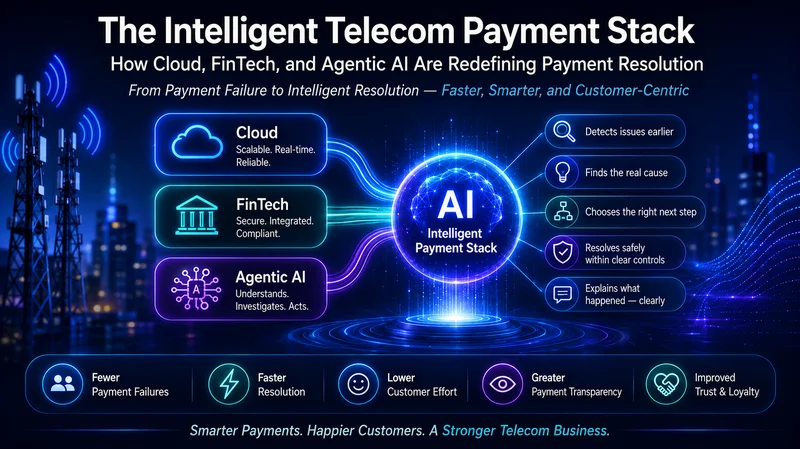
Rather than using AI only as a chatbot that explains payment problems, telecom providers can explore an Intelligent Payment Stack where Cloud provides the digital foundation, FinTech provides transaction capabilities, and Agentic AI provides a reasoning and orchestration layer for investigating payment exceptions and coordinating appropriate resolution.
The objective is not to give AI unrestricted authority over financial transactions. The objective is to create payment experiences that can detect problems earlier, understand them faster, explain them more clearly, and help resolve them safely.
When a Payment Fails, the Real Work Begins
Consider a common telecom scenario. A customer's monthly bill is scheduled for AutoPay. The payment attempt fails. The customer receives a generic notification:
"We were unable to process your payment. Please update your payment method."
But what actually happened? Was the card declined? Did the payment gateway time out? Did the payment method expire? Was additional authentication required? Was the transaction authorized but not posted correctly? Was another payment already submitted? Could retrying the payment accidentally create a duplicate transaction?
These are very different conditions requiring different responses. Traditional payment platforms are good at recording transaction states such as successful, failed, declined, pending, or reversed. But understanding the complete reason behind a payment problem may require correlating information from several systems.
A billing platform knows the outstanding balance. A payment gateway knows what request was submitted. A processor knows the authorization response. A fraud platform may know whether a risk rule was triggered. CRM knows the customer's interaction history. Reconciliation processes may know whether money actually moved.
Each platform holds part of the answer. The payment-resolution challenge is bringing those pieces together quickly enough to determine the right customer outcome.
Cloud Modernized Payments, but Integration Is Only the Beginning
Cloud technologies have fundamentally changed how digital payment platforms are built. Cloud-native architectures allow organizations to expose payment capabilities through APIs, process events in near real time, scale services dynamically, improve observability, and integrate payment experiences across mobile applications, websites, retail stores, and contact centers.
But moving payment applications to the cloud does not automatically solve payment resolution. An organization can modernize every component and still create cloud-based fragmentation. APIs connect systems. Event platforms distribute signals. Observability shows what applications are doing. The missing capability is often the ability to interpret those signals collectively in the context of the customer's problem.
FinTech Has Expanded the Telecom Payment Ecosystem
FinTech innovation has significantly expanded the capabilities available to telecom providers. Modern payment ecosystems can incorporate payment gateways and processors, tokenization, digital wallets, payment orchestration, fraud detection, authentication services, account validation, settlement, and reconciliation.
These capabilities improve convenience, security, payment acceptance, and operational flexibility. They also create more signals that can be used to understand payment problems. Consider a failed AutoPay transaction. Relevant information may exist across:
The issue is no longer simply whether a transaction succeeded or failed. Organizations may need to understand where it failed, whether authorization occurred, whether money moved, whether a retry is appropriate, whether duplicate-payment risk exists, and what the customer should do next.
This is particularly important in telecom because payment outcomes can affect not only financial records but also collections activity, customer notifications, service status, installment arrangements, and future customer interactions. FinTech provides increasingly powerful transaction capabilities. Agentic AI can potentially help make sense of the information those capabilities generate.
Agentic AI as the Payment Reasoning Layer
Traditional automation remains essential in financial systems. When conditions are predictable, deterministic rules are often the safest and most efficient approach:
If condition A occurs => execute approved action B.
Agentic AI should not replace those controls. Its potential value is in the space between rigid automation and manual investigation. Imagine giving an AI agent a bounded objective:
Determine why this payment failed and identify the safest permitted next step.
The agent could gather approved information from multiple systems, correlate transaction states, examine relevant policies, identify missing evidence, classify the likely cause, and recommend or initiate an authorized workflow. This is different from a conventional chatbot.
A chatbot might respond: "Your payment may have failed because your payment method was declined."
A payment-resolution agent could potentially determine: "The AutoPay attempt received a decline response. No successful authorization or duplicate transaction was identified. Based on the approved payment policy, another automatic attempt should not occur until the customer updates the payment method." The difference is fundamental.
Generative AI explains information. Agentic AI can investigate the workflow behind that information.
The Intelligent Telecom Payment Stack
The combination of these technologies creates what I call the Intelligent Telecom Payment Stack.
The architecture can be viewed as five connected layers:
- Customer Experience Layer => Mobile App | Web | Retail | Contact Center | CRM
- Cloud & Integration Layer => APIs | Microservices | Event Streaming | Observability | Data Services
- FinTech & Payment Layer => Payment Gateway | Processor | Tokenization | Digital Wallets | Fraud Controls | Payment Orchestration | Reconciliation
- Agentic AI Intelligence Layer => Transaction Correlation | Root-Cause Analysis | Policy Reasoning | Resolution Recommendation | Workflow Orchestration | Customer Explanation
- Governance & Resolution Layer => Authorization | Security | Privacy | Auditability | Human Approval | Compliance | Financial Controls
The outcome is: Detect => Understand => Decide => Govern => Resolve => Explain
This architecture is important because Agentic AI does not replace Cloud or FinTech infrastructure. Cloud provides connectivity and scale. FinTech provides secure transaction capabilities. Agentic AI provides contextual reasoning. Governance determines what actions are permitted. Together, these components can transform payment resolution from a fragmented investigation into a more intelligent workflow.
Inside an Agentic AI Payment Investigation
An intelligent workflow could begin by gathering permitted account and transaction context across billing, gateway, processor, risk, and reconciliation systems. In the event of a timeout message from the payment gateway, a rules-based approach might deem the transaction failed and attempt the transaction again. However, what if the transaction was successfully received by the processor? Retrying could result in a duplicate payment.
An Agentic AI workflow would correlate both states and offer a recommendation accordingly. The investigation could follow this sequence:
- Detect:A cloud event identifies the payment exception.
- Gather:The agent retrieves permitted transaction and account context.
- Correlate:Signals from billing, payment, gateway, processor, risk, and reconciliation platforms are compared.
- Diagnose:The agent determines whether the issue appears to be a decline, technical failure, duplicate risk, posting discrepancy, authentication issue, or uncertain transaction state.
- Decide:The system identifies approved resolution options.
- Govern:Policies determine whether the action can happen automatically or requires customer or human authorization.
- Resolve:The appropriate workflow is initiated.
- Explain:The customer or service representative receives an explanation based on verified transaction information.
Importantly, "insufficient evidence" should be an acceptable conclusion. A trustworthy payment agent should know when not to act.
A Practitioner Perspective: Payment Resolution Is a Product Problem
Working on large-scale telecom billing, payment, CRM, and digital transformation initiatives has reinforced an important lesson for me: payment problems are rarely isolated to one system.
A customer may see one simple symptom, "my payment failed," while resolving that symptom can require information from billing, payment services, transaction history, CRM, integration services, and downstream financial platforms.
Payment resolution should be designed as an end-to-end capability rather than a collection of individual system functions.
Modernizing the user interface alone does not necessarily modernize the customer journey. Moving a payment capability from a legacy application to a modern CRM or cloud platform can improve accessibility, but the real customer benefit comes when representatives and digital channels have enough context to resolve the problem without repeatedly switching systems or escalating the investigation.
The same principle applies to AI. Adding a chatbot on top of fragmented systems does not automatically create intelligent payment resolution. If the AI cannot access the appropriate transaction context, distinguish between verified facts and assumptions, and understand what actions are permitted, it may simply provide a more conversational interface to the same fragmented experience.
The product opportunity is therefore bigger: Design payment resolution as an end-to-end capability rather than a collection of individual system functions. That means starting with the customer problem, mapping the systems and data required to understand it, identifying where deterministic automation is sufficient, and then introducing Agentic AI where contextual reasoning genuinely improves the workflow.
Bounded Autonomy: AI Should Investigate More Than It Transacts
Payments require a different standard of AI governance than many lower-risk enterprise use cases. An AI agent capable of understanding a transaction should not automatically receive unlimited authority to move money, issue refunds, change payment methods, or override fraud controls.
A useful design principle is bounded autonomy. Within clearly defined boundaries, an AI agent might:
- Gather transaction evidence.
- Correlate payment states.
- Categorize payment problems.
- Explain verified outcomes.
- Recommend resolution paths.
- Trigger approved low-risk workflows.
Higher-risk actions should remain protected by deterministic controls, authentication, policy validation, financial authorization, customer consent, or human approval.
For example:
- Investigating a refund ≠ approving a refund.
- Identifying a failed payment ≠ initiating another charge.
- Detecting a duplicate transaction ≠ automatically reversing it.
This separation between reasoning authority and financial authority is essential. AI governance should therefore include identity and access controls, data minimization, encryption, tokenization, audit trails, model monitoring, explainability, human escalation, and clearly defined authorization boundaries. The objective should not be maximum autonomy. It should be appropriate autonomy.
What Product Managers Should Measure
The success of an Intelligent Payment Stack should not be measured by the number of AI agents deployed. It should be measured by customer and business outcomes. Important payment metrics can include:
- Payment Success Rate:How often payment attempts complete successfully.
- Payment Recovery Rate:How effectively recoverable failures are ultimately resolved.
- Payment-Related Contact Rate:How frequently customers need service assistance because of payment problems.
- Mean Time to Resolution:How quickly a payment exception reaches a verified outcome.
- First Call Resolution (FCR):Whether representatives can resolve payment issues during the first interaction.
- Average Handle Time (AHT):Whether better transaction intelligence reduces investigation effort.
AI-specific measures should include classification accuracy, human overrides, incorrect recommendations, and whether customer explanations accurately reflect verified transaction states.
The guiding principle is simple: AI adoption is not the outcome. Better payment experiences are.
From Reactive Payments to Intelligent Resolution
Most payment platforms are designed primarily around transaction execution. The Intelligent Payment Stack expands that responsibility to transaction understanding. The traditional journey often looks like:
Payment Attempt => Failure => Customer Notification => Customer Contact => Investigation => Resolution
A more intelligent journey could become:
Payment Attempt => Exception Detected => AI Investigation => Governed Resolution => Customer Explanation
The opportunity is to dramatically improve what happens after the exception occurs. That is where Cloud, FinTech, and Agentic AI become particularly powerful together.
Conclusion
Telecom payments have evolved significantly, but payment resolution remains an area where customers can still experience unnecessary complexity. Cloud-native technologies have provided scalable infrastructure, APIs, event-driven processing, and better system integration. FinTech innovation has introduced sophisticated payment processing, tokenization, digital wallets, orchestration, fraud management, and reconciliation capabilities.
Agentic AI adds a potentially important third capability: contextual reasoning across the payment journey.
Together, these technologies create the foundation for an Intelligent Telecom Payment Stack capable of detecting exceptions, gathering evidence, understanding transaction context, selecting appropriate resolution paths, and explaining outcomes more clearly. But the future should not be based on uncontrolled financial autonomy.
The strongest model is one where AI investigates broadly but acts within carefully defined boundaries. For product managers, this means shifting the conversation from:
"Where can we add AI to payments?" => "Where does payment resolution create unnecessary customer effort, and how can Cloud, FinTech, and Agentic AI work together to remove it safely?"
Customers do not want to understand payment architecture. They simply want their payment to work and when it doesn't, they expect the company to know what happened. The next generation of payment platforms should be designed to meet that expectation. That is the opportunity behind the Intelligent Telecom Payment Stack.