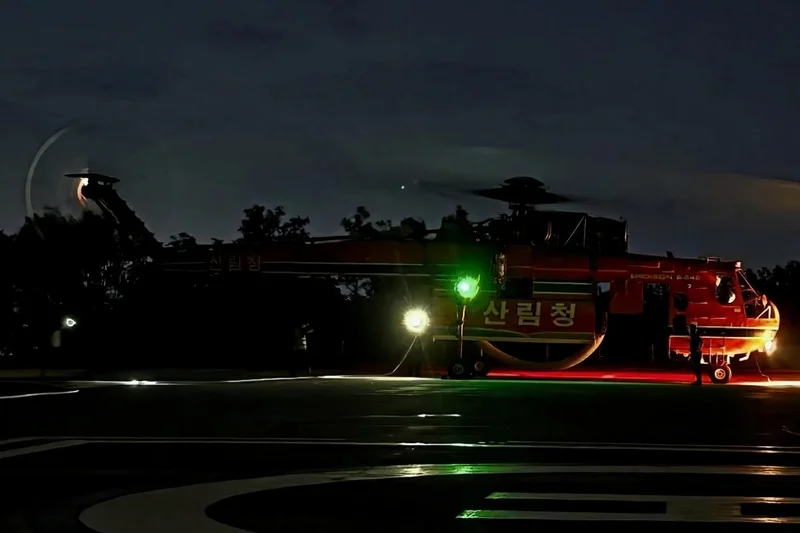
When dusk fell across Korea's rugged mountainous landscape, aerial firefighting fleets were historically forced to land, leaving ground crews to battle encroaching blazes against the cover of darkness. That tactical gap is now closing as forestry authorities embrace specialized night operations.
The Andong Regional Aviation Office, under the Korea Forest Service, said it has qualified two pilots for night vision goggle (NVG) operations aboard the S-64E Skycrane — a heavy-lift helitanker capable of dropping thousands of liters of water in a single pass. This establishes a dedicated nighttime firefighting capability centered in North Gyeongsang Province, a region historically vulnerable to destructive seasonal blazes.
The certification marks the culmination of an intensive multi-stage training program conducted from late May through early August. Pilots underwent rigorous ground instruction, flight-simulator training and drills before progressing to advanced tactical night flights using NVGs.
Central to the preparations were high-intensity exercises around Andong Lake and Imha Dam. Crew members practiced low-altitude night navigation, terrain avoidance, and emergency procedures using the massive S-64E. On Aug. 5, the unit completed a comprehensive nighttime simulation evaluating joint air-and-ground operations. The exercise stress-tested crucial protocols, including daytime reconnaissance, night water-refueling, precise aerial water drops and strict airspace safety controls.
The push for nighttime capability addresses a long-standing vulnerability in forest management.
Nighttime aerial firefighting presents extreme operational risks: disorientation, mountainous terrain, high-voltage power lines, lack of light and dense smoke plumes drastically reduce visibility. However, halting air operations at sunset often allows blazes to spread unchecked overnight, fanned by unpredictable mountain winds. Equipping heavy-lift helitankers with NVG technology allows authorities to strike during crucial nocturnal windows when cooler temperatures and rising humidity offer the highest chances of containment.
The urgency of this operational shift is underscored by the escalating scale of wildfire destruction in recent years.
Spurred by shifting global climate patterns, prolonged droughts and unseasonably high winds, Korea has experienced a dramatic rise in wildfires. Devastating blazes across eastern coastal regions and North Gyeongsang Province — including catastrophic fires near Uljin and Gangneung in recent years — consumed tens of thousands of hectares of forest, destroyed hundreds of homes and forced thousands of residents to evacuate.
Looking ahead, the Andong office said it plans to train additional pilots in phased NVG courses to expand its round-the-clock operational readiness.
"Wildfires can break out at any hour, making a rapid, night-capable response essential," Shin Seung-bok, director of the Andong Regional Aviation Office, said. "Through continuous pilot qualification and rigorous tactical drills, we will do our utmost to ensure a swift and safe response to nocturnal wildfires."
This article was published with the assistance of generative AI and edited by The Korea Times.