analysis
East Asia
Zhu Rongji’s death adds new dimension to China's high-profile remembrance of Jiang Zemin
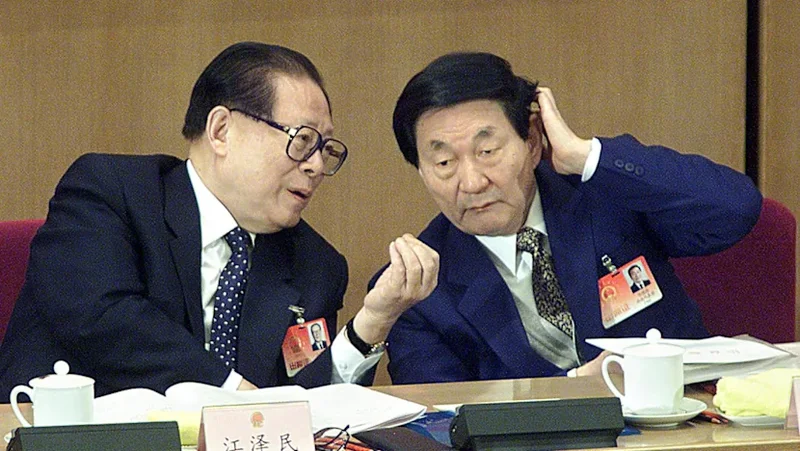
Former Chinese Premier Zhu Rongji died aged 97 on Wednesday (Aug 12), five days before former President Jiang Zemin’s birth centenary. The convergence puts renewed focus on their reform-era legacies - and Beijing’s balancing act in celebrating them, analysts say.
BEIJING: Former Chinese Premier Zhu Rongji's death has added a new dimension to China's high-profile remembrance of former President Jiang Zemin, bringing increased attention to a pivotal period of reform and opening for the world’s second-largest economy, say analysts.
But it also raises questions over how the country’s current leadership wants that legacy to be understood today, they add.
Zhu died from illness on Aug 12 at the age of 97, just five days before Jiang’s birth centenary, which Beijing is marking with a series of high-profile commemorative activities.
Zhu's remains will be cremated in Beijing on Tuesday (Aug 18), when national flags will be flown at half-mast at key government sites across the country, including in Hong Kong and Macau, as well as at Chinese diplomatic missions overseas, state news agency Xinhua reported.
The two men served alongside each other at the top of China’s leadership from 1998 to 2003. Zhu served as premier alongside Jiang, who was already Communist Party chief since 1989 and president since 1993.
"The image of Jiang and Zhu as decisive problem-solvers will be more prominently constructed and promoted," Hou Yichao, a researcher of China's political economy and former research assistant at the S Rajaratnam School of International Studies (RSIS), a Singapore think-tank.
He added that this image aligns with current leadership messaging on confronting difficult challenges and pursuing change.
Zhu's reputation for pushing through tough economic reforms and taking on entrenched obstacles also gives his legacy added relevance today, Hou said.
At the same time, Beijing’s framing of the Jiang-Zhu era serves a dual purpose: celebrating the achievements of reform while presenting President Xi Jinping’s leadership as necessary to address problems left unresolved by China’s rapid transformation, analysts said.
WHY JIANG'S LEGACY IS BACK IN FOCUS
Jiang’s centenary has placed his legacy back in the official spotlight.
On Aug 11, state broadcaster CCTV began airing a 12-part documentary titled “Jiang Zemin”, which it said chronicles Jiang's more than seven decades of political life and his contributions to the party and state.
The series is a joint production by the Communist Party's propaganda department, party history institute, broadcast regulator and CCTV.
It is being aired in a prominent evening slot, with two episodes broadcast each night from Aug 11 to Aug 16, according to CCTV's programme schedule.
A major commemorative assembly will be held on Aug 17 at the Great Hall of the People in Beijing to mark Jiang’s centenary, with Xi set to deliver a speech, according to Xinhua.
The event places Jiang's centenary among the most prominent official commemorations for former top party leaders, similar to the conference held for Deng Xiaoping's 100th birth anniversary in 2004.
Jiang served as Communist Party general secretary till 2002 and stepped down as state president in 2003. He relinquished his chairmanship of the party's Central Military Commission (CMC) in 2004, before leaving his final formal leadership position as state CMC chairman in 2005.
He died in Shanghai on Nov 30, 2022, at the age of 96, from leukaemia and multiple organ failure.
State media coverage and Xi's eulogy for Jiang in 2022 have stressed not only Jiang's role in advancing reform and opening, but his ability to steer China through periods of domestic and international uncertainty.
Xi's eulogy also highlighted his role in maintaining stability after becoming the party's top leader in 1989, deepening reform and opening, and navigating challenges including the Asian financial crisis and the devastating 1998 floods.
Analysts said that record offers today’s leadership a way to portray the party as having repeatedly navigated crises while keeping China's development on course.
"The CCP (China’s Communist Party) continues to see Jiang as someone who helped lay the groundwork for today's powerful party-state," Chong Ja Ian, an associate professor at the National University of Singapore (NUS) and a non-resident scholar at Carnegie China, told CNA.
"The commemoration shows continuity and helps emphasise the legitimacy of CCP rule."
THE ENDURING LEGACY OF REFORM
The legacy Beijing is invoking is not simply one of rapid economic growth, but of building institutions that continue to shape China's economy today, said analysts.
At the Communist Party's 14th National Congress in 1992, when Jiang was party general secretary, the country formally adopted the goal of establishing a "socialist market economy", paving the way for market-oriented reforms.
Gu Qingyang, an associate professor at NUS’ Lee Kuan Yew School of Public Policy (LKYSPP), said Jiang, Zhu and then-paramount leader Deng Xiaoping all played important roles in establishing that framework, which provided "an important institutional foundation for China's rapid economic growth".
Reform during the period moved beyond changes in individual sectors and became increasingly "comprehensive and systemic", spanning areas from public finance and taxation to foreign trade, state-owned enterprises and social security, Gu told CNA.
Bert Hofman, a senior associate fellow at the Mercator Institute for China Studies (MERICS) and senior fellow at NUS' East Asian Institute, said reforms developed after the 14th Party Congress established the basic framework for China's current fiscal and financial systems, state enterprises, labour market and social system.
Those included the 1994 tax-sharing reform that re-centralised fiscal revenues, reforms to the financial system, restructuring of state-owned enterprises and the gradual creation of a social security system to support workers affected by economic restructuring.
"Of course much has happened since, but reforms since then by and large worked within that framework," he said.
While the political context and balance between state and market have since changed, "the basic economic system established then has endured", Hofman added.
A BRIGHTER SPOTLIGHT
Zhu’s death has cast a brighter spotlight on the Jiang-Zhu period, broadening attention beyond Jiang’s individual legacy to Zhu’s own and to the reforms and institutional changes associated with their era.
While the goal of establishing a “socialist market economy” was formally adopted under Jiang in 1992, Zhu became central to putting it into practice.
Then a vice-premier overseeing the economy, Zhu was tasked with preparing sweeping reforms, which he continued to implement after becoming premier in 1998.
Backed by the political leadership, Zhu confronted resistance from local governments and state enterprises while using China's ambition to join the World Trade Organization (WTO) as leverage for domestic reform, Hofman highlighted.
Another defining feature of the Jiang-Zhu period was China's willingness to study overseas experience and adapt it to domestic conditions, rather than simply copy foreign models, said LKYSPP’s Gu.
"This approach - 'looking to the world while remaining rooted in China' - was an important part of the methodology behind China's latecomer catch-up," he said.
Singapore was among the countries Chinese policymakers studied closely during this period. Gu said Chinese officials examined areas including governance, economic management and urban development, while adapting lessons to China's own circumstances.
One example was the China-Singapore Suzhou Industrial Park, launched in 1994. It was the first government-to-government project between the two countries.
It was conceived as a demonstration project for learning from Singapore's development experience, Gu said.
Gu also noted that Zhu, while serving as Shanghai party secretary, led a delegation to Singapore in the early 1990s to study the Central Provident Fund system, which contributed to the development of Shanghai's housing provident fund scheme before it was later expanded nationwide.
PARTY NARRATIVE
For Beijing, Jiang and Zhu remain figures that can be comfortably incorporated into the party's broader story of reform, development and national revival, even as their legacies are not seen as uniformly positive, noted analysts.
RSIS’ Hou noted that some reforms which addressed immediate problems also produced longer-term consequences - including Zhu's 1994 tax-sharing measures, which strengthened central finances but contributed to local governments' later reliance on land revenues.
"These reforms were inherently complex: some look like the work of a reformer, others more like that of a conservative," Hou said.
"Some appeared effective at the time but left negative long-term effects."
NUS’ Chong said Zhu's legacy remains closely tied to both the achievements and costs of China's economic transformation.
As the person who helped steer China into the WTO, Zhu is associated with the wealth and global integration that followed, he noted.
But the restructuring of state-owned enterprises and other reforms also brought significant hardship, including layoffs for many workers, Chong said.
Critics of that period have also pointed to the widening inequalities that accompanied rapid growth, including the rise of private fortunes and debates over whether reforms weakened social protections.
Some of those debates remain part of how the Jiang-Zhu period is remembered today. Hou said the Jiang-Zhu period remains difficult to assess in simple terms, as the same reforms that helped drive China's growth also reshaped society and created new debates over inequality, opportunity and the role of the state.
Still, that complexity is partly why the Jiang-Zhu legacy can be celebrated as a major stage in China's development without being presented as a model to be recreated wholesale today, analysts said.
Xi's framing of reform and opening allows the party to maintain continuity with past achievements while presenting the current leadership as key in addressing unresolved challenges from that transformation, said Joseph Torigian, provost associate professor at American University's School of International Service.
"By emphasising continuity with the past, he maintains that the party is always right even if it takes time to figure things out," Torigian told CNA.
"But by pointing to the problems that reform and opening created, and by declaring a new era, he can make a case for why he is special and different and deserves to rule."
Analysts said Xi's framing of the reform era has pointed to issues such as corruption, inequality and imbalances created during decades of rapid growth as problems requiring further reform and governance changes.
Yet the way Jiang and Zhu are remembered in public can extend beyond the themes highlighted in official commemorations - potentially becoming uncomfortable for Beijing, they added.
Hou from RSIS said discussions around Zhu have focused not only on his economic record, but also on his personal style and perceived sincerity.
"Zhu Rongji has been widely shared and praised online for his sincerity, bluntness, and willingness to point out problems without mincing words," he said.
Such a reputation can still fit within official discourse, Hou said, as it is linked to the party's own emphasis on "seeking truth from facts".
But it can also create a different way of viewing leadership, particularly when public discussion focuses on personal qualities rather than official achievements.
Jiang's legacy has similarly developed informal forms of remembrance outside official channels.
Hou pointed to the "toad worship" subculture among Jiang’s fans in the younger generation who used memes and clips from his public appearances to create a more humorous and informal image of the late leader.
That form of remembrance - stemming from Jiang’s large-framed spectacles among others - was more sensitive, Hou said, because it could "deconstruct" the image of a top leader.
More broadly, Hou said the Jiang-Zhu period remains difficult to separate cleanly from the periods before and after it. The era inherited unresolved issues from the planned economy while also leaving challenges for subsequent leaderships.
The challenge for Beijing, analysts said, is not whether Jiang and Zhu can be incorporated into the official historical narrative, but whether all interpretations of their legacies can fit within that framework.
"Less comfortable for the CCP is a situation where the legacies of Jiang and Zhu become a means to criticise current policies and the current leadership," NUS’ Chong said.