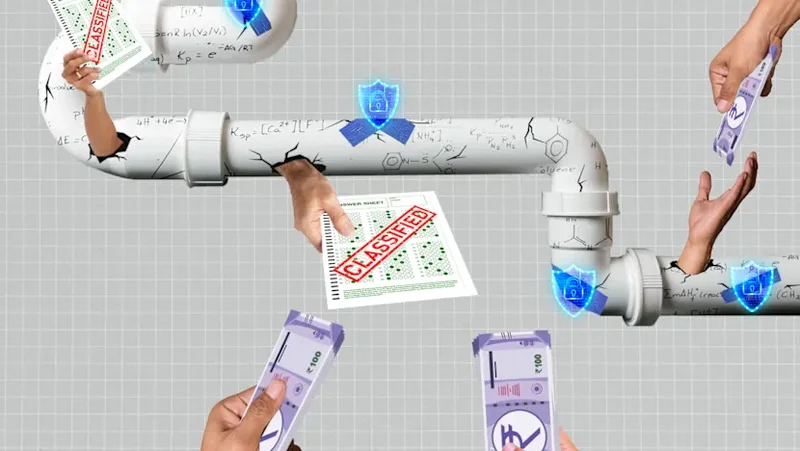
India wants to tap technology to prevent exam paper leaks, but experts say it’s not so simple
In the first of a three-part series on education issues in India, CNA studies how it can better tap technology to prevent exam paper leaks that sparked the student-led protests across the country in June.
BENGALURU: India’s medical entrance exam is meant to decide who gets to save lives as future doctors. But this year, it cost some students theirs.
A leak of the paper to be used in India’s biggest pre-medical test - National Eligibility cum Entrance Test (NEET) - led to at least 20 medical students reportedly taking their own lives, amid the increased stress, uncertainty and pressure of having to retake the exam.
The crisis surrounding the NEET leak later triggered student protests across the country in June, the resignation of India’s Education Minister Dharmendra Pradhan and scrutiny from the Supreme Court of the National Testing Agency's (NTA) handling of the examination.
The government has since appointed a task force led by Nandan Nilekani - co-founder of Indian IT services giant Infosys and architect of the Aadhaar digital identity project - to recommend tech reforms to the exam system.
But experts say the saga has exposed a fundamental issue on how a single exam can throw the futures of over 2.2 million students into turmoil.
They add that it has also forced the nation to confront a bigger question: Can technology make its high-stakes exams more secure, or does the system itself need to be redesigned?
But some say the real question is not just whether India can digitise the exam, but whether it can redesign a system built around a single high-stakes paper, a long chain of human custody and fragmented accountability. While technology can make leaks harder, it will not restore trust on its own, say experts.
“Computer-based testing by itself doesn’t solve the integrity problem, it just relocates it,” said Wally Dalrymple, chief security officer at Educational Testing Service (ETS), the US-based organisation behind global examinations such as the Graduate Record Examinations (GRE) and the Test of English as a Foreign Language (TOEFL).
“The countries that do this well have moved past the idea that any single fix will solve the problem.”
THE VULNERABILITIES IN INDIA’S EXAMS
The paper leak has already led to a criminal investigation.
India’s top police investigative agency, Central Bureau of Investigation, reportedly arrested 13 people - including three NTA subject experts, coaching‑centre operators and middlemen and uncovered what investigators describe as a multi‑state conspiracy
But while investigators have focused on who leaked the paper, the experts CNA spoke to argue India should instead examine what is it about the country's examination system that allows one leak to derail the academic prospects for millions of students?
“It is a design problem,” former secretary of India’s Ministry of Education, R Subrahmanyam, told CNA. “While online exams would help, what is needed is to look at the assessment system as a whole.”
In a policy paper published in July 2026 by the Centre for Research in Schemes and Policies (CRISP), a public policy research and advisory organisation founded by former senior Indian civil servants, Subrahmanyam suggested replacing a make-or-break exam like the NEET with multiple test dates as well as with dynamically generated but equally difficult papers, so that the leak of one paper would have far less impact.
Cybersecurity researcher Sai Krishna said India's physical-paper-based model is vulnerable because it exists in its final form long before students enter the examination hall.
“A paper-based national exam has a long physical chain of custody,” he told CNA.
Question setters, moderators, printing presses, transport contractors, storage facilities, district officials and examination centres each become another human trust point before the paper finally reaches candidates.
“Every handoff is a human trust point. A single compromised insider anywhere in that chain can defeat the entire system,” he said.
Almost every major exam leak in India has historically originated from insiders involved in printing, transport or examination centres rather than sophisticated cyberattacks, Krishna explained.
Unlike exams where different candidates receive different question sets, India's largest entrance tests revolve around one highly confidential paper taken by millions of candidates on the same day.
That means compromising a single document can undermine an entire national examination, according to security experts.
HOW OTHER COUNTRIES DESIGNED LEAK-PROOF EXAMS
If India is looking overseas for answers, experts told CNA it should avoid searching for a single technology to copy. Instead, they point to a common principle of reducing the value of a single leak.
Dalrymple of US-based testing agency ETS said the best exams make security “nearly invisible to honest test takers and expensive for bad actors.”
Different countries have adopted different approaches.
China, home to the world's largest university entrance examination known as gaokao, has adopted one of the world's most stringent exam security regimes.
Security researcher Krishna points out how authorities in China treat question papers as state secrets, transporting them under tightly monitored custody with severe criminal penalties for leaks.
Although gaokao remains paper-based, China treats the undistributed exam papers as top-secret state material. They are printed at specially authorised facilities, sealed and transported under strict chain-of-custody procedures, including police escorts, GPS-tracked vehicles and multiple handover checks.
Officials found leaking or stealing papers can face severe criminal penalties.
In recent years, China has continued to adapt its exam security as new threats emerge.
During this year’s gaokao, authorities along with major AI firms including ByteDance, Tencent, Alibaba, Baidu, Moonshot AI and DeepSeek temporarily disabled their AI features such as photo-based question solving and exam-related responses during the test hours to deter AI-assisted cheating, according to a Bloomberg report.
In the past, China has faced exam-security breaches.
In 2015, there were local reports that the questions from a postgraduate entrance exam had been leaked online.
In another case in 2022, a candidate photographed a maths paper during the gaokao exam and posted it online, prompting a police investigation, according to local reports.
Since 2015, China has also criminalised organised cheating and exam paper leaks under amendments to its criminal law, with offenders facing up to seven years’ imprisonment, according to media reports. Authorities have since tightened chain‑of‑custody rules and expanded surveillance around major state exams.
The United States has taken a different route.
Examinations such as the GRE use computer-based tests that pull questions from a large question bank, so candidates receive different but equivalent versions of the exam, said Dalrymple.
Many also use adaptive testing, where the difficulty of questions changes based on a candidate's previous answers that make compromising any single set of questions far less valuable, he added.
Krishna said that India should combine China's rigorous chain-of-custody practices with the US-based examination designs that reduce the value of anything stolen in advance. “The objective should be not merely to punish leaks after they occur,” he said, “but to design examinations in which no single paper can compromise the entire process”.
WILL GOING DIGITAL ACTUALLY PLUG INDIA’S LEAKS?
Subrahmanyam, the former Indian education secretary, has proposed a nationwide continuous assessment system built by upgrading existing schools, colleges and polytechnics into a national network of accredited digital assessment centres.
Under his proposal, every senior secondary school would, over time, be equipped with secure computer laboratories that could serve both teaching and assessment.
Rather than replacing paper-based exams overnight, he called for a phased transition over about a decade, allowing schools to gradually build infrastructure, train staff and shift to digital assessments.
This phased approach also reflects the scale of the challenge.
Proposals submitted by India’s Ministry of Education and the NTA to a parliamentary committee in July suggest that moving the NEET exam online in 2027 could require the exam to be spread over five to six days across about 1,000 centres in 500 cities, with roughly 500,000 candidates sitting each day, according to a report by local new publication The Indian Express.
Those numbers underscore the logistical hurdles involved that India would need enough secure computer labs, reliable power and connectivity, trained staff and multiple equivalent test versions to ensure fairness across sessions, said experts.
Although the NTA already conducts several major exams at computer centres, NEET remains paper-based largely because of its size - more than 2.2 million candidates appearing at 5,432 centres in 2026 - they added.
Experts said that with technology India can move away from setting one question paper for all candidates to plug leaks.
“If you can generate different but equivalent question papers for every candidate, there is no longer one paper worth stealing,” said Krishna. But he cautioned that technology only shifts the attack surface, from physical question papers to the computers, exam centres and digital systems used to administer the test.
“Centre operators, invigilators, vendors and the coaching ecosystem need as much design attention as encryption and key management,” he said.
That is also the lesson Dalrymple said ETS has learnt from decades of running high-stakes exams worldwide, in more than 180 countries, including the US, India, Japan, South Korea and across Europe.
He said ETS focuses on a “security architecture instead of a single control” - using constantly refreshed question banks alongside identity checks, test-centre safeguards and monitoring that work together, so that “one leak can’t take down an entire national exam”.
Rather than trying to build an unbreakable system, mature exam programmes continuously adapt to new threats while combining multiple layers of security, said Dalrymple.
“The biggest mistake governments make is building for today's threats instead of tomorrow's,” he added.
However, even if technology succeeds in making India’s exampaper leaks far harder, it will not resolve the broader pressures created by the country's dependence on high-stakes competitive examinations, said Ronojoy Sen, senior research fellow at the Institute of South Asian Studies in Singapore.
“Technology might prevent leaks but won't change the dependence on competitive exams and the problems that come with it,” he said.