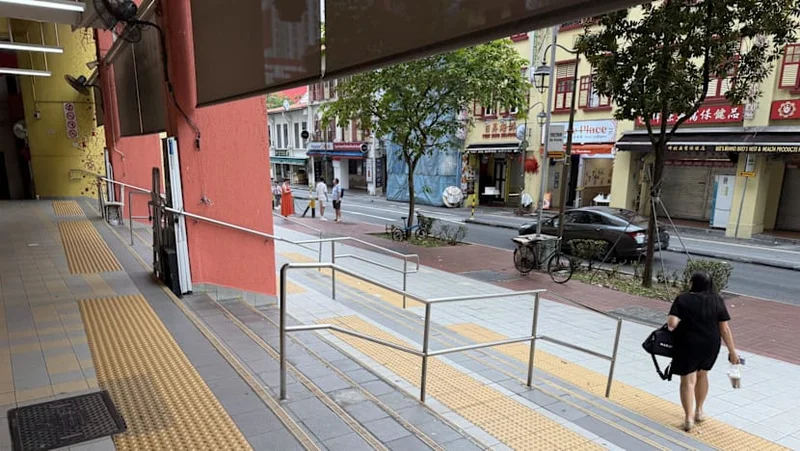
Slips, falls and stuck wheels: Residents raise concerns over tactile tiles in HDB estates
With the Land Transport Authority set to replace tactile tiles at pedestrian crossings, some residents are calling for a similar review for HDB estates.
SINGAPORE: When Madam Sim heard that the Land Transport Authority (LTA) would replace tactile tiles at pedestrian crossings, she felt her concerns were finally being heard.
Since slipping on such tiles near her block two years ago and ending up in hospital, the 54-year-old Sengkang resident has avoided the yellow tiles where possible.
Tactile tiles, which feature raised bumps and bars, are designed to guide people who are blind or visually impaired through public spaces.
Last month, LTA announced it would progressively replace the tiles at all signalised pedestrian crossings over the next four years with new tiles that are more resistant to slipping.
The announcement came after Ms Venecia Ng, 40, slipped on wet tactile tiles at a Thomson Road pedestrian crossing in June and fractured her ankle. She later died after undergoing surgery for the fracture.
Prior to the incident, LTA had already revised how the tiles were laid. In April 2024, it began implementing a new layout, with 300mm gaps between tiles to reduce the risk of slips in wet conditions while still guiding the visually impaired.
LTA said the tiles at the accident site were in good condition and met international skid-resistance standards.
REPEATED FALLS
Mdm Sim, who declined to have her full name published for privacy reasons, said she was glad that something was going to be done about the tiles.
“Looking at the comments online, I was also shocked to see that actually many experienced the same as what I experienced,” she said.
But the replacement programme applies only to pedestrian crossings under LTA's purview. Mdm Sim and other residents CNA spoke to said they hope a similar review will be carried out for tactile tiles in Housing and Development Board (HDB) estates, which are maintained by town councils.
Mdm Sim's first fall was in June 2022, on tactile tiles along a sloping pavement near her block on a rainy day. She grabbed a railing before landing on her thigh, leaving her badly bruised, and reported the incident to her town council.
“The town council contacted us and then requested us to send some photos and which part I fell at, and then they said that they would look into it.
“So that was it, and then we just left it as it was.”
Almost exactly two years later, she fell again.
This time, she was walking towards her husband's car at the sheltered drop-off point below her block after it had rained. She slipped on the tactile tiles despite wearing rubber-soled shoes, landing on her hip and tailbone and hitting the back of her head.
About 20 minutes later, she began experiencing numbness throughout her body.
"I started to panic. The first thought in my mind was: 'Am I going to be paralysed?'" she recalled.
Her husband drove her to Tan Tock Seng Hospital, where X-rays of her hip and lower spine found no fractures. The numbness gradually subsided after about half an hour, and she was discharged and recovered in about two weeks.
“It was really quite a frightening experience,” she said.
After the second fall, Mdm Sim raised the issue through her Sengkang GRC MP Louis Chua and was later told an anti-slip treatment had been applied to the tiles, with photographs sent to show the completed work.
But she questioned how long the treatment would remain effective.
"I'm not sure whether they regularly reapply the anti-slip chemical because it would wear away over time," she said.
CNA has contacted Sengkang Town Council for comment.
CHALLENGES FOR THOSE WITH MOBILITY ISSUES
Other residents interviewed by CNA in Chinatown and Bedok, where tactile tiles can also be seen around the estates, raised concerns about navigating them, particularly in wet weather.
Chinatown resident Loh Siew Zhu, 69, said the raised bumps sometimes catch the wheels of her shopping trolley.
"When it rains, I try not to walk around here because it gets slippery and could be dangerous," she said. "I'm always worried that when the wheels get stuck, the whole thing might fall over and I hurt myself."
Another Chinatown resident, who wanted to be known only as Mdm Ng, said her trolley sometimes gets caught on the tiles and that she had seen elderly wheelchair users struggle with them.
"Sometimes, I see the elderly, especially those on wheelchairs, get stuck on them or have difficulty walking over the tiles," she said.
In Bedok, residents said they generally avoid tactile tiles because of their uneven surface.
"I never really paid much attention to the yellow tiles, but I usually don't really walk on it because it's uneven," said Ms Isabelle Tan.
TACTILE TILES A REQUIREMENT, HDB SAYS
In response to CNA's queries, HDB said tactile tiles are required under the Building and Construction Authority's (BCA) code on accessibility in the built environment, which sets design standards to ensure buildings are accessible and safe for people with different needs and abilities.
The tiles help visually impaired people navigate common areas safely and independently, including by alerting them to slow down and exercise caution before reaching potentially hazardous areas, HDB said.
In HDB estates, they are typically installed at drop-off points, pedestrian crossings across driveways, and at the top and bottom of staircases.
BCA's code requires the tiles to be slip-resistant so they remain safe to walk on even in wet conditions, HDB added. Common areas in HDB estates are maintained by the respective town councils, and incidents involving residents slipping or falling in these areas are reported to them.
For commercial complexes under its management, HDB said it has not received any adverse feedback on tactile tiles. It added that it was aware of LTA's ongoing replacement of tactile tiles on public paths and walkways.
“We continue to study and adopt best practices and improvements applicable to HDB developments, in line with prevailing regulations and industry standards, to provide a safe and inclusive living environment for all residents,” it said.
CNA has contacted BCA and all town councils to ask whether they plan to review or replace tactile tiles under their purview, whether they have received reports of slips and falls involving the tiles, and what measures are in place to balance accessibility with pedestrian safety.
As for Mdm Sim, the two falls have changed how she moves around her estate. The tiles where she fell remain at their original sites.
"If I can, I won't even step on them," she said. "I'll be extra careful, especially on rainy days.
“I fully understand the intention of the tiles to help those who are visually impaired. But on the other hand, if you think about it, it's actually really slippery during rainy days, and even for visually impaired persons, it's also going to be a hazard,” she said.