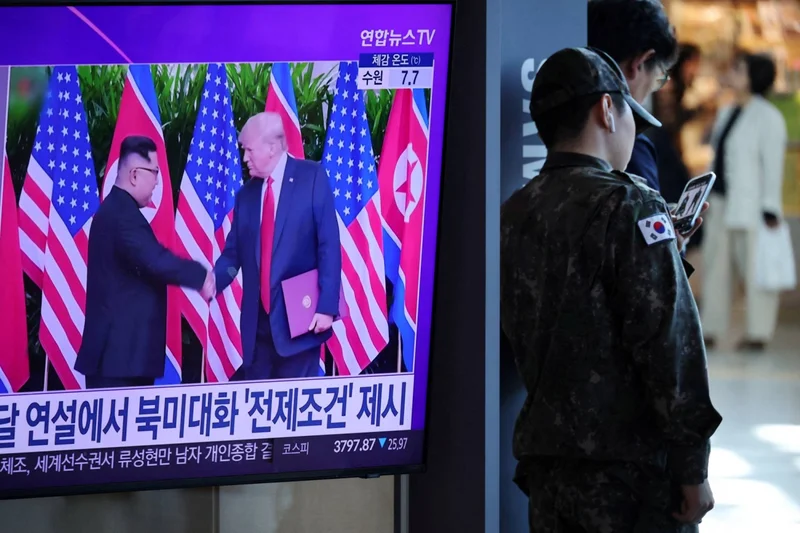
U.S. President Donald Trump said he was scaling back “costly” and “inappropriate” joint military exercises with South Korea scheduled to start Monday.
Citing his relationship with North Korean leader Kim Jong Un, as well as Seoul’s decision not to join U.S.-led actions against Iran, Trump said in a social media post that he was “not happy” with the current situation.
“Based on my very good relationship with Kim Jong Un … I am not happy with the fact that the United States has, long ago, agreed to participate in Joint Military Exercises with South Korea,” he wrote. “These exercises are not only costly, with much of these costs paid for by the United States of America (as usual!), but send a signal that is totally inappropriate and hostile, to a Country that, as long as Donald J. Trump has been President, has been unthreatening and respectful.”
The U.S. president said that while it was “too late to cancel,” he had instructed Secretary Defense Pete Hegseth to “substantially reduce” the drills.
Trump also hinted that South Korea’s decision not to join the U.S. in its attempts to open the Strait of Hormuz, which is now effectively controlled by Iran, played a role in the scaling down of the exercises.
“While somewhat unrelated (?), I recently asked the President of South Korea if they would like to join us in the Denuclearization of the Islamic Republic of Iran, and they said, ‘No thanks!’” Trump wrote.
Talks on ending the U.S. and Israeli war against Iran remain mired in stalemate, with both sides appearing to prepare for a protracted era of regional conflict.
North Korea views the annual joint U.S.-South Korean military exercises as a rehearsal for invasion, while Seoul and Washington call them purely defensive in nature.
The move to reduce the size of the drills has triggered speculation that Trump may again be seeking an opening for talks with the North Korean strongman.
The U.S. leader, who met with Kim three times during his first term and became the first sitting American president to enter North Korea, has repeatedly called Pyongyang a “nuclear power” during his second term, raising questions about whether he could pursue arms-reduction talks rather than return to the denuclearization efforts that ultimately failed in his first term in any attempt to reengage with Kim.