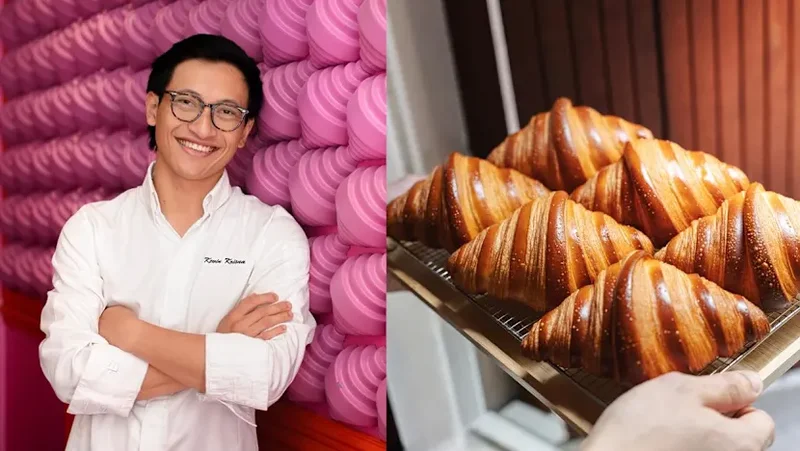
This Indonesian patisserie is drawing queues on Paris’ Rue Saint-Honore
Opened by Indonesian celebrities Raffi Ahmad and Nagita Slavina, La Petite Manis has drawn queues for French viennoiserie made with artisanal Indonesian ingredients – at the height of the rush, it was selling out by 2pm.
Behind the glass counter, buttery croissants, glossy shio pan and pain au chocolat made with single-origin Sulawesi chocolate sit beside the Cinnamon de Java, a laminated brioche flavoured with Indonesian cinnamon and gula jawa, or Javanese palm sugar.
The display would not look out of place in one of Jakarta’s contemporary bakeries. Instead, it sits on Rue Saint-Honore in Paris. This is La Petite Manis, a Franco-Indonesian patisserie opened with a clear goal: to prove that Indonesian ingredients and craftsmanship could hold their own in what its founders consider the world’s most demanding pastry city.
La Petite Manis was founded by a group of Indonesian entrepreneurs, including celebrity couple Raffi Ahmad and Nagita Slavina. Its kitchen is helmed by Indonesian pastry chef Kevin Krisna Pratama, who hails from Bali.
“We chose Paris quite deliberately,” said co-founder Kharisma Bibitani. “It is the most exacting audience in the world for this craft.”
MAKING IT IN PARIS
In Paris, exceptional viennoiserie and patisserie are part of everyday life, and customers have little reason to compromise. For a new establishment founded and staffed by Indonesians, earning their trust would be no small feat.
That challenge was precisely what attracted the founders. They saw Paris as the ultimate benchmark: If Indonesian ingredients and craftsmanship could succeed here, they believed, the brand would be taken seriously anywhere.
That meant resisting the temptation to rely on novelty. Rather than reinventing French pastry or immediately introducing traditional Indonesian pastries, the team focused on executing familiar classics to the standards local customers expected, while incorporating artisanal Indonesian ingredients.
“We didn’t want people to come because it was Indonesian,” said Kevin. “We wanted them to come because the pastries were good. The Indonesian ingredients should enhance the pastry, not distract from it.”
To that end, he spent months developing recipes that struck the balance. Sulawesi chocolate replaces conventional couverture in the pain au chocolat, while the Cinnamon de Java showcases Javanese cinnamon and gula jawa. Indonesian vanilla appears throughout the menu in mochi donuts and sesame croissants filled with cream. Future creations are expected to feature ingredients such as kecombrang, or torch ginger flower.
Achieving that balance required more than simply swapping French ingredients for Indonesian ones. It demanded a pastry chef fluent in both traditions. Kevin drew on the flavours he grew up with in Bali, where his mother prepared cakes and jajanan pasar, Indonesia's traditional market sweets, for religious ceremonies.
Those early influences were later matched by classical French training. Kevin apprenticed under Indonesian pastry chef Vincent Nigita before becoming a head pastry chef at Ismaya Group, a major Indonesian F&B and lifestyle company. He later led the kitchen at Philippe Tayac Patisserie in Nice before joining La Petite Manis to develop its Franco-Indonesian menu.
“It is our identity,” he explained. “These are ingredients we grew up with. We wanted to show that they deserve to be recognised alongside the best ingredients in the world.”
THE FRENCH RECEPTION
The team quickly discovered that while Parisian customers readily embraced familiar flavours such as chocolate, vanilla and cinnamon, more unconventional combinations were harder to sell. A shio pan flavoured with seaweed and honey, for example, gained little traction.
“It’s too weird for them – one of them told me it was disgusting,” he said with a chuckle. “We thought people would be more open to trying something different but we realised we had to earn their trust first.”
For Kevin, Indonesian ingredients are not a marketing exercise. They must withstand the same scrutiny as every other component in his pastries.
He is still searching for a reliable Indonesian source of pandan before introducing new menu items, rather than relying on Vietnamese pandan already available in Paris. The pain au chocolat receives the same attention. Instead of buying ready-made chocolate batons, he tempers his own using couverture from Indonesian producer Adore Cacao.
“I don’t buy the chocolate sticks from a distributor,” he said. “The chocolate comes as small buttons, then I mix the 58 per cent and 70 per cent chocolates and temper them myself.”
The result is a pain au chocolat with a fuller, more nuanced chocolate profile, balancing bitterness, sweetness and creaminess in a way that Kevin says commercially made chocolate batons cannot.
FINDING SUCCESS
The response has exceeded expectations. After a Paris food influencer featured the bakery on social media, queues stretched outside La Petite Manis and customers travelled across the city for its pastries. At the height of the rush, Kevin was working 18-hour days, producing as many as 500 pastries by himself – only to sell out by 2pm.
“The demand was too high,” he said. “One customer came four times looking for the pain au chocolat and still couldn’t get one. He was really angry. I can understand – he travelled here just for that.”
For now, however, La Petite Manis remains only partially realised. Several members of the pastry team are still waiting for French visas. Once they arrive, the bakery plans to expand beyond viennoiserie into a wider repertoire of jajanan pasar and contemporary desserts drawing on Indonesian flavours and ingredients.
Among the creations Kevin hopes to introduce are martabak manis, kue cubit, pukis, cendol and kue pancong, alongside classic French petits gateaux, or small French cakes, incorporating ingredients like kecombrang and pandan.
“I want to share our jajanan pasar,” he said. “This is what we grew up with. I want to show people in France that this is our food.”
On the business front, Kharisma hopes that enthusiasm will extend beyond individual pastries. "Indonesia has an extraordinary culinary heritage, with flavours, ingredients and traditions that deserve a wider audience," she said. "Our goal is to reinterpret those elements with respect and precision, creating pastries, cakes and breads that feel familiar to an international audience while remaining unmistakably Indonesian at heart."
In the long run, the founders hope to open more stores, although they are in no rush. For now, the priority is establishing La Petite Manis as a neighbourhood bakery before considering other European locations or eventually bringing the concept back to Indonesia.
“If we are fortunate enough to reach that day, it will be because Paris taught us well,” said Kharisma.