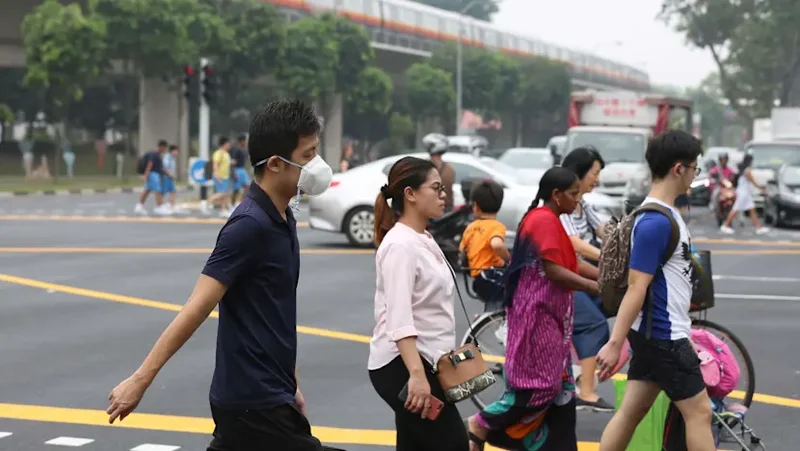
MOH, major retailers say N95 mask stocks sufficient to meet demand if haze worsens
The inter-agency Haze Task Force has advised retailers to monitor their stock levels and replenish supplies where necessary, as the country prepares for a rising risk of haze.
SINGAPORE: Major retailers in Singapore say they have sufficient stocks of N95 masks to meet demand if the haze situation worsens.
This comes as the country prepares for a rising risk of haze, with the inter-agency Haze Task Force engaging major retailers as part of its ongoing preparations.
The taskforce has advised retailers to monitor their stock levels and replenish supplies where necessary.
Singapore also maintains a government stockpile of N95 masks that can supplement retailers’ own supplies if needed.
Responding to CNA's queries, the Ministry of Health (MOH) said it regularly reviews Singapore's mask stockpile requirements to ensure the country is prepared, adding that there is sufficient stock.
Singapore is among several Southeast Asian countries facing a high risk of severe transboundary haze for the rest of 2026, according to the Singapore Institute of International Affairs. The think-tank said the risk is expected to peak between August and September, amid hotter and drier conditions.
In terms of severity, the National Environment Agency (NEA) said Singapore is likely to expect brief periods of haze this year, rather than a prolonged duration.
"At this point, we are expecting the current season to be more comparable to the recent El Nino event in 2023, as compared to maybe the past severe events in 2015," said Mr Lesley Choo, director of NEA's Weather Services Division.
He said the El Nino phenomenon began around July this year, similar to 2023. In contrast, the El Nino event associated with the severe haze in 2015 began around April.
El Nino is a naturally occurring climate pattern marked by unusually warm ocean surface temperatures in the central and eastern Pacific Ocean, resulting in hotter weather across the region, with less rain and drier conditions.
The number of hotspots detected so far is also comparable to 2023, and "quite significantly lower" than in 2015, Mr Choo added.
MONITORING THE SITUATION
Regional haze monitoring by the ASEAN Specialised Meteorological Centre (ASMC) is currently at alert level 2, with assessments carried out daily instead of weekly under alert level 1, the lowest tier.
Under alert level 2, national monitoring centres and focal points of member states of the ASMC exchange daily updates on hotspot numbers, fire locations and measures taken to tackle fires.
NEA's Mr Choo said various conditions, including the number of hotspots, current wind conditions and risk of transboundary haze, are among factors being monitored.
"For now, I think because there is still considerable activity over parts of the region, we are at alert level 2. We will definitely monitor to see whether the situation worsens," he added.
Efforts are also being made to tackle the problem at its source. These include bilateral agreements signed on environmental cooperation, including transboundary haze pollution.
SUFFICIENT STOCK
Watsons Singapore said it maintains a steady supply of masks across its retail network and online platforms, and works with established suppliers to ensure availability.
The pharmacy chain said it does not foresee any supply concerns for now, and that there are no purchase restrictions in place.
“As part of our regular contingency planning, we continuously monitor stock levels and customer demand patterns, and are ready to respond as needed,” it said.
Similarly, Guardian said it has sufficient stocks of N95 masks and would be able to replenish supplies at its stores within three days if needed.
“We are monitoring the situation closely with guidance from the relevant government agencies, including the haze taskforce, to support any haze countermeasures,” it added.
FairPrice Group also said it has sufficient stocks of N95 masks across its stores to meet customers’ needs, and will continue to monitor demand and replenish supplies where necessary.
“We are committed to ensuring that our customers have access to essential items, especially during periods of heightened concern,” said a spokesperson.
“We encourage customers to purchase only what they need for personal use, so that N95 masks remain available and accessible to everyone who needs them.”
CNA understands that major retailers were asked by the Haze Task Force to top-up supplies of masks months prior, as early as April.
In September 2019, major retailers asked for around 260,000 N95 masks from the government's stockpile to supplement their own supplies, as masks ran low at some retailers amid increased demand and consumers stocking up for personal use.
DEMAND APPEARS MUTED
Despite retailers’ assurances on overall supplies, a quick check of six outlets across four retail brands in Holland Village last week found N95 masks available at only one shop, which had a single box of 20 pieces for sale at around S$42 (US$33).
At Clementi Mall, two of four retail brands stocked either N95 or KN95 masks for sale, though only a handful of boxes were visible.
The limited availability on store shelves, however, does not necessarily point to a wider supply shortage, with N95 masks still available through online channels, said experts.
Demand also appears muted for now, with some shoppers telling CNA that buying N95 masks was not yet an immediate priority.
One shopper said she still had several masks at home but was reluctant to stock up excessively after having to dispose of unused masks bought previously.
“For the current situation, I think it's come and go,” she said, adding that her household had ordered an air purifier online as a precaution in case conditions worsen.
IMPACT OF HAZE
Prolonged exposure to poor air quality can have far-reaching implications for health, business operations and travel, said experts.
Short-term exposure to these air pollutants can trigger respiratory symptoms and worsen existing heart or lung conditions, they said. Particulate matter can also irritate the eyes, nose and throat, even in healthy individuals.
Dr David Teo, regional medical director of Asia at health and security risk management firm International SOS, told CNA’s Singapore Tonight that staying indoors during periods of haze can reduce exposure to poor air quality, but it does not eliminate the risk.
“Unless the windows and the doors are shut tight, (the polluted air) can still enter the house and cause an issue to the people working from home,” he added.