Lyttelton Port announces $821m expansion
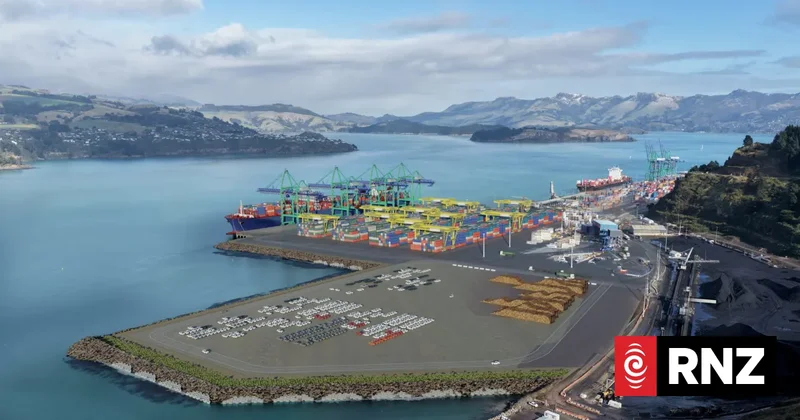
Lyttelton Port Company will spend $821 million expanding its container terminal and building a new 388-metre deepwater wharf at Te Awaparahi Bay.
The company said the project would help meet growing demand from South Island exporters and accommodate bigger ships.
The announcement follows Christchurch City Council's investment arm Christchurch City Holdings' July decision to reject an unsolicited proposal by global port operator DP World and three Canterbury rūnanga to lease the port's operations.
The expansion plans include a five-hectare container terminal, four new ship-to-shore cranes and semi-automated gantry yard cranes, with the work expected to be complete by 2031.
Watch a live stream of the announcement here:
Lyttelton Port Company (LPC) chair Barry Bragg said it was a significant step for the port, Christchurch and the South Island economy.
"We've spent the last decade rebuilding and strengthening the port. Today's announcement is about creating the capacity, resilience and capability needed for the next generation of South Island trade," he said.
CCHL chair Bryan Pearson said the project would be funded with debt and equity from CCHL.
"CCHL's investment into the infrastructure in support of South Island businesses, exporters and economic growth will be around $300 million. The rest of the project will be funded by LPC," he said.
LPC chief executive Graeme Sumner said the need for investment was clear, with ageing infrastructure, growing demand, larger ships and increasing export volumes.
"The resilience of some of the container berths is a major driver for the project. Rebuilding them would take at least three years and significantly disrupt container operations," he said.
"Building the Te Awaparahi Bay expansion removes the need to rebuild these wharves and allows the port to continue operating at full capacity."
The new terminal would feature semi-automated gantry yard cranes, helping the port handle more containers in less space, improving the speed and reliability of terminal operations and supporting safer, more efficient container movements, the LPC said.
More than $7.5 billion of exports left Lyttelton Port in financial year ending June 2025, according to the port's annual report.
The LPC said customers would pay more to use the Lyttelton container terminal as a result of the upgrades.
To protect Hector's dolphins during marine piling works, the company said it would implement trained observers, exclusion zones and gradual "soft starts" to warn dolphins of increased noise.
'A significant amount of debt'
In July protesters concerned about potential port privatisation rallied outside CCHL's Cambridge Terrace office, emphasising their call to keep the port in public hands.
Rail and Maritime Transport Union Lyttelton branch secretary Mark Wilson told RNZ the port company's $800 million expansion plans remained a concern, despite CCHL's decision not to proceed with the Tōnui consortium's bid.
"We have concerns around the potential of holding on to a significant amount of debt on to a company, with someone else coming on later on and saying lets partially privatise this to get rid of the debt. That's generally how things go. We're not saying no but we're saying you need to involve mana whenua, you need to involve the community, you need to involve Christchurch in this," he said.
In a statement announcing CCHL's decision, Pearson said the council's 2026/2027 letter of expectation to CCHL did not support leasing the port and encouraged retention of a directly employed workforce.
"Our assessment of the proposal, as presented, is it does not meet the threshold for ongoing consideration and is not sufficiently compelling to warrant further detailed investigation by CCHL, or additional consultation with council given its letter of expectation," he said.
Tōnui spokesperson Dr Liz Brown told RNZ the consortium's proposal would have retained public ownership while bringing together Christchurch, three Ngāi Tahu papatipu rūnanga and one of the world's leading port operators in a partnership that shared investment, risk and international expertise.