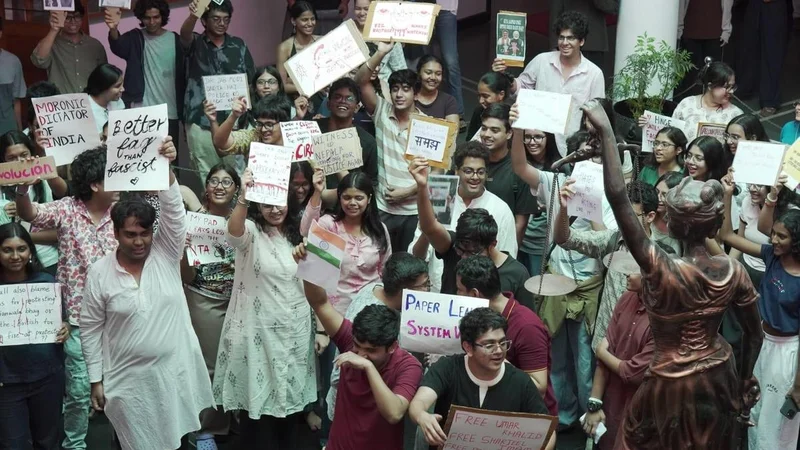
When students at NALSAR University of Law sat down to draft an email to their administration in early August, asking their university not to invite the Chief Justice of India, they did not think they were starting a national argument about the limits of dissent inside India’s legal profession.
Within two weeks, that request had reached the Supreme Court itself, drawn in the country’s top law regulator, and prompted an extraordinary rebuke from the sitting Chief Justice.
“It was meant to be an internal communication with the admin of NALSAR,” said Priya, a pseudonym for a 2026-batch NALSAR graduate who agreed to describe the episode on condition of anonymity. “We just wanted to, you know, not invite him and just talk to us. And that was ignored.”
The dispute has folded in questions well beyond one convocation: how far the right to protest extends to students training to become officers of the court, whether India’s bar regulator has authority over people who are not yet advocates, and what happens when criticism of the judiciary collides with the reverence traditionally expected of it.
The trigger, Priya said, traced back to remarks Chief Justice Surya Kant made from the Bench in the preceding months: a comparison of certain young people to “cockroaches” in May, and, in July, a refusal to view video evidence of an alleged police crackdown on student protesters at Delhi’s Jantar Mantar. The CJI later said the cockroach remark was taken out of context, aimed at people using fraudulent degrees to file harassing litigation, not at unemployed youth broadly. By then, though, the phrase had become the rallying cry of a youth movement calling itself the Cockroach Janata Party, and footage the court declined to watch had circulated widely online.
“We as law students, as people who believe in the Constitution, if the highest legal authority is saying we don’t have the time to watch videos on police brutality, that went against everything we stood for,” Priya said.
So NALSAR’s graduating students wrote to the administration asking it to reconsider its customary invitation to the CJI, who serves as ex-officio chancellor of India’s National Law Universities, as chief guest at convocation. Priya said the letter got no reply. “Then someone leaked the whole thing to the media, and then it became a whole thing,” she said. By mid-August, national outlets had picked up the story. Then, on August 13, the Bar Council of India (BCI), the statutory body regulating legal education and admission to the profession, escalated it into something else entirely.
Controversial ban
BCI Chairman Manan Kumar Mishra, a senior advocate, sitting Rajya Sabha member from the Bharatiya Janata Party and the council’s chairperson since 2014, directed every State bar council to withhold enrollment from NALSAR’s entire 2026 graduating class, roughly 1,400 students, pending an inquiry into the protest, and sought a report identifying those who had organized it.
“It was a six-page letter saying that we should not be enrolled,” Priya said. “It made us into people who are not expressing their dissent in a country with free speech. Rather, it turned us into organizers and conspirators.”
Roughly 450 of the 1,400 graduating students had taken part as per reports yet the BCI’s order applied to all of them. “So you would bar all of 1,400?” Shashank Maheshwari, an assistant professor of constitutional law at Jindal Global Law School questioned the order. “And on what grounds?”
The backlash was swift. Within hours, the BCI issued a second circular saying the “vast majority” of the batch were innocent and would be allowed to enroll after all, while keeping alive an inquiry against unnamed faculty and “outsiders” alleged to have instigated the protest. Mr. Mishra dropped that inquiry too, in a further communication issued in the early hours of August 14, after continued criticism from bar associations, alumni and legal commentators.
Priya said the walk-back did not fully resolve the students’ objections, since the second letter cast them as people who had been misled rather than as citizens exercising their own judgment. “You just did not deal with our dissent on its merits,” she said, “but you rather thought that we have just been naive people.”
A regular overstepping its brief?
Legal experts interviewed for this story largely agreed that whatever the merits of the protest, the BCI had no lawful basis to threaten enrollment over it.
“There is only Section 24A of the Advocates Act, which talks about disqualification for enrollment,” Mr. Maheshwari said, citing the statute’s narrow grounds: a criminal conviction involving moral turpitude, a conviction under India’s untouchability law, or dismissal from state employment on similar grounds. “The whole act works on the premise that someone has been convicted. Here, BCI acted totally opposite.”
Sanjay Hegde, a senior advocate at the Supreme Court, called the chairman’s letter an act outside the council’s authority altogether. “The Bar Council does exercise jurisdiction over standards of education and law colleges, but it certainly exercises no jurisdiction over debates or any controversies therein,” Mr. Hegde said. “Collective punishment of an entire batch is unknown to Indian law. The chairman appears to have written that letter as a frolic of his own.”
He rejected the idea that students, not yet enrolled as advocates when they protested, could face professional discipline for it. “They have not entered the profession,” Mr. Hegde said. “The Bar Council has no jurisdiction at all.”
The Supreme Court effectively agreed. Hearing the matter days later, a Bench led by CJI Surya Kant himself questioned the BCI’s authority to intervene. “Who are they to unnecessarily raise an issue? This is totally uncalled for. BCI has nothing to do with this,” the CJI said from the Bench, according to Live Law. The court issued an interim order shielding NALSAR students and faculty from further punitive action and gave the BCI two weeks to explain its circulars, even though the council said they had already been withdrawn.
Free speech or a line crossed?
The case ultimately turns on a constitutional question: how much license students, and future lawyers especially, have to publicly object to the conduct of a sitting judge.
Mr. Maheshwari placed the protest squarely within Article 19(1)(a), which guarantees freedom of speech and expression, including peaceful protest, and drew a comparison to an earlier precedent: when students at Jawaharlal Nehru University raised black flags against then-Prime Minister Manmohan Singh during a campus visit, no disciplinary action followed because, as Mr. Maheshwari put it, “they didn’t misbehave with him, they didn’t talk any nonsense about him.”
“Students, whether they study law, medicine, journalism or anything, are entitled to protest,” Mr. Hegde said. “It can’t be that there are holy cows that are beyond criticism. There are no holy cows in this country.”
Mr. Maheshwari separated legality from the merits of the students’ underlying position, a distinction he said the controversy tended to blur. “Whether their demands were right or wrong, that’s something to discuss separately,” he said. “But if they are saying this person shouldn’t be present, I think that’s fine, and it’s covered under constitutional law.”
Both acknowledged the profession’s traditional self-image as a “pious” calling requiring higher conduct, but argued that standard cannot stretch to bar peaceful, non-defamatory dissent. A student who raises concerns about a constitutional functionary without personally targeting him, destroying property or causing harm has not committed misconduct, Mr. Maheshwari said. “Even for law students, they can’t be punished.”
Asked to distinguish, as a legal matter, between criticizing a Chief Justice’s conduct and disrespecting the office itself, a line the BCI’s original letter appeared to blur, Mr. Hegde dismissed the distinction outright. “There is no holy office in India,” he said. “You cannot impose any penalty for criticism per se.” Neither lawyer suggested the campaign had crossed into defamation, or implicated contempt of court, which in India generally requires conduct that scandalizes the judiciary or obstructs justice, not advocacy over a guest list.
An apology, but not the end
The episode’s latest turn came over the weekend, when Mr. Mishra publicly apologized to law students nationally, acknowledging his characterization of NALSAR students as “instigated” by teachers and outsiders had caused “concern and anguish.” He wrote that law students are “among the most informed and discerning young citizens of the country,” reversing his earlier framing of them as needing protection from outside influence.
Priya said an apology had, in fact, become the students’ central demand once the enrollment threat lifted. NALSAR’s Student Bar Council issued a formal statement seeking one, as did alumni in a separate letter. “That has been met with right now,” she said.
Whether the episode closes there is unclear. The Supreme Court has given the BCI two weeks to respond in writing, and a separate petition now before the court seeks structural changes to the regulator, including fixed terms for its office-bearers, a pointed response to Mr. Mishra’s decade-plus, seventh-term tenure atop the council. Voices from the Cockroach Janta Party, the movement whose name originated in the CJI’s own remarks, have called for his resignation.
For Priya, the episode’s significance lies less in its resolution than in what it exposed. “It just says a lot about the state of free speech in the country right now,” she said. “It was a peaceful dissent. To make it into such a big issue, and to threaten our careers on the basis of that, was something we just did not expect.”
Published - August 17, 2026 08:00 am IST