New Zealand taxes the industrial emitters of greenhouse gases.
This happens through the Emissions Trading Scheme (ETS) whereby emitters must purchase ETS units and surrender them as they produce certain levels of greenhouse gases.
And where industrial emitters’ largest input costs are also subject to the ETS, energy for example, the cost increase is much magnified.
The problem of leakage occurs when imports from jurisdictions without a similar tax on emissions undercut New Zealand industry, with plenty of undesirable results.
Companies shift their production offshore to reduce costs. They go out of business.
And they end up at the Government’s door looking for exemptions and other forms of help, often resulting in the bizarre sorts of situations whereby the Finance Minister giveth with one hand and taketh away with the other. Enter Nicola Willis and Golden Bay Cement.
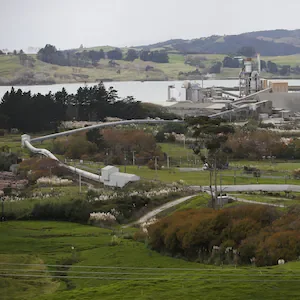
Finance Minister Nicola Willis called the Government's $60m handout to Golden Bay Cement a "one-off". But the problem that sits behind it endures. Photo / Mark Mitchell
It’s true Golden Bay receives an “industrial allocation” of ETS units free of charge to help ameliorate its situation.
But this is adjusted lower every year as the policy is “phased down” and the relief it provides is steadily reducing.
The business relies on high-intensity heat production processes. And that heat, from coal and electricity,is made expensive in considerable measure because it’s also subject to the additional costs of the ETS; such costs are either much lower or non-existent for cement imports from places such as Vietnam and Japan.
None of this reflects well on the Government, which is insisting the Golden Bay Cement problem and the $60m solution are one-offs.
While it may be the case that cement is among a few domestic industries that are systemically important to the economy and also reduced to a single, imperilled producer, it’s also true that high energy prices are driving a host of industries into retreat and insolvency.
Take pulp and paper mills. The Government’s answer to their struggles has been to make piecemeal choices to help the odd one and leave the remainder to the balance sheet-destroying mercies of high energy costs.
Japan-based Oji Fibre Solutions, for example, has applied to the Regional Infrastructure Fund for money to keep its Kinleith pulp mill going and funds have been ring-fenced for this purpose, though the amount is not disclosed.
Oji’s Kinleith papermaking operation has already closed, 255 jobs went with it, and the company has moved to a “paper import model” for its packaging.
Yes, that’s exactly as it sounds. Oji has replaced New Zealand-made paper in its packaging with paper it brings in from mills in Australia and Malaysia.
The team at Paper Machine 6 on their final shift before the closure of Kinleith Mill. Photo / Brian Loveday
The mills have suffered inflation across a range of costs, including labour. But energy costs, including electricity and natural gas (both subject to the ETS, and natural gas subject to the additional problem of supply uncertainty), have been described as an “existential threat”.
New Zealand chemicals producers are also in the firing line. It’s not a sexy business but before you hasten its departure, consider that products such as quicklime are essential for water treatment, especially wastewater, and needed to treat the runoff from everything from mines to dairy farms. It’s also used to treat human waste.
Work done over five years ago for the then Ministry for the Environment, which oversaw climate policy, advised that New Zealand’s quicklime producers (also known as burnt lime), were vulnerable to the market distortions of emissions pricing; lime is produced through the application of very high heat to limestone.
The country’s two main producers, Graymont NZ (Canada-owned) and Websters, have hung on. How long will that continue when numerous producers in Asia-Pacific make lime with no associated carbon cost?
The coalition Government may duck criticism because it’s a problem the Labour Government also failed to solve.
In 2021, then Finance Minister Grant Robertson and Revenue Minister David Parker considered a “carbon border adjustment mechanism”, essentially a tariff on imports not subject to the same “climate pricing” as New Zealand industry.
They even considered the cement sector as a case study, chosen because it was expected to be among the first of the emissions-intensive, trade-exposed industrial dominoes to fall.
Labour ultimately abandoned the idea of a tariff to plug the holes in the ETS, which, for all its lofty aims, continues to subject domestic industries to unfair competition from many jurisdictions abroad. Perversely, it’s a problem that frequently increases net global emissions.
The tariff would run contrary to New Zealand’s strong inclination towards free trade. But it’s not the only possible remedy.
The industrial allocation of free ETS units can be increased; there’s nothing intrinsically right about the current settings.
Another option would be to remove energy from the ETS, as the input cost that has the most pervasive effect on the price of industrial production, especially in heavy industry.
The Frontier Economics report got partway there when it assessed the New Zealand electricity market for the current Government last year and recommended the removal of electricity from the ETS.
There would be trade-offs, obviously, which ministers baulked at, and they opted to kick the can down the road again. It came to rest in Whangārei on Monday, but it won’t stop there.
- Stay ahead with the latest market moves, corporate updates, and economic insights by subscribing to our Business newsletter – your essential weekly round-up of all the business news you need.