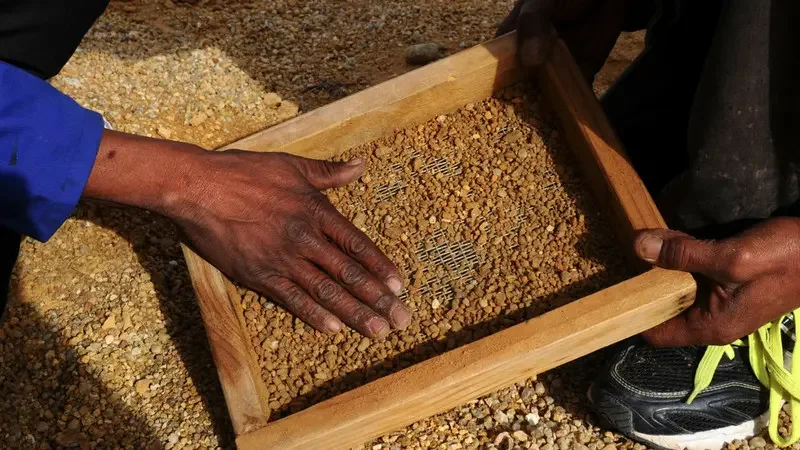
The Democratic Republic of Congo’s mineral wealth positions it as a central player in the global energy transition, supplying materials for electric vehicles, batteries, energy storage systems and renewable energy technologies.
African Development Bank (AfDP) noted some growth driven by exports and investment. Inflation fell to 8.0% in 2025, down from 17.7% in 2024. The AfDP attributed this to prudent monetary policy, which stabilised the economy and provided the nominal appreciation of the Congolese franc, and a decline in food prices.
The economic setback remains the security situation in the eastern front, where the government is spending a lot and battling rebels in a regional conflict that has caused thousands of deaths, prompting a budget deficit to rise to 2.6% of GDP, from 2.1% in 2024.
The DRC has been widely viewed as a prime example of a resource curse. But it appears that amid security concerns, a major government policy shift and drift towards stabilising the economy are priorities. There is a tangible effort towards creating a positive environment for a restive population bothered enough by endless military conflicts.
The gamer-changer in town are the DRC’s critical minerals increasingly sought due to a rising global demand, making the country a key supplier in international supply chains.
The DRC war, from the late 1990s into the new millennium, left scars of violence and corruption and a limping, underdeveloped and informal economy.
Leveraging on its critical minerals, DRC President Félix Tshisekedi has sent a signal to mining companies on the new terms of economic engagement in the country. This year, like other countries in the SADC region, among them Zimbabwe, the DRC made domestic mineral processing a must, providing the pillar of what they call “economic sovereignty”.
For decades, its mineral resources have been pilfered and its population exploited to develop the rest of the world, leaving nothing to show for anything from its rich belly. Two months back, marking the country’s 66th independence anniversary, Tshisekedi announced that he was making domestic processing of mineral resources a key pillar of its “economic sovereignty strategy”, underscoring the need to have copper, cobalt and gold refined in the country and banning the exportation of raw minerals.
The strategy echoes equally growing calls in West Africa against perceived Western exploitative tendencies that allow for the repatriation of resources, leaving the locals with nothing to show for it.
Prioritising investment in refining and battery-material plants over exports of unprocessed ore is high on the agenda. The underlying message and strategy is value addition and job creation.
This echoes Tshisekedi’s similar message on economic platforms such as the World Economic Forum earlier in the year, in which he emphasised mining partnerships based on fairness and sustainable value creation.
AfDP reports that the DRC public debt has remained sustainable, estimated at 18.1% of GDP. Further, its financial sector has also supported the economy with a 20% increase in lending to the economy and improved asset quality.
Hence, for now, it makes sense that after almost three decades of civil wars, to distil and understand the DRC economic growth through the lens of its extractive sector's growth and the impact on the broader economy.
The DRC's mining sector accounts for more than 90% of export earnings. China remains the main investor, eyeing its critical minerals to boost its own growth of electricity powered vehicles.
However, concerns abound around revenue leakages and the need for reforms in public finance and corruption. Also, political and military challenges in the eastern conflict can derail much progress and must be reconciled with its macroeconomic ambitions. If the security situation can be stabilised on the eastern front, there is inevitable potential for sustainable growth.
The DRC’s key critical minerals include cobalt, copper, manganese, zinc, germanium and industrial diamonds, which are essential for global energy, technology and manufacturing industries.
Despite security concerns, the DRC is the world’s largest producer of cobalt, a critical mineral for batteries, especially in electric vehicles. The major mining operations are taking place in the southern Katanga region and Lubumbashi, among others, which hold more than 60% of global cobalt reserves.
Moreover, copper mining, which is vital for renewable energy systems, is driving an economic boom in the Katanga Copperbelt, with Likasi, as the prime mining area zone, providing rankings of the country as one of the top global producers.
Manganese and zinc mining, also essential for batteries, is making a massive contribution towards global supply chains, elevating the status of the country as a major producer. Another critical mineral is germanium, which is used in semiconductors, and solar panels, supporting high-tech and renewable energy industries.
The DRC’s mineral belly is well endowed, simmering with minerals that are slowly transforming the country, registering economic growth and elevating the population accustomed to war, guns and atrocities. At least, becoming a central player in the global energy transition as international demand rises makes the country an important player in international supply chains.
Given that the critical minerals are indispensable for modern technology and clean energy, it’s difficult to ignore the status of the country playing a pivotal role in the global supply chain. With increased investments in its copper and cobalt mines, employment is set to grow. Close to 80 000 miners are employed by the large-scale mines, though most of them are artisanal miners.
The trick for Tshisekedi is reinvesting into infrastructure, health and restoring his country’s dignity and image battered after years of former president Mobutu Seseko’s ruinous policies and corruption.
Dr Brian Hungwe is a researcher in law, with interests in energy, innovation, IP and international criminal law.