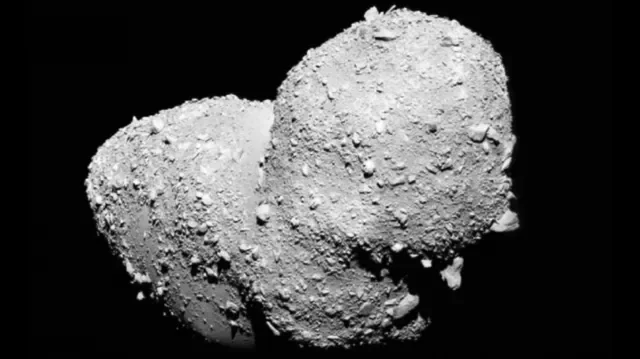
Across cosmic time and space, stellar systems form. This image shows the Orion Molecular Clouds, the target of the VANDAM survey. Yellow dots are the locations of the observed protostars on a blue background image made by Herschel. Side panels show nine young protostars imaged by ALMA (blue) and the VLA (orange). Protoplanetary disks not only are rich in organic molecules, but contain species that are not often seen in typical interstellar dust clouds. For several million years after the protostar phase completes and the star reaches equilibrium, circumstellar gas-rich material can persist. Credit: ALMA (ESO/NAOJ/NRAO), J. Tobin; NRAO/AUI/NSF, S. Dagnello; Herschel/ESA Molecular gas clouds contract, fragment, and portions of it collapse. This false-color look inside the star-forming region G333.23–0.06 shows ALMA data of multiple systems of high-mass protostars. Within these clumps of matter, ALMA has found multi-star systems, with singlet stars being a relative rarity. Credit: S. Li, MPIA / J. Neidel, MPIA Graphics Department; Data: ALMA Observatory Some fragmented regions form protostars, surrounded by a protoplanetary disk. This planet-forming protoplanetary disk, IRAS 04302+2247, is one of the closest examples of a protostar with a protoplanetary disk to Earth: just 525 light-years away. JWST reveals a streak of dusty gas that represents a protoplanetary disk, while the bipolar ejects shows protostellar material being blown away perpendicular to the disk. There is likely a combination of inflows and outflows occurring here, making it difficult to know how massive the star at the center will ultimately become. Credit: ESA/Webb, NASA & CSA, M. Villenave et al. After the star’s birth, imperfections within the disk rapidly grow and evolve. These figures show several different detection bands of the observations of WISPIT 2, revealing the protoplanetary disk and gaps within it, as well as the presence of a directly imaged planet about five times the mass of Jupiter: WISPIT 2b. Along the bottom row, five different detection images all reveal WISPIT 2b’s presence with the Very Large Telescope’s SPHERE instrument. Credit: R.F. van Capelleveen et al., Astrophysical Journal Letters, 2025 After another few million years, a planetary system typically results. This image, from ALMA, shows the protoplanetary disk around HL Tauri. The gaps within the disk correspond to the locations of newly-forming planets, and emit jets and outflows (not shown) associated with Herbig-Haro 150: part of the same system. Credit: ALMA (ESO/NAOJ/NRAO) At a variety of locations, “frost lines” enable ice-rich objects to develop. In a system dominated by a single protostar, there will be major regions defined by multiple lines, including the soot line and the frost line for each specific molecular species. Large initial imperfections in the disk will grow to form planets, but the various ices that form at various lines, away from those massive planets, will lead to the creation of belts consisting of large numbers small, ice-rich objects. This includes the asteroid belt between Mars and Jupiter and the Kuiper belt beyond Neptune in our own Solar System. Credit: NASA/JPL-Caltech/Invader Xan This leads to “belts” of material accumulating, with small, sub-planetary objects inside. A wide variety of telescopes have looked at the Fomalhaut system in a variety of wavelengths from both the ground and in space. Only JWST, so far, has been able to resolve the inner regions of the dusty debris present in the Fomalhaut system. Whereas Herschel, Hubble, and ALMA data all point to a picture with an inner disk and an outer belt, JWST’s capabilities reveal an “intermediate” belt in between the two. Unlike our Solar System, which has only the asteroid and Kuiper belts, this find was a total surprise. Credit: NASA, ESA, CSA, A. Gáspár (University of Arizona) et al., Nature Astronomy, 2023 In our own Solar System, we have two such belts: the asteroid and Kuiper belts. Here in our own Solar System, a single star anchors the system, where inner, rocky planets, an intermediate-distance asteroid belt, and then more distant gas giant planets eventually give way to the Kuiper belt and Oort cloud. Only around stars that have formed with a large enough fraction of heavy elements from the lives and deaths of previous generations of stars can rocky worlds, the only home for life that we know of, come into existence. Credit: NASA/Dana Berry Approximately 4.6 billion years have elapsed since those belts first formed. Although we now believe we understand how the Sun and our Solar System formed, this early view of our past, protoplanetary stage is an illustration only. While many protoplanets existed in the early stages of our system’s formation long ago, today only eight planets survive. Most of them possess moons, and there are also small rocky, metallic, and icy bodies distributed across various belts and clouds in the Solar System as well. Early on, more planets and protoplanets were likely present; the eight that we possess today only represent the long-term survivors. Credit: JHUAPL/SwRI Over time, many objects have gravitated and merged: growing quite massive. The dwarf planet Ceres, shown here, is the largest world in the asteroid belt and the only one known, for certain, to be in hydrostatic equilibrium. Discovered in 1801 by Giuseppe Piazzi, it was originally classified as a planet: then the Solar System’s 8th, and is known today to represent about 40% of the asteroid belt’s total mass. Credit: NASA/JPL-Caltech/UCLA/MPS/DLR/IDA But most objects remain small, only experiencing random, chance encounters. This shows a montage of comets and asteroids visited by various spacecraft (annotated), showcasing their differences in color, size, and albedo, or reflectivity. Below, a graph from recent Gaia data tracks the number of asteroids sorted as a function of diameter and reflectivity, with a big “spike” in the reflectivity distribution appearing due to the carbonaceous asteroids at low reflectivities. Objects must be at least a few hundred km across to reach hydrostatic equilibrium: to have their shapes primarily determined by gravity and rotation. Credits: NASA / JPL / Ted Stryk; ESA / OSIRIS team; NASA / JHUAPL / Ted Stryk; NASA / JPL / UMD; NASA / JPL (top); J. Ge et al., Astrophysical Journal Supplement Series, 2025 (bottom) These ice-rich objects are sometimes called dirty snowballs: composed of rock and ice mixes. This image shows the nucleus of Halley’s Comet from the last time it visited the inner Solar System in 1986, when the ESAs Giotto probe flew by it and took this photograph from a distance of just 2000 km. The Sun, to the left, heats the comet’s nucleus which leads to offgassing and the release of dust. The model of a comet nucleus is typically as a “dirty snowball,” a mix of ice-and-rock, and that model, albeit with a different set of volatile ices, applies to many asteroids as well. Credit: ESA/MPS In theory, when these snowballs collide, they should fuse together: forming contact binaries. This animation shows a rotating shape model of contact binary asteroid 216 Kleopatra, based on a series of ground-based observations from which the shape model was inferred back in 2018. 216 Kleopatra is one of nearly 100 bodies confirmed to be a contact binary in our Solar System, with nearly 100 additional candidate contact binaries presently known. Credit: RunningNonsenseMan/Wikimedia Commons We’ve now discovered many objects that appear as contact binaries, including: This view of asteroid Donaldjohanson was acquired by NASA’s Lucy spacecraft, and assembled out of two stereo images taken 72 seconds apart. The thin, darker colored neck and the two bulges on either lobe of the body give away its nature as a contact binary object. Credit: NASA/Goddard/SwRI/Johns Hopkins APL/Brian May/Claudia Manzoni Donaldjohanson, visited by Lucy, This image of the contact binary asteroid Torifune is the only image ever acquired that spans more than one pixel: captured by the Hayabusa 2 mission. Up until this image was taken, we did not know whether Torifune was a single, extended object or a contact binary. With this direct, in situ image, we now know it’s a contact binary, formed by the fusion of two predecessor bodies. Credit: JAXA, The University of Tokyo, Chiba Institute of Technology, Institute of Science Tokyo, AIST, Paris Observatory, IAC Torifune, visited by Hayabusa 2, This image, acquired from the New Horizons space mission’s LORRI imager, showcases the Kuiper belt object Arrokoth, showing its clear contact binary shape. Arrokoth was formed by two predecessor bodies that interacted and fused together, giving it its present snowman-like shape. Credit: NASA/JHUAPL/SwRI/Roman Tkachenko Arrokoth, visited by New Horizons, Comet 67P/Churyumov-Gerasimenko was imaged many times by the ESA’s Rosetta mission, where its irregular shape, volatile and outgassing surface, and cometary activity were all observed. The comet’s nucleus itself would have to have been much larger and more massive to be pulled into a “round” shape by self-gravitation; instead, it is an example of a contact binary. Credit: ESA/Rosetta/MPS/UPD/LAM/IAA/SSO/INTA/UPM/DASP/IDA and Churyumov-Gerasimenko, visited by Rosetta. This series of 10 images of asteroid belt object 44 Nysa helped identify Nysa’s highly concave and irregular shape. It contains numerous large craters and basins. The asteroid has a rapid rotation period of 6.4 hours and is the largest and brightest E-type asteroid: rich in enstatite. Credit: K. Minker et al./EDP Sciences/ESO Asteroid Nysa, discovered in 1857, is our first trilobed object: a contact trinary. The primary component of the Nysa system, asteroid 44 Nysa, is shown at the center of this image, as constructed with a series of observations from the Large Binocular Telescope. Indicated with a pink arrow in the upper left is a natural satellite of Nysa: one of many examples of an asteroid or Kuiper belt object with a satellite of its own. Credit: K. Minker et al./EDP Sciences/ESO These relics provide compositional glimpses into our pre-solar nebula. The relative abundances of elements in the Solar System has been measured overall, with hydrogen and helium the most abundant elements, followed by oxygen, carbon, and numerous other elements. However, the compositions of the densest bodies, like the terrestrial planets, are skewed to be a vastly different subset of these elements. Hence, it’s by measuring the oldest, most primordial objects, things like asteroids, Kuiper belt objects, and Oort cloud objects, that we gain our most powerful window into the composition of the pre-solar nebula. Credit: 28bytes/English Wikipedia Mostly Mute Monday tells an astronomical story in images, visuals, and no more than 200 words. This article “Dirty snowballs” have joined together since the planets formed is featured on Big Think.
“Dirty snowballs” have joined together since the planets formed