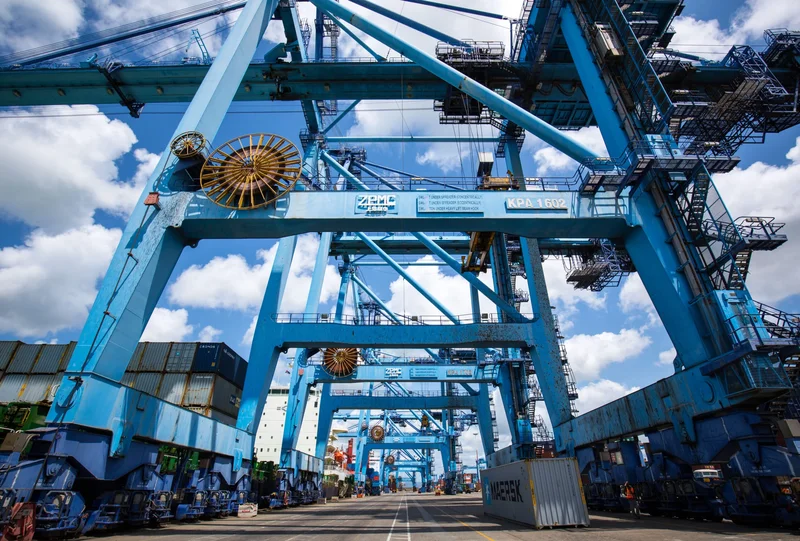
China Now Supplies a Quarter of Kenya’s Imports
KENYA · ECONOMY
China Kenya imports set a record
Kenya bought Sh336.2bn of goods from China between January and May, about US$2.60bn at the May average rate of 129.40 shillings to the dollar. That is 34.7% more than the same five months of 2025.
Set against a total import bill of Sh1.33 trillion, roughly US$10.28bn, it gives China 25.3% of everything Kenya imported. The share has climbed steadily, from 16.6% in 2023 to 19.1% in 2024, 22.5% in 2025 and 25.3% in January to May 2026.
There is a sharper way to put the same point. Kenya’s import bill grew by Sh220.3bn (about US$1.70 billion at 129.24 shillings to the US dollar on 17 August 2026) over the year, and Sh86.6bn (about US$670 million) of that increase came from China alone.
China, in other words, accounted for 39.3% of the entire growth in what Kenya buys from the world. No other trading partner is close.
The explanation on offer does not fit the calendar
Business Daily, reporting the same KNBS release, attributed the surge to three Chinese-built projects: the Rironi to Mau Summit highway, the railway extension towards the Ugandan border, and the Talanta stadium.
The dates get in the way. Presidents William Ruto and Yoweri Museveni flagged off the Naivasha to Kisumu to Malaba railway extension on 21 March, but civil works only began on 1 July, in Narok, a month after this data period closed.
The stadium is further along than the story requires. The Controller of Budget put it at 90.44 percent complete in July, meaning its heavy import phase ran through 2024 and 2025, not this year.
Only the Rironi to Mau Summit road genuinely overlaps, and early earthworks do not import Sh86.6 billion (about US$670 million) of goods. It is a toll concession worth Sh96bn (about US$743 million) in its first phase, held 60% by China Road and Bridge Corporation and 40% by Kenya’s National Social Security Fund.
What the category data says instead
The statistics office publishes imports by category, and the category that mega-projects consume is not the one growing. Machinery and other capital equipment came to Sh175.7bn (about US$1.36 billion), just 13.2% of the total bill.
Its share is falling, not rising. In May it was 11.2% of the month’s imports, down from 16.3% in December 2025.
The category that exploded is fuel. Petroleum products and lubricants hit Sh122.3bn (about US$946 million) in May alone, 37.4% of that month’s imports, against Sh53.1bn (about US$411 million) in April.
That is a story about energy prices and stockpiling, not about concrete and cranes. The China Kenya imports headline is accurate; the causal explanation attached to it is not.
The momentum may already be turning
One further figure complicates the trend line. In May itself, China’s share was 22.2%, below the five-month average rather than above it.
India, meanwhile, more than doubled its sales to Kenya, from Sh26.9bn (about US$208 million) to Sh55.1bn (about US$426 million). A single month proves nothing, but it is not the shape of a share that is still compounding.
Why this matters beyond Nairobi
A quarter of the import bill from one supplier is a dependency, whoever the supplier is. It shapes what Kenya can say in a trade negotiation and what it can afford to refuse.
The useful question is not whether Kenya is drifting towards Beijing. It is whether Nairobi’s own statisticians are being read carefully enough by the people writing the strategy.
Frequently Asked Questions
What share of Kenya’s imports now comes from China?
China supplied 25.3% of Kenya’s imports in the first five months of 2026, according to Kenya National Bureau of Statistics data. That is up from 22.5% a year earlier and 19.1% in 2024.
How much did Kenya import from China in 2026?
Imports from China reached Sh336.2bn, about US$2.60bn, between January and May 2026. That was 34.7% more than the same period a year earlier.
Is Kenya’s import surge caused by Chinese infrastructure projects?
The timing does not support that explanation. Civil works on the railway extension only began on 1 July, after the period closed, and the Talanta stadium was already about 90% complete by July.
What is actually driving Kenya’s import bill?
Fuel is. Petroleum products and lubricants reached Sh122.3bn in May alone, 37.4% of that month’s imports, while machinery and capital equipment fell to 11.2% of the monthly bill.
This article was produced by The Rio Times’ automated newsroom system. How we use AI · Report an error
LatAm Markets: Live Signals → — real-time movers, turnover leaders and FX across Latin America.