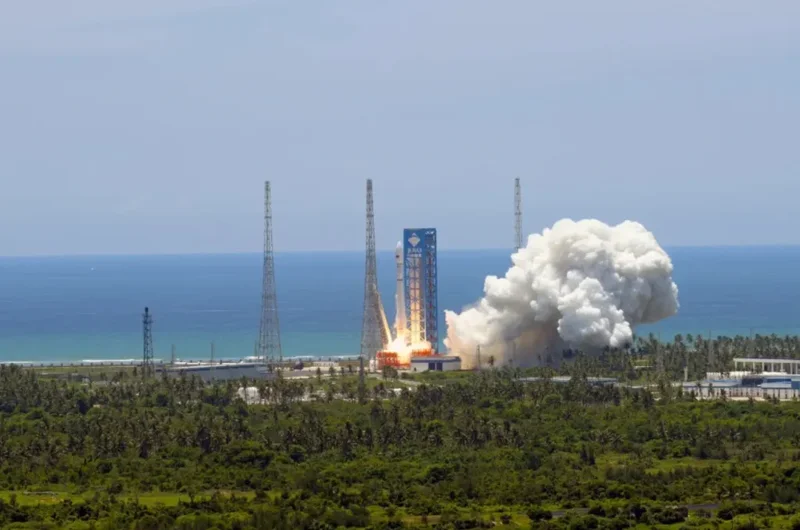
HELSINKI — China launched a new batch of Guowang megaconstellation satellites over the weekend, following up with a separate launch of a developmental satellite for the UAE.
The launch of the Long March 12 notably came under a week after the explosive failure of a Long March 7A rocket, suggesting that the issue was not related to the YF-100 engine family; an outcome which may have had a substantial and cascading effect on major Chinese programs.
The Long March 12 lifted off at 12:10 a.m. Eastern (0410 UTC) Aug. 16 from pad 2 at the Hainan commercial space launch center, southern China. The China Aerospace Science and Technology Corporation (CASC) announced launch success, revealing the payload to be a new batch of satellites for the Guowang constellation.
The satellites are the 24th operational batch launched for Guowang, bringing the number of satellites in orbit for the program to 195, not including related experimental satellites. The satellites were built by CASC’s China Academy of Space Technology (CAST). In keeping with general programmatic opacity, no details nor images of the satellites were released. The program calls for around 13,000 satellites in low Earth orbit.
The launch was operated by CASC’s China Commercial Rocket, which uses the acronym CACL, which should not be confused with another commercially-focused CASC entity, China Rocket Co., which operates the Jielong solid rocket series.
The mission was the seventh launch of the standard, expendable Long March 12. CASC also operates the potentially reusable methane-liquid oxygen Long March 12A and kerosene-liquid oxygen Long March 12B launchers. Both have reached orbit on debut flights, but neither of the first stages were recovered.
It was also highlighted in local reports that the pad quickly switched from a 5-meter rocket to a 4-meter rocket—having supported the historic Long March 10B flight in early July—and underlined that the Long March 12 occupied the pad for just 2.5 days ahead of launch.
The successful launch of the Long March 12, which uses YF-100K engines, suggests that the anomaly which caused the Aug. 10 Long March 7A was not engine-related. The grounding of the Long March 7A will impact China’s plans and scheduling for geosynchronous and related launches, and—having inherited its third stage from the Long March 3B—could also have further implications for the country’s workhorse launcher for GEO. The 3B only recently returned to flight following a January failure.
SEO sat for UAE
China followed the Guowang mission with a launch for the United Arab Emirates later Sunday. A Long March 2C hypergolic rocket lifted off at 11:02 p.m. Eastern, Aug. 16 (0302 UTC, Aug. 17) from Taiyuan Satellite Launch Center, northern China.
The launch carried the “Satellite for Earth Observation” (SEO) for the UAE into orbit, according to China Great Wall Industry Corporation (CGWIC), a CASC entity charged with facilitating international launch contracts.
“The ‘SEO’ mission aims to develop advanced space technologies and represents an ambitious step toward utilizing space technologies to support sustainability and future development,” CGWIC stated. “The mission seeks to provide data and insights that contribute to environmental protection, natural resource management, and enhanced planning and decision-making efficiency.”
The satellite is a project of UAE University’s National Space Science and Technology Center (NSSTC), developed with the UAE Space Agency and Chinese partners. Late last year NSSTC’s hyperspectral Satellite 813 flew on a CAS Space Kinetica-1 rocket.
The Long March 12 and Long March 2C missions were China’s 58th and 59th launches of 2026, with the country understood to be targeting over 100 launches this year. The Zhuque-3 rocket could make a launch and recovery attempt in the coming days, while Galactic Energy’s Pallas-1 rocket could also debut from Jiuquan’s commercial innovation launch zone in the near future.