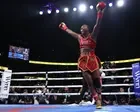
Over the weekend, more than 16,000 fans, including former and current world champions such as Floyd Mayweather, Terence Crawford, and Shakur Stevenson, filled State Farm Arena in Atlanta to witness Claressa Shields dominate Kaye Scott.
Shields made quick work of Scott winning by TKO in six rounds after unleashing a flurry of punches against the Australian, whose corner threw in the towel to stop the fight before more damage could be done.
The celebrity sightings, audacious music performances, and Shields’s pure class made it an entertaining night as the American took Scott’s middleweight world title. But no one will be asking for a rematch anytime soon.
Shields is in a peculiar position. She lacks knockout power – only four of her 19 wins have ended in KOs – but she is unbeaten and has won world titles across five weight classes to go alongside her two Olympic golds. She’s the most renowned figure in her sport, but lacks the type of fierce rival who would help her push women’s boxing forward.
Throughout the history of men’s boxing, rivalries have sparked intrigue, spurred animosity, and driven growth. Mayweather and Manny Pacquiao; Joe Lewis and Max Schmeling; Muhammad Ali and Joe Frazier; and Mike Tyson and Evander Holyfield were rivals who helped boxing thrive. In other sports, it becomes second nature to associate Larry Bird with Magic Johnson, Tom Brady with Peyton Manning, and Lionel Messi with Cristiano Ronaldo.
Women’s boxing needs a similar culture-shifting rivalry to reach its pinnacle.
After her victory over Scott – who is 42 and had only seven professional fights before Saturday – I asked Shields about whether the lack of an outstanding rival was a negative.
“I feel like it’s a blessing and a curse,” Shields said. “You’re never going to see another girl get into the ring and be 50-50 with me. It’s just not going to happen …God chose me to be No 1, and I train to be No 1. I don’t need another dance partner who is easy to beat because they’re all easy to beat. Right now, I’m in my Mike Tyson era. Everyone is showing up to the arena to see what Claressa Shields is going to do.”
Shields’s promoter Dmitriy Salita, pushed back on the notion that the 31-year-old has yet to face a worthy opponent.
“When [Shields] was 9-0, she became the undisputed middleweight champion by defeating Christina Hammer, who was 22-0 at the time,” said Salita. “Then she went to England and defeated [the 12-0] Savannah Marshall. Claressa has gone up and down in weight throughout her career. We line them up, and Claressa Shields knocks them down … No man or woman in this sport has the resume of Claressa Shields.”
It’s not just inside the ring where Shields dominates though. Her contemporaries have yet to equal her mastery of social media to initiate discussions that drive engagement online. When she’s not boxing, thousands are intrigued by her controversial remarks, her relationship with rapper Papoose, and her elaborate style. She understands how to create and embrace a major moment that instantly becomes viral.
Gabriela Fundora, and Mikaela Mayer, who could potentially be Shields’ next opponent, are accomplished fighters, but they lack visibility that extends beyond boxing. Katie Taylor is a massive star in her native Ireland and had an arch-rival in Amanda Serrano. But Taylor is 40, competed in a different weight class to Shields and will almost certainly retire after fighting in front of a huge home crowd in Dublin next month.
The closest potential for a groundbreaking matchup for Shields came with rumors of a fight against Muhammad Ali’s daughter, Laila. The two have sparred verbally for the past few years without an actual fight date being set. And even though Laila Ali owns a 24-0 record, if they did fight they would not meet on equal terms: Ali last fought in 2007 and is now 48, 17 years Shields’s senior.
But even without marquee opponents, Shields has commanded attention and helped push women’s sports closer towards the recognition they deserve. And perhaps no women’s league has enjoyed more growth than the WNBA in recent years. A day after Shield’s fight at State Farm Arena, more than 17,000 fans were at the same venue to watch Indiana Fever’s victory over Atlanta Dream.
After the game, I asked Fever star Caitlin Clark about the importance of rivalry.
“These are the games you get up for,” Clark shared. “That’s what’s fun about competition. You know, you want to play the best. It makes you better and it brings out the best in you.”
In recent seasons, the WNBA has benefited significantly from the intense rivalry between Clark and Angel Reese, drawing larger audiences, generating greater interest – not all of it welcome – and helping create the conditions where the league’s players were able to negotiate significant pay rises.
If Shields had an equally compelling counterpart, women’s boxing could make a similar leap in popularity.
“I think that everything is God’s timing,” Shields said after her win over Scott. “I knew that once the WNBA started making money, and I made $1m, I knew that women’s sports was changing. All of us are packing arenas. All of us have great brands. We have great fans who want to support us. And I think that women’s sports have always been very entertaining. It’s just that people try to talk down on our sports by saying the NBA is better than the WNBA, and men’s boxing is better than women’s boxing.
“If you really look at it, you will look at the sport and see women’s boxing is just as entertaining. We work just as hard. We love to play, we love sports. I don’t box because I want to be like a man, I box because I strictly love fighting. When you take out the stereotypes surrounding women’s sports, we just love to play. People are allowing us to play and allowing us to fight, and it’s very entertaining.”