Listen to this essay
22 minute listen
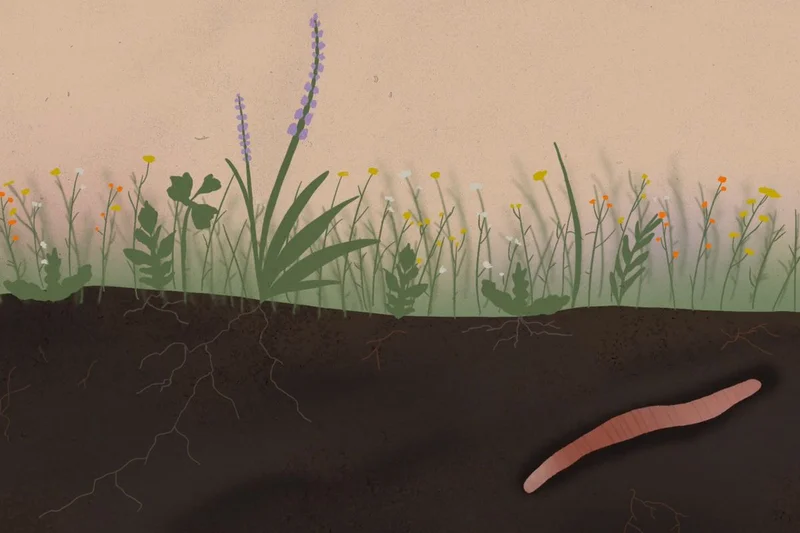
Earthworms do not have a discernible mouth, a means to make sound, or ears, and most spend their lives burrowing below ground, eating soil and decaying organic matter. However, their behaviours produce sounds, which can reveal a surprising amount about the subterranean world in which they live. I’ve recently found myself leaning over a box of soil in the basement of my university department, headphones clutched to my ears, revelling in the soft, Velcro-like scrapes of earthworms eating. It sounds like this:
I have always loved earthworms. As a child on my parents’ allotment, I delighted in finding them in the soil as potatoes were dug in, fascinated by their soft, alien form wiggling in my hand. Now, I amuse my friends by ducking down in crowds at music festivals to rescue distressed earthworms from being squashed by the mob of muddy boots.
Until recently, my scientific research focused on the rapid patter and chop of bat echolocation calls, monitoring how their populations were responding to largely human-driven environmental change. I didn’t consider that the same ecoacoustic approaches could be applied below ground, to understand how earthworms are affected by us surface-dwellers. Fortunately, others had. I finally had a way to connect my scientific research speciality with my ardour for earthworms in the soil.
Worm munch might seem like a curiosity, but it represents a much bigger change in how we understand nature. More than just the behaviour of single creatures, such sounds can also reveal the health of whole ecosystems – and the underground is emerging as a new acoustic frontier.
Sound itself is a wave, a travelling vibration. Vibrancy is a word often used to describe colour and life. A vibrant ecosystem, therefore, is one that hums with the sounds of life.
While reading this essay, you can listen to a 15-minute recording of various sounds of the underground, collected in Oxfordshire in 2024:
Monitoring nature’s sounds has a long history. The ancient Greeks wrote poems and plays about birdsong and, in medieval England, the sounds of local birds gave many places their names. Today, an expert ornithologist will stand in a forest and conduct a bird survey using nothing but their eyes and ears.
However, when bioacoustics researchers in the 20th century began to place microphones or hydrophones and recorders in the field for days, weeks or months – known as ‘passive acoustic monitoring’ – they discovered whole new natural soundscapes. This technique has been especially powerful in realms where humans cannot stay for long, or for species that emit infrasonic or ultrasonic sounds beyond human hearing range (20-20,000 Hz).
Underwater habitats, for example, are difficult for people to be immersed in for extended periods without specialist equipment and training (for obvious reasons). Thus, collecting data on animals like whales and dolphins, which can traverse vast oceanic distances, was historically done with sightings from land or boats. That changed with passive acoustic sensors.
Bats use the returning echoes of their ultrasonic calls to build a sonic map of their surroundings
In the 1950s during the Cold War, the US Navy developed its Sound Surveillance System (SOSUS), an underwater network of hydrophones with the purpose of tracking Soviet submarines in the Atlantic and Pacific oceans, originally code-named ‘Project Jezebel’. Arrays of hydrophones were deployed on the seafloor, connected via cables to the shore where the acoustic data could be monitored. While an original premise of this system was upheld – that enemy submarines would be easily tracked by their low-frequency sound signatures – the assumption that there would be little other noise in the ocean was not true. Sailors operating the SOSUS detected many other unknown sounds, including one they attributed to the ‘Jezebel Monster’. It took some years and the detective work of marine bioacousticians for this to be identified as the 20 Hz call of fin whales. Many other mysterious sounds began to be discovered, including the ‘boing sound’ and the ‘lightsabre sound’, both of which were also eventually attributed to minke whales. Since many cetaceans use sound for day-to-day activities – ranging from the low-frequency songs of blue whales to the whistles and high-frequency echolocation clicks of bottlenose dolphins – hydrophone technology has enabled these animals to be more fully understood as they move through the ocean.
Passive acoustic technology was similarly illuminating in demystifying bats and revealing one of their incredibly sophisticated evolutionary adaptations. Nearly all bats are nocturnal, relatively small, fly fast, and vocalise at frequencies mainly outside of human hearing, all of which makes them effectively invisible to people, or has caused them to be associated with evil and hence feared. Unless you’re looking for bats, you’re unlikely to notice them (although admittedly this is not true of larger fruit bats, which are hard to miss in parts of the world where they can congregate in cities in large numbers).
In the 1930s, the American physicist George W Pierce developed a method for detecting ultrasound using piezoelectric crystals and a sonic amplifier to study the ultrasonic sounds of birds and crickets. When the Harvard undergraduate Donald Griffin – who was convinced that bats were using sound for navigation – brought a cage of bats to Pierce’s lab, they discovered a cacophony of ultrasonic sound. Further research by Griffin and others revealed the full complexity of bats’ use of ultrasound, showing they used the returning echoes of their ultrasonic calls to build a sonic map of their surroundings, orienting themselves during rapid flight. Griffin termed this ‘echolocation’ – and ever since then it has allowed us to better understand the sonic world of the bat, which before was hidden in plain sight.
Although bioacoustic sounds have now been studied for decades, it’s only relatively recently that scientists have begun to use soundscapes to gauge ecosystem health, with the establishment of the field of ‘ecoacoustics’ in 2014. Ecoacoustics incorporates parts of bioacoustics, but also draws on the ideas of ‘soundscape ecology’, which traces back to the 1960s. As well as ‘biophony’ (animal sounds), ecoacoustics also incorporates geophony (sounds made by wind, rain, waves) and anthropophony (sounds made by humans or human activities).
A core principle of ecoacoustics is that complexly noisy natural places are healthier natural places. This means that it’s not just the volume of noise, but the diversity of sound that indicates habitat health. The dawn chorus in an intact Bornean tropical forest is magical in its complexity, especially if you’re lucky to experience it mixed in with the whoops of a troop of gibbons swinging through overhead, as I was during a visit in 2019.
In contrast, cities are generally not ecologically healthy and, while they are incredibly noisy places, they are filled with the harsh, more monotonous sounds of car engines and other machines, and often little biotic sound. Soundscapes dominated by anthropogenic sounds have been linked to poor mental health in people, whereas the opposite has been found for natural sounds like birdsong or forest soundscapes.
Carson demonstrated that the lack of spring’s dawn chorus in the US was due to the accumulation of DDT
A biotically silent landscape is a sign of nature collapse, as exemplified in Rachel Carson’s Silent Spring (1962):
Over increasingly large areas of the United States, spring now comes unheralded by the return of the birds, and the early mornings are strangely silent where once they were filled with the beauty of bird song.
Collating scientific research, Carson demonstrated that the lack of spring’s dawn chorus in the US was due to the accumulation of DDT, a synthetic pesticide. DDT caused the thinning of bird eggshells and thus reproductive failure. Without Carson publicising the alarm of a silent landscape, resulting in the eventual ban of DDT in the US, many bird species may have been lost.
While the ecoacoustics of forests or cities are relatively straightforward to monitor, the underground world is more difficult to access. Monitoring earthworms and other soil-based creatures presents a similar challenge to listening to whales in the deep ocean or bats in the dark sky: there’s only so much an ear to the ground can hear. Yet by inserting acoustic probes or burying hydrophones into the soil, it’s possible to hear the rustling cacophony of an ant’s nest, the clicks of beetle larvae communication, and the scrapes of earthworm engineering.
Before I began listening in earnest to the underground, I almost solely used passive acoustic sensors to record bat echolocation and social calls, gleaning information on which species were where, how they were using different habitats, and how human actions were impacting their populations. I grew comfortable in this ultrasonic world and could pick out bat calls almost instantly when listening to recordings (slowed down to bring them into our hearing range), looking at a spectrogram. Transferring these skills to the low, soft sounds in the soil has been somewhat of a sonic culture shock.
The first time I listened to a soil soundscape, it felt like taking my first steps into an alien world. I’d spent so many years focusing on identifying sounds above ground, and now I had a portal into this earthy realm and a whole new acoustic space. Much of our recordings contain periods of little noise or near silence, punctuated by the unpredictable shuffles of something moving or something eating. I began to feel like Jodie Foster’s character Dr Ellie Arroway in the film Contact (1997), spending hours listening, searching for signals to decode and link to a biotic source or anthropogenic activity. Instead of ticking off in my head what the sources of the sounds might be, I’m often perplexed, imagining what the faunal, or otherwise, origins of the scratches, sifts, drums and buzzes could be.
We found post-midnight peaks in acoustic activity when earthworms are most active in the soil, and higher diversity under rewilded grassland
Here are two examples, one of which sounds like a laser, and the other like something buzzing:
Soil is the foundation of many ecosystems above ground: the medium from which plants grow, and the basis of most food chains. However, it also comprises complex ecosystems itself, filled with a high diversity of fauna, from microscopic bacteria to carnivorous mammals, which impact soil structure, function and chemical composition. And we’re finding that a healthy soil is often a noisier one.
Early results from studies using passive acoustics to assess soil health in garden, forest and farmland ecosystems have proved promising. Researchers have found associations between forest recovery and ecoacoustic measurements of soil soundscapes, suggesting healthy soils do sound significantly different. In my own research, we are testing the use of passive acoustic monitoring for assessing soil health and the effectiveness of nature recovery approaches in UK grassland landscapes. Unlike previous soil ecoacoustic projects, we have collected continuous 24-hour recordings across our sites, which has revealed dynamic patterns in the soundscapes from day to night. We found post-midnight peaks in acoustic activity when earthworms are most active in the soil, and higher diversity under rewilded grassland, compared with intensively grazed cattle pasture. Concurrent to the ecoacoustic data, we conducted traditional soil biodiversity sampling, scooping up large and tiny soil-dwelling animals, such as earthworms, ants, woodlice, millipedes, beetles and insect larvae. Earthworms made up most of the soil invertebrates, and we believe their movements are contributing significantly to the soil soundscape.
Why? Earthworms are soil ecosystem engineers. Their burrows change the soil structure, and different types of earthworms have different burrowing behaviours – vertical or horizontal, deep or shallow – which allow air and water to flow. Earthworms also break down dead plant and animal matter into smaller pieces, which are fed on by bacteria and fungi, releasing nutrients that would otherwise be trapped. That’s why counting earthworms is a common method for assessing soil health in agricultural settings.
To meet internationally agreed goals for biodiversity restoration, we need systematic and standardised ways to monitor soil health. Traditional techniques require costly manual effort, followed by laboratory analysis for chemical indicators, such as pH and nutrient availability, or physical indicators, such as water-holding capacity, texture and compactness, or biological indicators, such as soil enzymes, microbial biomass and diversity, and soil carbon. The effort means such tests can be conducted only at relatively small scale, sampling only snapshots of the soil.
Passive acoustic sensors, by contrast, can be buried in the soil and left to collect data over multiple days, with multiple sensors buried simultaneously in different locations. A healthy soil where natural biological processes are intact will sound different to a depleted or chemically scarred soil due to the differences in diversity and abundance of animals living in it, the physical properties, and resulting structure. At least that’s the ecoacoustic theory.
Since underground ecoacoustics is a young field, we’re still ironing out details, discovering unknowns, and encountering challenges. Firstly, some ecoacoustic methods for analysing environmental soundscapes are based on the premise that audible biotic sounds are made between 2,000-15,000 Hz and anthropogenic sounds between 1,000-2,000 Hz. This was defined on the frequency range of bird calls, but it already causes headaches for researchers in areas with a lot of anthropogenic sounds, such as cities, where machines emit sounds across the frequency spectrum. The problem may be particularly acute in soil ecoacoustics, because much of the sounds we’re recording are between 1,000-3,000 Hz, spanning both the ecoacoustically defined biotic and anthropogenic categories.
A second thing we’re learning is that only a small fraction of soil organisms are acoustically detectable. Unlike bats or crickets or frogs or whales, earthworms and other soil organisms do not shout to find their way around, nor trill and whoop to attract mates. In fact, earthworms don’t make any deliberate sounds at all. Movement sounds alone are incredibly difficult to assign to specific species as they don’t have a function, like bat echolocation. However, if we can link some of these soil sounds to broad functional groups, this will give us better insight into soil health and above-ground habitat, enabling us to unpick what is driving differences between sites.
We are on the cusp of unearthing and understanding a subterranean soundscape never heard before
A third major challenge is the lack of available libraries on soil faunal sounds with which to verify signals in our recordings. However, we are starting to build these. While others are focusing on beetle sounds, such as those made by dung beetles under cow pats, we have started with the earthworms. By listening to earthworms in a bespoke soundproof worm habitat (a 0.5 m3 wooden box covered in soundproof foam and filled with soil), with no other fauna present, we can confirm we’re hearing the same worms in the field.
We also still need to unpick confounding factors that affect the soil soundscape. For instance, the impact of soil type and moisture on sound transmission is not well known, yet it will impact the sounds recorded. The dispersion of sound in the soil is complicated. Fortunately, there is a significant body of research outside ecoacoustics, focusing on detecting cracks in oil pipes and similar important, buried infrastructure, that has tackled this problem. So work is underway to translate this to our field.
Finally, there are the physical challenges. Soil type and moisture also affect the ability to actually get the acoustic sensors into the soil. In July 2025, a couple of students and I were conducting a small-scale soil ecoacoustic survey on a Cotswolds-based regenerative farm; temperatures were above 30°C and it hadn’t rained for weeks. The ground was rock solid, making digging the roughly 10 cm-deep holes for the hydrophones incredibly difficult. It took us bouncing on top of spades like pogo sticks to make any headway. We ran into a further extreme weather-related challenge with the effect of high heat on the recorder’s portable battery, which drained power quicker than anticipated.
However, all of this is part of the learning process with new field techniques. And the bigger picture? We are on the cusp of unearthing and understanding a subterranean soundscape never heard before.
Sound is a tangible way of connecting to aspects of nature that are hidden from humans. The deep ocean, the dark night, and now the dense earth beneath our feet. Listening to realms that may seem devoid of life invokes new understanding and can highlight the vibrancy of life, thriving in overlooked places.
What other uncanny sounds will we encounter in the subterranean realm, and what might they tell us about nature recovery? Like the oceanic hydrophone network, eventually we could have a Soil Sound Surveillance System (a SOSOSUS, if you will) buried in fields, woodlands, savannahs and moorlands, monitoring the hidden world beneath our feet. Maybe we’ll discover an underground ‘Jezebel Monster’.
‘What is it like to be a bat?’ was the question posed by the philosopher Thomas Nagel, in his essay about understanding the experiences of others and differences in perception. Bioacoustics opened up the world of bat echolocation and sonic sensory experience. Perhaps, through understanding sonic vibrations in the soil, we can unlock an experience even more alien than a bat’s, prompting the question: What is it like to be an earthworm?
This essay was developed within a partnership between the Leverhulme Centre for Nature Recovery and Aeon.