[Today’s Iran war post launched before complete. Please return or refresh this page at 8:30 AM EDT for a final version]
We said from the outset that this war would prove to be a test to destruction. And it is the illusion of US military dominance that is cracking first. Mind you, the US still has a huge nuclear arsenal, but if it conventional capacities keep proving to be wanting compared to its global commitments, when does the US effectively a hypertrophied North Korea, reduced to limited yet civilization-destroying power projection options? While that comparison may seem extreme, the fact that too many Serious Experts are discussing tha the US (or Israel unleashed by the US) might resort to using nukes in Iran says that is the US direction of travel.
The US, like an over-aged, out-of-shape boxer, is being badly pummeled military and increasingly, economically, keeps coming back into the ring for more punishment. And Iran is set to keep dishing it out. As we will unpack soon, the US has loudly promised it will unleash the worst economic beating evah….when there is little more that it can do beyond what it has already done. And continuing to choke Iran economically has a military component, namely, keeping the blockade on. By contrast, Iran has many ways it can tighten the noose on the US, particularly economically. If it wanted to play hardball without blowing up more assets (ex US bases) in the region, the most expedient way would be to completely shut down traffic in the Strait of Hormuz.1 It would take a short while for the further strangulation to ripple through supply chains, but one can guess the pain level would move to a level higher than what was already baked in in early to mid October.
The US’ inadequacies are on full display between its depleting defensive and increasingly offensive missiles world-wide. Now Iran has exposed the dependence on bases for supply to its navy, it becomes even more questionable as to how the US can maintain its blockade on Iran without breaking its surface fleet. Moving in the George Washington to replace the Abraham Lincoln is no remedy. The George Washington crew will soon face the same privations when its inventories on ship are depleted.
As it did when it shrank the army in the post-Soviet era, the US also cut down the size of its navy. As Haig pointed out in Links yesterday, relocating the George Washington to rotate out the Abraham Lincoln means the US has no aircraft carriers in the Pacific.2
On top of that, some vessels do not look to be in the best of shape. This is presumably not typical but the fact that it is happening at all is a tell:
Jesus Christ.
This Arleigh-Burke Destroyer looks like we raised it from bottom of the ocean and put it back into service.
Embarrassing, quite frankly. pic.twitter.com/PRpMbdVR44
— Maine (@TheMaineWonk) August 16, 2026
Needless to say, if a blockade is stretching the Navy’s ability to provision ships to a near-breaking point, pray tell how can the US possibly land and supply a ground operation, which military experts saw as a Mission-Near-Impossible even before the Abraham Lincoln fiasco?
Simplicius gives an overview of the success of the Iranian attrition. From Iran’s Strategy Vindicated as US’s Logistics Chain Hobbled and Stretched by Early Strikes:
…the most interesting item over the transom today are new reports… that US’s naval problems in the theater all stemmed from Iran’s deliberate strategy of wiping out US bases in the region…
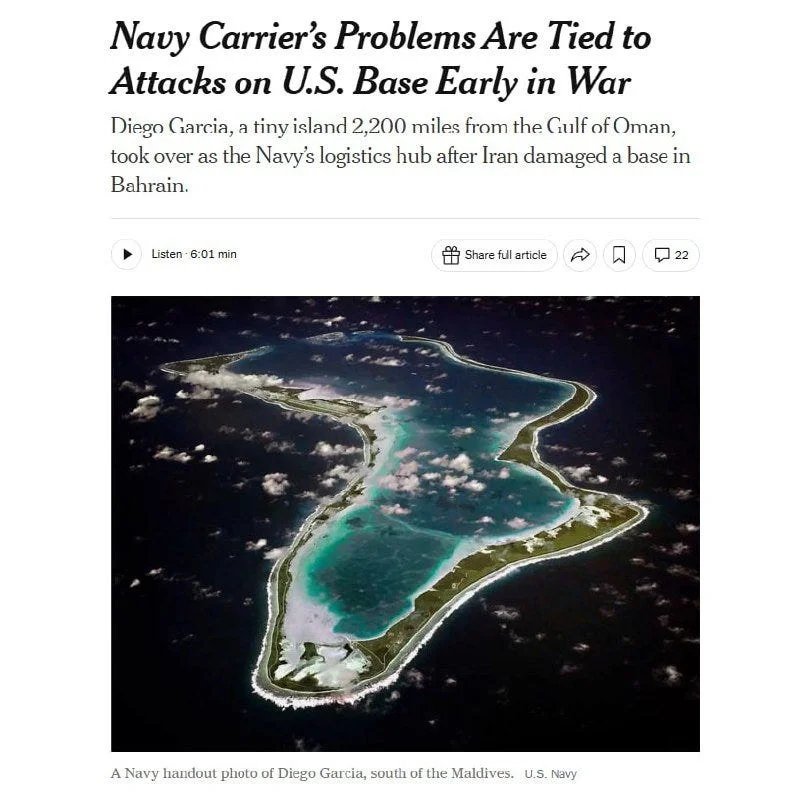
The piece asserts that the US Navy’s problems began immediately after Iran’s opening salvo of the war, which saw the Navy’s top regional logistics hub in Bahrain go up in smoke from Iranian missiles and drones:
The aircraft carrier U.S.S. Abraham Lincoln’s supply problems began soon after the first day of the war, as Iranian missiles and attack drones fell on a Navy base in Bahrain.
The Iranian attack, retaliation for the U.S.-Israeli assault on Tehran, destroyed much of the base. And as it went up in smoke, so did a major logistics hub that the Navy has relied on for decades…..Israeli outlets had previously covered the fact that the Pentagon allegedly launched a ‘secret’ operation to essentially retreat strategic assets from within immediate range of Iranian strikes toward “protected rear hubs”, which stretched an aging and sclerotic US military to the brink..
The NYT piece goes on:
The loss of the hub in Bahrain has contributed to a host of reported problems on carriers supporting operations against Iran, as Democratic senators raise concerns about the Lincoln’s 5,000 sailors and their nearly nine-month deployment…..The state of the US Navy has shocked observers who were not attuned to such a rapid organizational decline, particularly amidst a major conflict wherein the Navy was meant to play the key sustaining role….
We can conclude that Iran’s strategy has worked: Take out US’s eyes and ears in the region by targeting radar systems, saturate air defenses—whose stocks can’t be regenerated—with cheap drones and throwaway first-gen ballistic missiles; then when the battlefield has been sufficiently shaped, begin throwing in the most advanced and accurate ballistic missiles to hit the actual logistics nodes, base C2 HQs, etc., to cause US to scramble its entire tail out as far out of range as possible. This then strains the degraded logistics chain to the point of breaking, as we’re seeing now
with the striking deterioration of morale.
Larry Johnson describes long-form how the Navy elected to hollow out its logistics. From The Tail That Couldn’t Keep Up: How the US Navy Ran Its Own Sailors Short on Food and Soap:
Warships do not carry enough on their own to stay at sea indefinitely. What keeps a carrier strike group fed, fueled, and armed without returning to port is a dedicated fleet of supply ships called the
Combat Logistics Force (CLF)— the underway replenishment ships, operated by Military Sealift Command with mostly civilian crews, that steam alongside warships and pass fuel, ammunition, food, and stores across on cables and hoses while both ships are moving….The Combat Logistics Force today numbers about 34 ships — a figure that has stayed essentially flat for well over a decade. On paper, stability. In practice, a slow hollowing, because the demands on that force have grown while its most capable ships have disappeared.
Around 2010, the Navy operated all four of its Supply-class fast combat support ships. Today only two remain. In the mid-2010s the Navy inactivated two of them into reserve to save roughly $30 million a year each in operating costs — a decision that looked reasonable on a spreadsheet and looks indefensible from the deck of a hungry ship. The reason it bites is arithmetic: replacing the combined capability of one fast support ship typically takes an oiler
plusa dry cargo ship — two hulls, two crews, two schedules — to move the fuel, ammo, and food that one ship used to carry in a single package. Cut the fast support fleet in half and every sustained single-carrier mission becomes harder to feed.The rest of the force is aging underneath the flat headline….
The line from a thinned logistics force to a specific empty tray runs through a system with almost no slack left in it. A navy running long deployments in distant waters on a supply fleet that has stayed flat in numbers while shedding its most capable ships is a navy operating with vanishing margin. When margin is thin, the failures show up first in the least glamorous places — not in a missile that won’t fire, but in a laundry that won’t run and a galley that runs low. Food, soap, and clean water are the leading indicators of a sustainment system operating at its limit, and off Arabia in 2026 those indicators went red.
And an admission of weakness:
In the meantime, Iran does not intend to stand pat. From the landing page of PressTV:
Now to the action the US has threatened to take: Scott Bessent’s too-loudly-proclaimed scheme to yessiree-bob finally prostrate Iran with new meaner-than-evah economic torture:
🇺🇸🇮🇷 — US Treasury Secretary Scott Bessent just put Iran on notice:
“Measures like have never been seen in the history of economic isolation on a country.”
Coming next week.
Combined with the continued Hormuz blockade that blocks anything in or out of Iranian ports. pic.twitter.com/SeMbFaKZAI— Rajat Jain (@RajatJain) August 14, 2026
Even normally-cheerleading or at worst politely neutral Bloomberg is skeptical. From What Bessent’s Economic Isolation of Iran Could Look Like:
- Treasury Secretary Scott Bessent says the US is getting ready to squeeze Iran with unprecedented economic pressure, despite the country already being subject to a naval blockade and thousands of sanctions.
- The US could target China’s ties to Iran, including penalties on entities that facilitate Iran’s oil exports, but this risks worsening tensions with Beijing and lifting oil prices.
- Other options for the US include targeting exchange houses that help Iran repatriate funds, threatening secondary sanctions on Iran’s trading partners, going after Iranian overseas assets, and targeting the shadow fleet that enables shipments to Iran.
….“Unless the president decides to prioritize addressing the Iran threat over all other issues, and namely China, it’s unlikely any action they take is going to materially change Iran’s calculus,” Bloomberg Economics analyst Chris Kennedy said…
China buys more than 90% of Iran’s oil exports. Penalties on entities that facilitate these purchases would directly reduce Tehran’s oil revenues…
The risk is that hitting Chinese companies or financial institutions risks worsening tensions with Beijing ahead of a planned meeting between President Donald Trump and Chinese leader Xi Jinping. There’s also an economic tradeoff, since curtailing Iranian barrels would remove discounted crude from the global market and could lift already elevated oil prices….
There are a number of exchange houses in countries such as the United Arab Emirates that help Iran repatriate funds….
Treasury has already demonstrated that it sees this as a vulnerability…
The US could threaten secondary sanctions on any entity doing even limited business with Iran…That could force foreign companies and banks to choose between doing business with Iran and retaining access to the US financial system…
Such a move could put additional pressure on Russia and China, but also on companies and financial institutions in countries around Iran’s borders — including US partners like Turkey — that maintain significant commercial ties with Tehran….
The US could go beyond freezing Iranian government assets and try to confiscate assets already under US jurisdiction…
However, the pool of Iranian state assets actually within US reach may be limited…
Such a move would keep Iran from accessing many of its funds, but Iran has spent years building alternative channels to move money outside the formal financial system. Cutting off individual exchange houses will likely push transactions toward new intermediaries, currencies or digital assets, rather than stopping them altogether.
Importantly, the august Foreign Affairs is sounding the alarm about the intensifying energy crunch. From The Long Shadow of the Iran Shock:
It would be tempting to conclude that the dangers of energy supply disruptions have been overstated, but such complacency would be misguided. The Hormuz crisis has so far led to only modest oil price spikes thanks to an unusual combination of favorable market conditions and years of investment in energy security measures. Before the war began, oil markets were oversupplied, inventories were relatively high, Saudi Arabia and the United Arab Emirates had built pipelines around the strait, and governments and companies had amassed emergency and commercial stocks. In addition, China helped stabilize the global oil balance by reducing its imports, drawing on its immense capacity to curb how much oil it buys for stocks, holds in inventory, refines for export, and consumes domestically.
These conditions may not endure. If the conflict enters a new phase of intense fighting that threatens to spill across borders and continues to block the strait, oil markets, now stressed by shortages of refined products such as diesel and jet fuel, could see crude oil prices surge higher. But even if hostilities in the region de-escalate, a persistent risk to traffic through the strait will likely remain, with passage either outright controlled by Iran or, at the very least, subject to Iranian disruption at any time. A more optimistic scenario in the next several months seems a chimera, barring major and unlikely change in Tehran….
The relatively modest movement in global benchmark prices concealed a strikingly uneven distribution of pain, as countries in Asia and Europe endured high prices, shortages, rationing, fiscal strain, and forced reductions in consumption, while the United States and China demonstrated newfound levels of insulation and influence. Delayed effects also loom on the horizon. Because of the crunch in refining, diesel and other crude products are priced much higher than they normally would be at current headline oil prices. And the shock is making it harder and more costly for Europe to replenish its natural gas inventories, leaving the continent with lower-than-usual storage levels and more vulnerable to energy and geopolitical coercion in the coming winter.
In preparing for these scenarios, as well as new crises in the more distant future, the world should not take solace in the relatively benign outcome of the last five months for energy markets. The cushions that helped the world manage those months are now more threadbare: inventories have been depleted, demand is recovering, alternative routes are becoming more vulnerable, and infrastructure continues to come under fire and, in some cases, will take years to repair. A second phase of the Hormuz crisis could prove substantially more damaging than the first.
In a similar vein:
Trump and Chris Wright say there is an abundance of oil.
Bloomberg has tripled down on their "super glut" call.
The data says otherwise. https://t.co/YXjmjjXWv0
— Josh Young (@JoshYoung) August 16, 2026
And a sanity check from a reader in the Deep South via e-mail: “Does Trump really believe people won’t notice this?”
Nawfal and Jeff Currie discuss why paper oil prices are not registering the supply crunch. Currie contends that the extreme price volatility has driven speculators and investors away. Recall that their activity, in total transaction volume, greatly outweighs that of users”:
1 That may not take transits to zero but an average of below five a day is effectively zero. Note tracking data says that is the current state of affairs but the US keeps claiming stealthy vessels are getting through on the Oman side.
2 From JohnM_inMN in comments:
Title 10 of the United States Code, Section 8062 (b), requires the Navy to maintain not fewer than eleven operational aircraft carriers. This was fascinating to learn. So, I looked up where our 11 carriers actually are.
Deployed:
-
USS George HW Bush (Arabian sea)
-
USS Abraham Lincoln (Arabian sea)
-
USS George Washington (lone carrier in pacific theater, South China Sea, forward-deployed from Japan, pulled this week from pacific theater, en route to Arabian sea) This is the SECOND time we’ve borrowed a carrier from the pacific, much to the horror of countries like TAIWAN.Available:
-
USS Theodore Roosevelt (San Diego, coming off training at pearl harbor, expected deployment in September)
-
USS Vinson (San Diego, local training)The remaining SIX: Norfolk, Newport News, Bremerton, and…. wait for it…. “in name only”
-
USS Eisenhower (Norfolk, post-deployment availability. a maintenance period, not a ready ship)
-
USS Gerald Ford (Norfolk, undergoing repairs after historic deployment and laundry fire)
-
USS Truman (RCOH, Newport News, June 2026, return ~2029)
-
USS Stennis (RCOH since 2021)
-
USS Reagan (dry dock, Bremerton, August 2026)
AND
- USS Nimitz (originally scheduled for DECOMMISSIONING in May 2026, “retirement” pushed to March 2027 due to ongoing construction delays with USS John F Kennedy)The USS John F Kennedy’s original completion date was July 2025, construction delays have pushed that back to 2027. The Nimitz is a placeholder.
We have not had 11 operational carriers since 2013. GAO found that maintenance finishes late 75% of the time. May 2024: GAO told the senate that US shipyards are a “major readiness concern.” Backlog: $54 billion.
Construction for the USS Kennedy began in 2011. Delivery date originally July 2025, delays (advanced arresting gear/ advanced weapons elevators pushed it to 2027). It was supposed to replace the Nimitz.
Behind the Kennedy: the Enterprise (CVN-80), delivery slipped from September 2029 to July 2030 due to late material and supply chain performance.
Behind the Enterprise: the Doris Miller (CVN-81). Behind the Miller: Congress is exploring a two ship block buy for CVN-82 and CVN-83.
The rule of thirds: 1/3 deployed, 1/3 at home (training and readiness), 1/3 in maintenance.
Reality: three deployed, two in training/readiness, five in maintenance, and one is a corpse holding space for a law that hasn’t mattered in 13 years.
Somebody decided, well, let’s go ahead and start a war anyways.