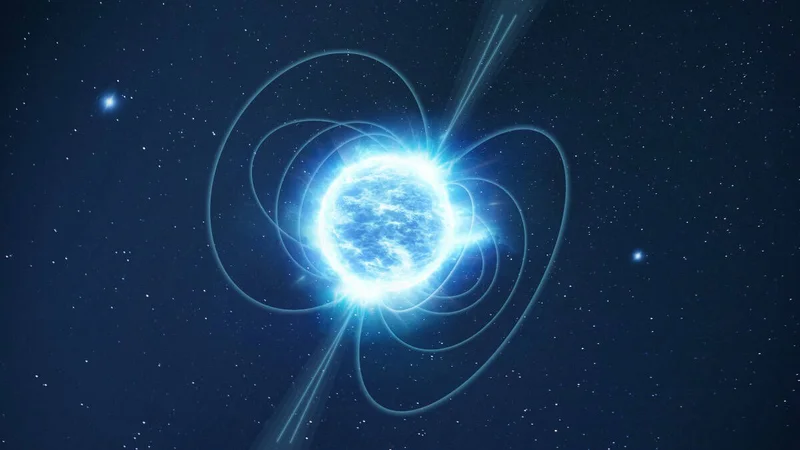
The first direct glimpse of vacuum birefringence has been claimed by astronomers who have studied X-ray and radio emissions of a neutron star that is both a magnetar and a pulsar. A central, but unconfirmed prediction of quantum electrodynamics (QED), vacuum birefringence involves the polarization of the quantum vacuum by powerful magnetic fields.
Made by a US-led international team, the observation could lead to the use of magnetars as natural laboratories to study other extreme-field phenomena of the quantum vacuum. However, another group headed by researchers in Italy remains unconvinced that the data constitute a “smoking gun” for vacuum birefringence. They believe that alternative explanations remain viable.
Birefringence occurs when the refractive index of a medium depends on the polarization of the radiation passing through it. When refraction occurs at such a medium, there is an angular separation of the two differently-polarized waves. This occurs with certain crystals such as calcite and lithium niobate, where the anisotropic lattice structure interacts differently with oppositely polarized photons. Birefringence can also arise from the interaction of photons with magnetic fields in plasma.
Virtual pairs
A key prediction of QED – first made in 1935 by Werner Heisenberg and Hans Euler – is that sufficiently strong magnetic fields can make a vacuum birefringent by polarizing the virtual electron–positron pairs that fluctuate in and out of existence. Ninety years on, however, vacuum birefringence had not been observed because the huge fields required cannot be generated in the laboratory.
“Having a natural lab already existing that could look into some of these effects is something that would be very beneficial,” says astronomer Rachel Stewart of George Washington University in the US. “That’s something people have probably been looking into for decades.”
Stewart and colleagues’ natural lab is a magnetar. These objects comprise a rare subtype of neutron star that have extreme magnetic fields of up to 1011 T. This makes magnetars the most magnetic objects observed in the universe and bright sources of X-rays. Data from NASA’s Imaging X-ray Polarimetry Explorer (IXPE) telescope have shown that this radiation is often polarized.
This is not surprising because the surface of a magnetar is likely to be surrounded by magnetized, birefringent plasma. The plasma’s field, however, should be tangled and variable, so the net polarization imprinted on light emitted into the far field should be relatively small.
Magnetic axis
If the magnetar’s intense magnetic field polarizes the vacuum of empty space, then the birefringence polarization imprinted onto the X-rays should follow the orientation of the magnetic poles into the far field as the magnetar rotates. Disentangling the two effects is difficult, however, because it is not generally possible to ascertain the orientation of the magnetic poles with respect to the direction of our observation.
A very few magnetars, however, are also pulsars that emit narrow beams of radio waves from their magnetic poles. The magnetic and rotational poles of a pulsar are misaligned, which causes the radio beam to sweep around like a lighthouse beam. If Earth happens to be in the path of the beam, we observe radio pulses.
In the new research, Stewart and colleagues observed the magnetar 1E 1547.0−5408, which is unique among observed objects for having persistent, bright radio emission alongside its X-ray emission. They combined observations from two space-based X-ray telescopes – IXPE and the Neutron Star Interior Composition Explorer (NICER) – with radio observations from Australia’s Murriyang telescope.
The radio observations allowed the team to the work out the angle between the magnetar’s magnetic and rotational poles and the angle between the rotational pole and the direction of our observation. This gave them the information needed to disentangle the two birefringence effects.
Large polarization
The researchers found a high degree of polarization in the detected X-rays – up to 80% at photon energies 2–3 keV in energy. They point out that this high degree of polarization is consistent with vacuum birefringence being driven by the magnetar’s powerful field.
The X-ray emission is closely aligned with the radio emission, which the researchers believe is naturally explained by the magnetic poles of the star being closely aligned with the rotational poles – and difficult to reconcile with alternative explanations.
However, another recent paper challenges this interpretation. Roberto Taverna of the University of Padova in Italy, who led the work, says that pairing the radio emission data with the X-ray observations was “very smart”, but he says that “it is not obvious to me whether the two observations – the radio and the X-rays – are compatible or not.” He says that, if the X-ray emission all emerged from one small region such as a hotspot slightly away from the radio polarization axis, the X-ray radiation would be polarized in the absence of vacuum birefringence. As a result he does not believe the observation is a “smoking gun”.
Quantum vacuum fluctuations illuminated by new computational technique
George Younes of NASA’s Goddard Space Flight Center in Maryland – part of the US group – argues that Taverna and colleagues are “ignoring about 60 years of radio pulsar science…They are hiding behind the fact that magnetars are different from pulsars, so we don’t know exactly where the radio emission comes from and all results are on the table,” he says, “but there are fundamentals that we should not ignore.”
The US-led team is now investigating further to see whether they can find more evidence for vacuum birefringence. Nuclear astrophysicist Hoa Dinh Thi of Rice University in Texas, who led the theoretical effort, is now modelling QED effects of magnetism on radiation in the plasma. “In the far future we also plan to use machine learning in the model so we can explore the different sources together and understand better the properties of neutron stars and magnetars.”
Stewart and colleagues describe their work in Nature. Taverna’s team has published in* The Astrophysical Journal. *