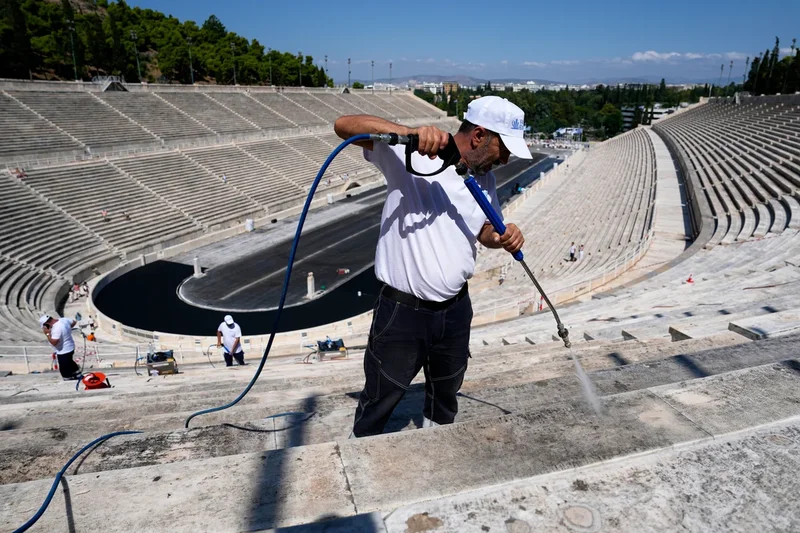
Athens’ famed Panathenaic Stadium – which hosted the first modern Olympic Games – is undergoing its first thorough cleaning in more than a century.
The venue, constructed entirely from white marble, requires painstaking care as it shares the same stone source as the Acropolis.
Reconstructed for the inaugural modern Games in 1896, the landmark acts as the traditional ceremonial send-off point for the Olympic flame, including the upcoming handover for Los Angeles 2028.
The ongoing work highlights a structure altered by weather, time and millions of visitors.
Specialists wearing white and blue overalls move across the stadium’s 47 steep tiers, applying clean water at low, carefully controlled pressure through thin spray lances, while machines vacuum up the runoff liquid.
"The goal of cleaning is not to make everything white. It’s to remove the dirt and the first layers of organic material that are deposited on the surface," said Dimitris Selemis, a senior conservator at the site.
"The idea is to clean all the material that (contains) dirt from the surface, so we have a better understanding of the monument," he said, noting that there is more weed growth and dirt in areas that receive less direct sunlight.
Chewing gum and soft-drink stains
Crews are also using steam to remove blotches of chewing gum, which have turned black over time. Stadium officials say gum, high heels and soft-drink stains are among the main culprits that stain the marble.
Now slowly being revealed, the original gleaming look of the venue earned it the widely used Greek nickname “Kallimarmaro”, or beautiful marble.
“We call it Kallimarmaro because it is made of the finest marble, the best that was ever produced ... We are very proud of it,” Isidoros Kouvelos, president of the Hellenic Olympic Committee, said.
“It needed to be cleaned of everything that has accumulated over all these years," he said.
"This way the Panathenaic Stadium will show all its brilliance and will once again be the foremost monument of humanity for the Olympic Movement.”
Ancient history
Built into a natural ravine, the stadium’s site was used for ancient Greek athletic contests and later Roman spectacles before falling into centuries of disuse.
Since its 1896 revival, it has staged fashion shows, rock concerts, boxing matches and national celebrations — as well as lavish patriotic ceremonies ordered by a military dictatorship in the 1960s.
Today, it is a popular draw for tourists. Apart from the cleanup, the Kallimarmaro is also getting a new track, upgraded lighting and fresh support facilities. The project is privately funded by a shipping company and overseen by the Hellenic Olympic Committee with guidance from Culture Ministry experts.
The work will continue through 2026 but is currently concentrated on the stadium’s “sling”, or curved end, in time for the next torch-passing ceremony on 10 September.
That will be for the Dakar Youth Olympics, scheduled fo 31 October to 31 November in Senegal, which will be the first Olympic competition ever hosted in Africa.
IOC President Kirsty Coventry, a swimming gold medal winner from Zimbabwe, is due to attend the 10 September ceremony.