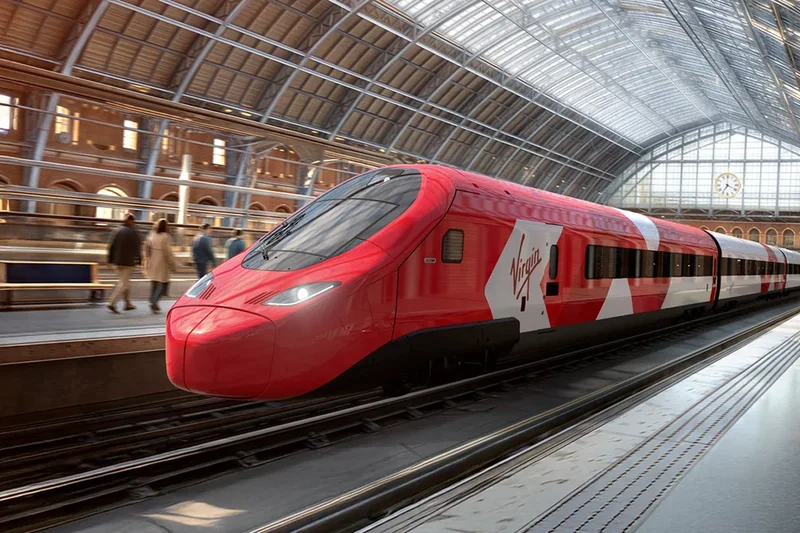
A Virgin Trains plan to challenge Eurostar has taken one big step forward after the firm was granted track access for proposed services linking London to Paris, Brussels and Amsterdam from 2030.
The Office of Rail and Road (ORR), the rail regulator, confirmed that it has approved Sir Richard Branson’s company to run as many as 20 daily return trips through the Channel Tunnel.
The newly approved agreement spans the period from 1 October 2030 through to 31 December 2040.
The decision clears another critical regulatory hurdle toward launching cross-border routes, following approval last October to share Eurostar’s Temple Mills depot in east London to maintain and store its fleet.
Temple Mills serves as the only depot with direct access from High Speed 1, the rail line linking London to the tunnel.
Eurostar has held an exclusive monopoly over passenger rail travel through the Channel Tunnel since the route opened in 1994.
The tunnel currently operates at just 50 per cent capacity, offering significant scope for prospective rival operators.
Italian state railway operator FS Italiane Group has ordered 19 high-speed trains to launch services between London and Paris by 2029.
Sir Richard previously said it was “time to end this 30-year monopoly and bring some Virgin magic to the cross-Channel route”.
Virgin Trains plans to run services between London St Pancras and the same stations in Paris, Brussels, and Amsterdam used by Eurostar: Gare du Nord, Brussels-Midi, and Amsterdam Centraal.
The ORR said that the decision to grant track access was “an important next step”.
However, it added that there is “still more work to do” before the new services can run.
Deputy director of access and international Martin Jones said: “This is an important next step in bringing competition and growth to the market for international rail services, and we welcome the progress Virgin Trains and London St Pancras High Speed have made.
“While there is still more work to do, we are supporting Virgin and the wider industry to grow international services.”
For example, Virgin Trains must secure access to other rail networks and obtain safety approvals from the ORR and relevant regulators in the EU ahead of the plans to begin running services in 2030.