- Published
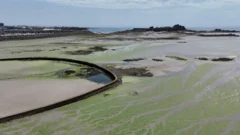
A combination of recent hot weather and changes to agricultural practices are believed to be behind a lack of sea lettuce this year.
Its growth in St Aubin's Bay, Jersey, is normally attributed to warm, shallow conditions, combined with run-off from fields and treated water. It is blamed for making the beach smell and stopping people from going for walks on the sand.
The government said conditions this summer had "disrupted its normal growth". It also confirmed that no sea lettuce has been collected from the beach so far in 2026.
The prolonged dry weather, beginning earlier than in previous years was also considered to be a factor, officials said.
A spokesperson for the Environment Department said: "Sea lettuce mainly reproduces in May.
"The unusually high temperatures we experienced during that period were likely to have disrupted its normal growth and reproduction".
Jersey recorded its hottest May day ever this year, with temperatures reaching 29.2C (84.5F), and persisting throughout the summer.
Alongside the hot weather, the government said "the efforts of the Action for Cleaner Water group and agriculture industry to reduce nitrate use on fields will support the reduction of build-up".
Action for Cleaner Water is a joint initiative between Jersey Water, the government and representatives from Jersey's farming and dairy industries to improve water quality.
The government previously identified, external that "nutrients from outside the bay, run-off from streams that contain fertiliser and treated waste water from the water treatment works' all normally contribute to the growth of sea lettuce".
In recent years, sea lettuce had been removed from St Aubin's Bay and used on the island's fields.
In 2025, almost 3,000m sq (32,300ft sq) of lettuce was taken from the beach for this purpose.
Follow BBC Jersey on X, external and Facebook, external. Send your story ideas to channel.islands@bbc.co.uk, external.