Rachel Feltman: Happy Monday, listeners! For Scientific American’s Science Quickly, I’m Rachel Feltman. Let’s catch up on some of the science news you may have missed last week.
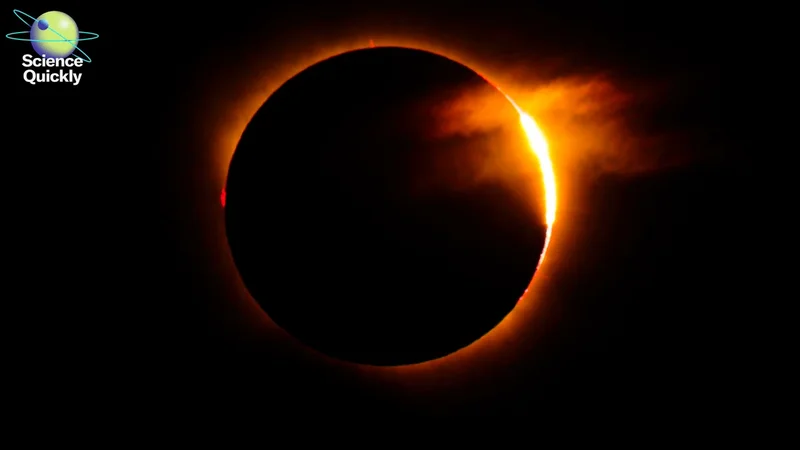
Last Wednesday, the only total solar eclipse of 2026 swept across northern Russia, the Arctic Ocean, Greenland, Iceland, the Atlantic, part of northeastern Portugal, and northern Spain. If you caught the eclipse, I hope you protected those precious peepers of yours. And if you saw a partial eclipse somewhere off the path of totality, I hope you don’t make the mistake that I hear many, many people make about eclipses: assuming that hitting 90% or even 99% totality means you basically saw a total eclipse. I’m not saying that partial eclipses aren’t really really cool but allow me to be briefly insufferable and tell you that the moment of actual, 100% totality is weird and incredible and makes you understand why ancient civilizations treated these events as apocalyptic omens.There is absolutely nothing like it. I refuse to stop talking about how incredible it is to experience a total eclipse, because every time I’ve successfully convinced someone to go out of their way to see one, I’ve invariably made their lives at least a little better and more wondrous and magical. And not a single one ever said like, “Rachel, why did we drive 8 hours for this? That was stupid.”
With all of that in mind, the next time a total eclipse will meaningfully cross the U.S.—no offense, Alaska—is 2044, and that one will only hit Montana and the Dakotas. Luckily for the rest of the lower 48 we’ll get a cross-country totality path in 2045. And yes, I know that’s a long time from now! There’s a reason why all the science people you know made such a big deal out of the ones in 2017 and 2024! That was really a banner decade for American eclipse chasers looking to avoid international travel.
On supporting science journalism
If you're enjoying this article, consider supporting our award-winning journalism by subscribing. By purchasing a subscription you are helping to ensure the future of impactful stories about the discoveries and ideas shaping our world today.
Now, obviously going abroad is not always or ever feasible for many people, but if you’re planning on taking some big trips anyway, an eclipse is a great thing to plan around. If you want an excuse to finally check out New Zealand or Australia for instance, it’s definitely not too early to start booking stuff for their July 2028 total eclipse.
You could also try to catch the 2027 total eclipse that’s passing over the southern Mediterranean, perhaps even on an official Scientific American river cruise guided by our chief of reporters, Clara Moskowitz. Yes, Scientific American hosts science-y vacations! And no, no one told me to mention that. I haven’t gotten to go on one. I just really like eclipses. It seems like this will be a cool one. You can find out more about that at scientificamerican.com/travel.
Now for some public health news. Last Monday, President Donald Trump issued an executive order aiming to alter the U.S. childhood vaccine schedule. The president is reportedly asking Secretary of Health and Human Services Robert F. Kennedy, Jr. to present plans for breaking up the combined measles, mumps and rubella, or MMR, vaccine into individual shots. In presenting the order on Monday, Trump suggested that this combination of shots is dangerous, which contradicts a large and rigorous body of scientific evidence on the subject. And his order more broadly takes aim at the practice of administering multiple vaccines at once in children, “to the maximum extent feasible,” the order states, “all childhood immunizations should be administered at separate medical visits.” But all evidence shows getting multiple vaccines at once is safe including for children.
The president also alluded to the possibility that childhood vaccines could contribute to rising autism rates ...
[CLIP of President Donald Trump signing the executive order in the Oval Office: “ Decades ago, children received only a small fraction of the vaccines required today. In those times, people were much healthier, and of course, the high rates of autism now observed did not exist. So there’s a reason for such epidemic rates of autism, and we’re gonna bring it back to much closer to where it was.”]
Feltman: Which has also been repeatedly and definitively ruled out by scientists.
Now, even if you’re aware of the concrete evidence that vaccines save lives and are safe and do not cause autism. You might be wondering what’s so bad about breaking the MMR shot into three separate vaccines. The answer is that, theoretically, there’s nothing wrong with getting each vaccine separately. But the childhood vaccination schedule as set by the American Academy of Pediatrics was developed to give children protection against these potentially fatal diseases as efficiently as possible. If parents split shots up into multiple appointments, it takes longer for their kids to become fully inoculated against all the illnesses in question. And having the government advocate for the use of three separate shots definitely implies that there is something wrong with taking them all at once—which, again, to be totally clear, there is not—which could lead to parents unnecessarily delaying a child’s vaccinations.
It’s not clear what impact this executive order will actually have on pediatrician visits. But for the best, science-based information on childhood vaccinations, we always recommend referencing the American Academy of Pediatrics’ website.
In global news, Colombia was hit with a magnitude 7.4 earthquake last Monday. The Colombian Geological Service told the Associated Press that this was the country’s strongest earthquake in the last decade, and Reutersreported that it was the strongest seen in Colombia since the start of the century. The earthquake struck around 150 miles west of the city of Bogotá, where the Nazca, South American and Caribbean tectonic plates interact. According to the U.S. Geological Survey, the quake occurred about 68 miles underground. An earthquake that deep can be felt over a large geographic area, but the distance up to the surface helps to diffuse the energy. That’s partly why the two earthquakes of similar magnitude that struck Venezuela in June caused more concentrated destruction: Those quakes, which killed more than 6,000 people, came from fault systems less than 15 miles down.
The death toll in Colombia was continuing to rise last week, with CNN reporting at least 200 casualties. If you’re looking for ways to help, several relief charities are already on the ground. You can go to charitynavigator.org to find a list of places to donate. And remember that experts say that cash goes much further than in-kind donations like canned goods or clothes in the wake of a disaster.
Now let’s move to some lighter news most of us can certainly use: Science may finally have reached a consensus on coffee’s health benefits. Here to tell us more is Andrea Gawrylewski, chief newsletter editor at Scientific American. Over to you, Andrea!
Andrea Gawrylewski: Thanks, Rachel. For decades, scientists have been going back and forth on whether coffee is good for us or bad for us. But after years of people getting mixed messages on whether their morning brew is helping or hurting them, the scientific winds do seem to be turning in favor of coffee’s health benefits.
In just this year, studies across multiple disciplines have found that coffee could reduce dementia risk, protect your liver, and even improve your gut microbiome. Last month, the American Heart Association said in a statement that, yep, coffee is beneficial, and drinking up to five cups of caffeinated coffee a day has been linked to a lower risk of heart attack, diabetes, stroke and irregular heartbeat.
So why is the story on coffee changing in this way? Well, for one, the way scientists conduct research and analyze their results is improving. For example, until now, confounding factors made it really hard to tease out coffee’s true effects on health. So people who smoke or have higher stress levels tend to both drink more coffee and have worse health outcomes.
But in recent years, advances in the statistical tools that scientists use help them account for those confounding factors. This means that recent results from experiments that track tens of thousands of people over decades are finally rolling in and creating a much clearer picture of how lifestyle choices, and which lifestyle choices, affect health for good or bad.
So these modern studies are built to minimize ambiguity. But there are caveats, and most studies that find a positive effect from coffee do have them. For example, the American Heart Association did give an aside that warned that adding cream and sugar to your daily coffee could counteract its health benefits.
And of course, large epidemiological studies cannot be applied to individuals really, so people’s own metabolisms and health conditions can determine what effects coffee has on them. Plus, there are many other unknowns remaining around what scientists know about how coffee affects health. For example, scientists still don’t quite understand which particular chemicals in coffee, and there are thousands, cause which outcomes.
And this is not even to mention a whole other sector of caffeinated beverages like energy drinks that scientists say we need a lot more evidence on to know how they affect health.
For the time being, it looks like a cup or few of joe a day is a safe way to fuel your life.
You can read more news like this at scientificamerican.com/#newsletter.
Feltman: Thanks for the update, Andrea! Listeners, subscribe to Today in Science to get more of SciAm’s best stories sent straight to your inbox. You can also subscribe to newsletters focused on topics like math, parenting, health and more.
That’s all for today’s episode. We’ll be back on Wednesday for a chat about how human creativity has evolved through the ages—and what we can do to find inspiration in the era of AI slop.
Science Quickly is produced by me, Rachel Feltman, along with Fonda Mwangi and Jeff DelViscio. This episode was edited by Alex Sugiura. Marielle Issa and Aaron Shattuck fact-check our show. Our theme music was composed by Dominic Smith. Subscribe to Scientific American for more up-to-date and in-depth science news.
For Scientific American, this is Rachel Feltman. Have a great week!