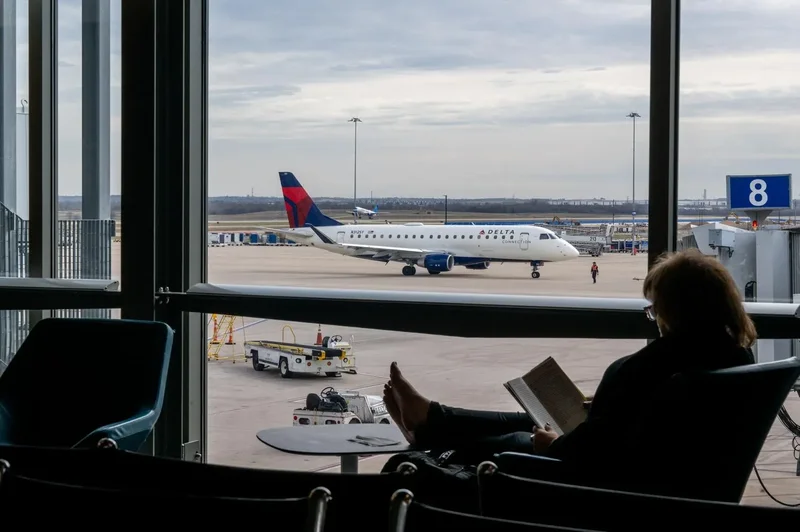
It seems that Delta Air Lines has been given a second chance in Texas.
In 2005, during its bankruptcy, Delta shut down its hub at Dallas/Fort Worth International Airport. “I think it was the right decision at the right time,” said Joe Esposito, Delta’s chief commercial officer, during an interview in Austin, as Delta announced new service to Paris and San Diego. “We were post 9/11; the industry had all gone into bankruptcy.
“The nice thing about Austin is that it puts Delta back in Texas,” Esposito continued. Austin “is something that nobody’s claimed. And I think we’re the right carrier for Austin," he said.
Austin is the center of a high-growth area located between American’s hub in Dallas and United’s hub in Houston. It is about 165 miles from the former and 200 miles from the latter. Austin metro area population is about 2.5 million: the city, with just over a million people, is the 12th biggest in the U.S., just ahead of San Jose and Charlotte.
The Austin-Paris route plan had already been widely reported in the aviation press when Delta made its announcement. At a reception for media and local leaders at a swanky boutique hotel, the assumption was that someday, in conjunction with ongoing airport expansion, Delta will open an Austin hub.
Delta currently has 65 daily Austin departures: The Paris flight, aboard an A330-900 with 281 seats, will be number 71 when it starts on March 27, 2027.
Will Austin become a Delta hub?
“When we build a city like this we’re here for the local consumer,” Esposito said. “We follow the economic trends, and Austin is booming. Think about the companies here -- Tesla, Apple and we can go on. That’s where we want to serve. Our primary is not connecting; our primary is serving the Austin consumer.”
However, “We wind up connecting people,” he said, noting that already 15% to 20% of Delta’s Austin passengers are connecting – largely between the West Coast and Florida. “We’re not technically calling it a hub,” he said. Yet, given the connections, “you can call it a hub already.”
International service is a natural, he said, not just because people connect in Austin but also because “Austin is a global city.” About 1,000 people fly transatlantic daily; about 300 fly daily to Asia (including 100 to India) and about 1,000 fly daily to Latin America, he said. For an airport with just 21.6 million total passengers in 2025, Austin already has a large contingent of international carriers: British Airways flies twice daily to London, Lufthansa serves Frankfurt and KLM serves Amsterdam. About 70 people a day fly to Paris. Today, those passengers must connect. Also, three Latin American airlines and three Canadian airlines serve Austin.
Ghizlane Badawi, chief executive officer at Austin Bergstrom International Airport, said the airport would make a good hub for Delta. “We provide the best location for Delta,” she said in an interview. They can grow to the South.”
AUS currently has 36 gates. An ongoing $5 billion expansion will create 32 more by the 2030s. Like most airport directors, Badawi is on the hunt for more service. The airport, once a military base, has two runways, one 9,000 feet and one a long 12,250 feet. “We’re working on Seoul and Tokyo,” Badawi said. Fully loaded widebody jets to Asia would require the longer runway. Seoul is a hub for Delta partner Korean Air.
You wouldn’t know it from the Delta celebration, but for now Austin is primarily a Southwest airport. (To my knowledge, AUS provides better, more complete statistics than any other U.S. airport; it even breaks down passenger count by aircraft type. Badawi told me that she is an airport stats nut.) In June, Southwest carried 44% of airport passengers, while Delta had 19%, American had 13% and United had 12%. In the 2030s airport configuration, Southwest will have 18 gates and Delta will have 15.
American will grow to nine gates from four today. Recently, American’s share at Austin has declined, down 13% from June 2025 and down 42% from June 2023. Badawi said the decline reflected the carrier’s decision to allocate aircraft to other markets following a pandemic buildup, when American’s strategy was to dominate Sunbelt flying. Nevertheless, American partner British Airways is currently the top transatlantic carrier at Austin. Dennis Tajer, spokesman for the Allied Pilots Association, which represents 17,000 American pilots, said Delta’s Austin growth after its Dallas retreat means that “Delta is not in our front yard anymore, but they are certainly in our backyard.”
Tom Noonan, CEO of Visit Austin, the city’s marketing organization, noted that in 2017 the airport had just 25 gates. “I think we’re just going to see continued growth in our airport,” he said. Delta will be able to add both domestic and international flights. “We’re excited about the future of the partnership,” he said. “I think we are becoming the third hub in the State of Texas.”