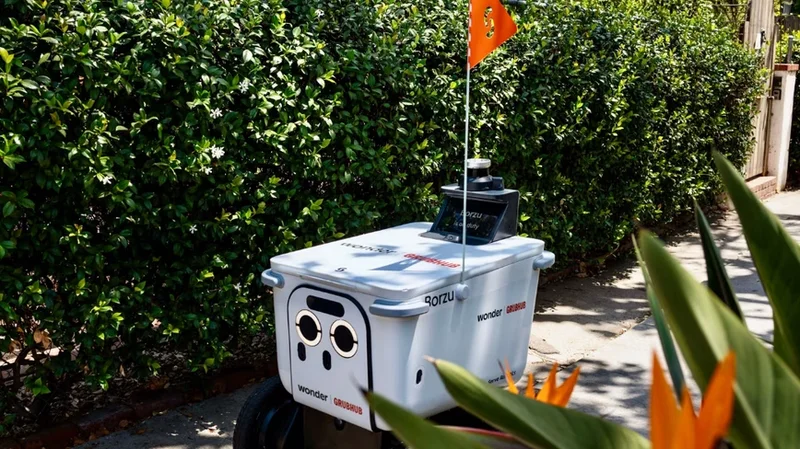
Serve Robotics, the sidewalk-delivery company that spun out of Uber, has added Grubhub to its roster of partners, a move that quietly turns it into something close to the neutral plumbing of America’s food-delivery robot business.
Through a deal with Wonder, Grubhub’s parent, Serve’s cooler-sized bots will start carrying takeaway orders placed on the Grubhub marketplace, beginning in Chicago, Los Angeles and Alexandria, Virginia.
It is the third of the big US delivery platforms to climb aboard. Serve already runs deliveries for Uber Eats, the app of its former parent, and for DoorDash, and by lining up all three it is wagering that the robots themselves, rather than any single app, are the asset worth owning.
That is a meaningfully different bet from the one most people picture when they imagine sharing the pavement with little delivery bots. The Grubhub rollout starts with more than 100 participating merchants in Chicago and close to 200 in Los Angeles.
Serve says it now has more than 2,000 robots deployed across the US, reaching around three million people and serving over 4,000 restaurants, a fleet it has built out aggressively since promising Uber Eats up to 2,000 bots back in 2023.
For a category long stuck in the perpetual-pilot phase, actually fielding thousands of working machines is the harder, less glamorous milestone.
Alongside the Grubhub deal, Serve said it had switched on two new markets with DoorDash, Washington, DC and San Jose, its seventh and eighth, lifting its combined reach to roughly eight million people across cities that also include Atlanta, Dallas and Miami.
It is experimenting, too, with “micro-depots”, small, low-cost bases meant to let it colonise fresh neighbourhoods without building out expensive full-scale facilities, exactly the sort of unglamorous logistics tweak that decides whether the economics ever close.
The company is no longer a pure sidewalk-delivery play. In 2026 it bought Diligent Robotics, maker of the Moxi hospital robot, and is now rolling out a faster Moxi 2.0 to hospitals in Chicago and Los Angeles, a bet that the same autonomy stack can shuttle medical supplies down a corridor as readily as a burrito down a street.
It has also launched an in-robot advertising line, complete with a hamburger-suited character called “Chomp” co-created with Grubhub, a reminder that a robot loitering on a busy pavement is also a moving billboard.
Delivery robots have been “about to arrive” for the better part of a decade, from Domino’s experiments with Nuro to Boston Dynamics teaching Spot to walk to the doorstep.
What has shifted is less the technology than the willingness of the big platforms to treat autonomy as a line item rather than a science project, and Serve’s pitch, to be the shared robot layer they all plug into, only pays off if that shift is real and durable.
The caveats are the familiar ones for a young, listed hardware company. Deploying robots is not the same as earning money from them; sidewalk delivery is a low-margin business with stubborn hardware, maintenance and mapping costs, and Serve, like its peers, is still spending to prove the unit economics rather than banking them.
The release, true to the genre, talks in robots and reach rather than revenue and margin. A milestone counted in bots on pavements is encouraging, but it is not yet one counted in profit.
Still, the direction is telling. By making itself the delivery robot that Uber Eats, DoorDash and now Grubhub can all summon, Serve is trying to become infrastructure, the dull but essential layer beneath the apps rather than a rival to them.
Whether America’s pavements can absorb thousands more little rolling coolers, and whether anyone can turn them into a durable profit, are the questions the next few thousand robots will have to answer.
Get the TNW newsletter
Get the most important tech news in your inbox each week.