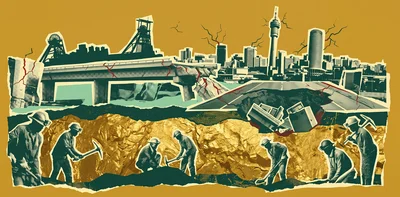
Beneath South Africaâs economic capital lies one of the worldâs richest gold-bearing basins â a vast network of historic mine workings stretching from Springs in the east to Randfontein in the west.
Yet the city continues expanding above it with new schools, hospitals, clinics, highways, petrol stations, housing estates and industrial developments, while illegal miners systematically remove the underground pillars designed to keep the surface stable.
The result, according to the University of Johannesburgâs Professor Hennie Grobler, is a slow-moving engineering, environmental and urban planning crisis that could continue for another century.
âThis could continue for another 100 years,â said Grobler, head of the universityâs Department of Mining Engineering and Mine Surveying. âThere is still significant gold remaining beneath the Witwatersrand Basin, stretching from Springs to Randfontein. As long as the gold remains there, people will continue trying to mine it.â
A section of Wemmer Pan Road which has collapsed as the result of a sinkhole caused by illegal mining. The City of Johannesburg faces infrastructure reconstruction costs likely to run into billions as illegal mining-linked sinkholes undermine roads, business and homes. (Photo: Anna Cox)
Planning without knowing what lies beneath
For Grobler, one of the greatest risks facing Joburg is not simply illegal mining itself, but that municipal authorities continue approving major developments without fully understanding the historic mine workings beneath them.
Before 1994, Grobler said, developments proposed over mining areas generally required consultation with mining authorities, who checked historical mine plans before developments were approved to determine whether they could safely proceed. He believes that process has weakened over time.
âWe need to understand what is underneath before we build on top of it,â he stressed. âThe problem is that we continue building without a comprehensive, integrated mapping system showing exactly what lies beneath. If you donât know what is underneath, you are introducing risk before construction even starts.â
Grobler believes Johannesburg urgently needs an integrated digital mapping system combining historical mine plans, geological information, municipal planning records and engineering data so that underground risks can be assessed long before developments are approved.
The pillars holding up Joburg
Unlike Johannesburgâs historic mining industry, todayâs operations are entirely uncontrolled.
âThe pillars that are now being mined were deliberately left behind. They were engineered to support the mine workings and ultimately the surface above,â Grobler explained. âIt is like removing the four walls holding up a room. Eventually, everything above starts collapsing.â
The consequences are already visible across Johannesburg, where roads have collapsed, sinkholes have appeared beneath businesses and residential estates, bridge structures have been undermined and transport corridors abandoned. But Grobler believes these are only the first visible signs of a much larger problem.
A permanent legacy beneath the city
In a lecture delivered at AGH University of Science and Technology in Kraków, Poland, Grobler argued that illegal mining has evolved into one of the greatest long-term threats facing former mining cities because its impacts extend far beyond crime.
Sinkholes on 15 March 2023 in Johannesburg, South Africa. (Photo: Gallo Images / Fani Mahuntsi)
A road closure due to a sinkhole under the M1 bridge in Newtown on 30 May 2023. (Photo: Gallo Images / Papi Morake)
His presentation identified infrastructure collapse, flooding, severe water pollution, environmental degradation, public health risks, organised crime, loss of tax revenue, declining investor confidence and long-term remediation costs as interconnected consequences of uncontrolled illegal mining.
âMining is a non-renewable activity leaving a permanent legacy,â Grobler said. He argues that authorities must stop treating illegal mining solely as a policing problem and begin managing it as an engineering, planning and disaster-risk issue.
Planning for the next century
Grobler believes Joburg needs to fundamentally rethink how it manages development across the mining belt. Before infrastructure is approved, underground conditions should be mapped, geological investigations undertaken and long-term monitoring introduced.
In a separate technical presentation examining illegal mining and urban resilience, he proposes a comprehensive monitoring system using satellite imagery, Geographic Information Systems (GIS), LiDAR (remote sensing technology), drones, digital twins, fibre-optic monitoring, real-time sensors and community reporting to detect underground movement before catastrophic failures occur.
SANDF members pull a generator that was found operating about five metres down a cliff near a dam during an operation targeting illegal mining activities in Randfontein on 12 March 2026. (Photo: Felix Dlangamandla)
Rather than waiting for sinkholes to appear, he believes the City should establish a permanent, proactive undermining management programme. His recommendations include:
- A central underground mapping database.
- Geographic Information Systems (GIS).
- Satellite monitoring and LiDAR surveys.
- Drones and fibre-optic monitoring.
- Digital twin technology.
- Community reporting systems and real-time early warning systems.
- Risk ranking of vulnerable areas.
- A permanent multidisciplinary undermining working group bringing together engineers, geologists, planners, disaster management officials, mining specialists, and government departments.
âKnowledge reduces risk,â he said, identifying highways, schools, hospitals, fuel pipelines, gas pipelines and other strategic infrastructure as priority assets requiring continuous monitoring.
Rehabilitation and responsibility
One of the questions Grobler believes deserves urgent attention concerns the financial provision for mine rehabilitation.
South African mining law requires applicants and holders of mining rights to make financial provision for rehabilitation and the management of environmental impacts before mining rights are granted. Section 41 of the Mineral and Petroleum Resources Development Act, together with the Financial Provisioning Regulations, allows this financial provision to take several forms, including trust funds, bank guarantees, or other approved financial instruments.
Grobler stressed that rehabilitation should be viewed as an ongoing responsibility rather than a once-off payment.
âIf rehabilitation funding exists, how is it being managed and how much remains available to deal with legacy mining problems?â he asked, cautioning that many of Joburgâs historic mines predate the current legislative framework.
Contrary to public perception, Grobler noted that major mining companies generally acted responsibly when closing their operations in the early 2000s, capping known shafts with concrete, sealing them, and mapping them in cooperation with the City.
âBy around 2005 most known shafts had been sealed, capped, and mapped,â Grobler said. âThey understood the underground workings better than anyone and had the engineering expertise to deal with many of these problems. Instead, many mining companies have closed, sold their assets, left the goldfields, or ceased to exist, leaving government with much of the long-term responsibility.â
Mining the roads and bridges themselves
Illegal mining is no longer confined to abandoned underground tunnels.
Many Johannesburg roads were historically constructed using discarded mine rock because it was an inexpensive and readily available construction material. Grobler said illegal miners were now digging beneath roads â and even bridges with gold-bearing sand under their foundations â to excavate the structural foundations themselves to recover small quantities of trapped gold.
âThey are literally mining the substructure beneath the tar,â he warned.
A damaged bridge in Johannesburg seen during a tour by Transport MMC Kenny Kunene on 22 June 2026 on the impact of illegal mining. (Photo: Bheki Simelane)
His technical presentation highlights water ingress as a major accelerant of sinkhole formation, creating a vicious cycle where damaged underground water and sewer infrastructure further weakens the ground.
âThe consequences of failure are no longer limited to roads. Critical infrastructure, including water mains, sewer lines and fuel or gas pipelines, is increasingly vulnerable.â
Who is directing the miners?
Beyond the physical damage, a central puzzle remains: How do illegal miners know exactly where to dig?
Grobler believes organised syndicates possess advanced geological knowledge. Knowing where remaining reefs, tunnels, and support pillars lie suggests access to detailed historical underground plans.
Regarding the sale of the gold: âBecause the possession of unwrought gold is illegal under South African law, the syndicates cannot simply sell raw gold on the open market,â Grobler explained.
âTo bypass the law and obscure its origin, a significant portion of the illegally mined gold is melted down, cast into crude items or simple jewellery, and moved into local and international markets disguised as legitimate scrap or finished goods.â
Research into illegal mining supply chains shows that once gold leaves the underground workings, it enters a multi-tiered illicit network. Syndicates frequently blend melted gold with legitimate scrap or cast it into informal bars with forged paperwork. From there, it is either smuggled across SAâs porous borders into neighbouring countries, or shipped directly to international gold-refining hubs like Dubai, where it is refined and absorbed into the legal global supply.
The forgotten victims
While residents see the visible destruction above ground, Grobler emphasised that the men working underground were frequently victims of this broader criminal enterprise. Many were impoverished and desperate, risking their lives in toxic conditions for minimal payoff.
âThe people underground are not the ones making the money,â he said. âThe syndicates are.â
Gold is rarely refined underground today because of the extreme danger. Instead, ore is crushed near the surface before processing elsewhere using dangerous chemicals like cyanide and mercury. Criminal syndicates orchestrate the enterprise from a safe distance, reaping the profits while insulating themselves from the physical dangers.
Illegal gold miners climb down an old rope as they enter a disused commercial gold mine. (Photo: EPA / Kim Ludbrook)
A problem for generations
For Grobler, the ultimate concern is not just todayâs sinkholes, but the future of the metropolis itself. Johannesburg will continue expanding across the mining belt long after todayâs illegal miners have moved on.
Without comprehensive mapping, continuous monitoring and coordinated urban planning, every piece of critical infrastructure built above historic mine workings risks inheriting the consequences of decisions made more than a century ago.
âThe gold will eventually run out,â Grobler warned. âBut the damage beneath Johannesburg could remain for generations.â DM