Research integrating Western medicine and TCM gets boost under new collaboration
AI generated
SINGAPORE – Research to integrate Western medicine and traditional Chinese medicine (TCM) – particularly for sleep orders, chronic diseases and women’s health – will be strengthened under a new collaboration between the Nanyang Technological University (NTU) and healthcare provider OUE Healthcare (OUEH).
The partnership will establish formal frameworks for joint scientific research projects and scholarly publications, as well as specialised clinical training, mentorship and exchanges for TCM practitioners.
TCM practitioners will also be able to take part in international healthcare conferences, seminars and collaborative academic workshops.
Sleep disorders, chronic diseases and women’s health are the three areas the partnership will focus on initially, said Swee Yong Peng, the chief commercial officer of OUEH.
He noted that OUEH, via its subsidiary Healthway Medical, already has two clinics in Hougang and Aljunied offering an “integrative medicine” model – utilising both Western medicine and TCM. More such clinics to be launched in the near future.
OUEH and NTU aim to “develop a structured clinical pathway to evaluate outcomes, and to translate this research into practical care models across our network of integrative clinics”, said Swee, who is a family physician and TCM specialist.
The collaboration is timely given the Health Ministry had previously announced it was exploring integrating TCM into the country’s preventive health initiative Healthier SG, he noted.
Linda Zhong, director of biomedical sciences and Chinese medicine at NTU’s School of Biological Sciences, said the partnership will combine NTU’s expertise in biomedical sciences and Chinese medicine with OUE Healthcare’s valuable clinical experience.
“By bringing researchers and clinicians together, we can ensure that research addresses real clinical needs while generating knowledge that contributes to better patient care and advances the practice of integrative medicine,” she said.
In 2026, NTU introduced a new master’s degree in Chinese medicine, the first such postgraduate programme offered by a local university.
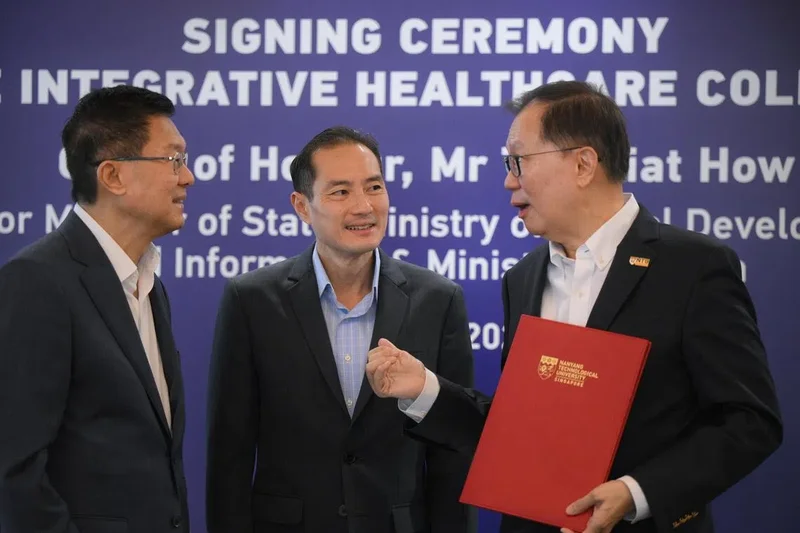
The collaboration agreement between NTU and OUE Healthcare was inked on Aug 17 at the university’s Nanyang Lake Pavilion, witnessed by Senior Minister of State for Health Tan Kiat How.
The event also saw the launch of the Stephen Riady Professorship in Healthcare and Technology, established with a $3 million endowment from real estate group OUE, the parent company of OUEH.
“The endowment is designed to accelerate early medical interventions, enhance healthcare accessibility, and support healthier longevity through interdisciplinary research,” NTU and OUE said in a statement.
The professorship aims to “foster new approaches to healthcare that are more personalised, preventive and technology-enabled”, working across disciplines such as biomedical engineering, artificial intelligence and wearable sensors, they added.
NTU deputy president and provost Christian Wolfrum is the inaugural Stephen Riady Professor. He is an expert in metabolic research and also executive chairman of national artificial intelligence initiative AI Singapore.
“By establishing the NTU Professorship in Healthcare and Technology, I hope we can move closer to shaping the future of healthcare by fostering understanding and building connections between technology, medicine, research and clinical practice, as well as integrating modern and traditional medicine to provide holistic patient care,” said OUE’s executive chairman and group chief executive officer Stephen Riady.
NTU president Ho Teck Hua said the future of healthcare is interdisciplinary, and that the partnerships inked that day will help turn ambition into action.
“If we can break down the walls between disciplines, bring the right people together, and invest in the best talent, we can help Singaporeans live not only longer but better,” he said.