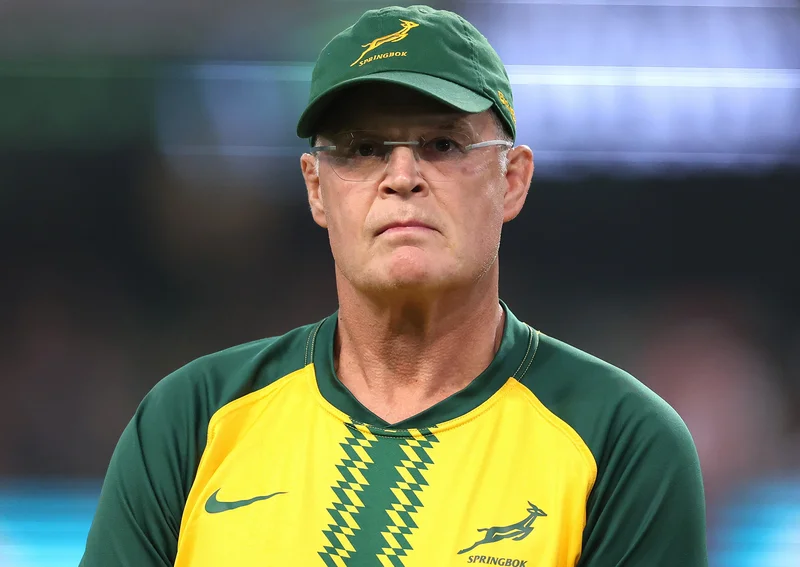
Springbok coach Rassie Erasmus would be forgiven if he played the old Rage Against the Machine song Killing in the Name for this team before the first Test against the All Blacks at Ellis Park this Saturday.
The bandâs frontman, Zack de la Rocha, rages in the 1993 hit, âAnd now you do what they told ya (now youâre under control)⦠f**k you I wonât do what you tell meâ, over and over.
The Boks wonât be changing their style to suit a certain narrative, put out in the media by the likes of assistant coach Tana Umaga and then intensified through social media.
âMy opinion is New Zealandâs played four matches and thereâs certainly been a narrative out there, which is very technical around the speed of the game and the slowing down of the game,â Erasmus said at a media conference on Monday.
âYou can see on their social media, they are advocating this high-intensity, multiphase game, saying: ânobody can keep up with us.â They are not hiding it.
âThere are always three truths â New Zealandâs truth, the worldâs truth, and our (the Boksâ) truth. If you look at the last two games against New Zealand in Auckland and in Wellington, were those slow games?
âI mean, New Zealand beat us in the first one against Auckland (the All Blacks won 24-17) and protected their record there.
âThen we got a good one in the second one (the Boks won by a record 43-10). We try to find the balance so that when games become clutch and crunch, that you have a system that you can fall back onto if you need to.â
No warnings
Springbok laws manager Jaco Peyper, a respected former Test referee, joined Erasmus to explain the finer details of what the reality is versus the perception of the Boksâ style. He also detailed how the feedback system with World Rugby works.
âAt the World Rugby âshape of the gameâ meeting at the beginning of the year, all the big technical issues were discussed. The things that come out of those meetings are what we call the key focus areas for referees.
âThatâs basically the contract between refereeing and coaching. Coach your players to play this way, weâll try and referee this way.
âThe five games that weâve (the Boks) have played, weâve not had one piece of feedback warning that weâve slowed down the game.
âMaybe theyâve (the All Blacks) have played against teams that are in pre-season mode. Maybe thereâs something there, but weâve certainly not got negative feedback around it.
âWe expect to play in terms of those agreements between referees and coaches. And yes, the law is very clear.
âThere are 30 seconds from the moment the referee puts his foot down to make a mark, whether itâs a scrum or lineout, to form the set piece. We adhere to that and we respect that.â
That means the Boks can take 29 seconds to form a lineout if they wish and the All Blacks can take 10 seconds to form it. Both are within the parameters of the law.
Erasmus then joined in the conversation.
âAnother frustrating thing is what you do up until that lineout in those 30 seconds is our choice,â Erasmus said.
âYou can pray if you want to, you can go down on your knees. If you want to idle, you can idle. Thereâs nothing in the law that says you canât do that.â
Peyper hinted that the All Blacks slow the game down in different ways.
âIâve had the privilege of being in Test match weeks with the All Blacks a lot. What a great team,â Peyper said.
âThe narrative is about slowing down, but you can also slow the game down by continuously infringing at the breakdown or at the maul and break the game tempo there.
âThe good thing is thereâs proper, strong referees in these matches, and we are very clear on the guidelines. Itâs up to the teams who are under pressure. They will probably try and slow the game down.â
Possession dictates how you play
While World Rugby issued new directives on how coaches can provide feedback to referees earlier this year, one of the changes was that coaches can no longer meet with referees before games.
Well, they can, but only if both sets of coaches agree. And that is unlikely to happen.
Erasmus said he expected All Black coach Dave Rennie to come up with some innovations that he had not revealed during their three wins on tour so far.
âDave is a very sharp coach,â Erasmus said. âI coached against him for Munster against Glasgow and obviously heâs had our number a few times when coaching Australia (Rennieâs Wallabies beat the Boks three times in four meetings).
âI think the big battle is when they have the ball, theyâve got total control of what they do with the ball and when we have the ball, weâve got total control of what we do with it.
âWe canât tell each other what you must do with the ball and I think people must accept that.â DM