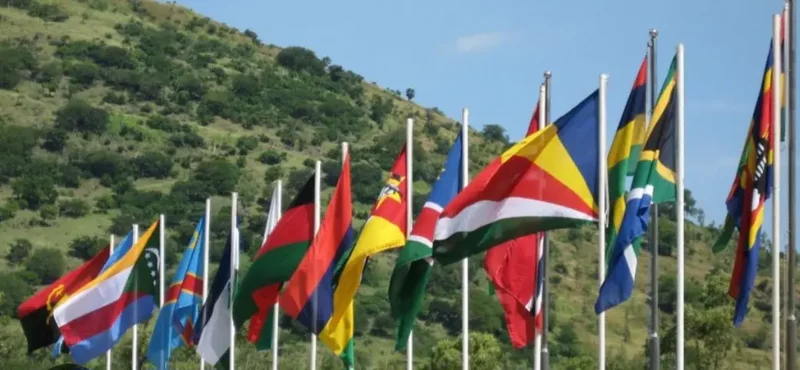
For a country that often struggles to find its footing in global markets and attain a competitive advantage, South Africa holds one card it rarely plays well, that being the Southern African Development Community (SADC).
This week, as International Relations Minister Ronald Lamola accepted the SADC Council of Ministers chairpersonship for 2026-2027, the opportunity presented itself once again. The question is whether we will finally use it wisely.
Lamola has set out the right priorities he wishes to advance during this chairpersonship. The priorities include accelerating regional industrialisation, pushing for critical minerals beneficiation, expanding infrastructure and strengthening human capital. These are not new ambitions. The SADC has been talking about these things for decades. What is new is the urgency. With regional trade languishing at around 20% of total commerce and manufacturing contributing only 10% of GDP, we are running out of time to change the story and drive regional integration.
Keep in mind that the SADC region is one of the few regions where South Africa has a competitive edge at a time when global markets remain exceptionally challenging and unpredictable. South Africa continues to dominate the SADC region and account for almost half the regional GDP.
Ultimately, the real opportunity lies in how South Africa approaches the tenure. For too long, policymakers have treated the SADC as a market for our finished goods and a source of cheap raw materials. Trucks simply leave Johannesburg packed with manufactured products and return carrying minerals. That is not regional integration. It is old-fashioned extraction dressed up in diplomatic language. The entire SADC region continues to export minerals and agricultural commodities while importing manufactured goods.
Lamola acknowledged this uncomfortable truth when he noted that "our region's wealth has nourished economies far and wide, while our own economies have remained trapped in old patterns of extractive accumulation". The solution he proposes to address the disparity, including beneficiation, building regional value chains and increasing intra-regional trade, is sound. But the implementation will require South Africa to do something it has historically resisted: treating its neighbours as genuine partners in industrialisation and development as opposed to its junior suppliers.
Consider the statistics. The SADC region holds nearly 30% of the world's proven critical mineral reserves, including approximately 50% of global cobalt reserves and 20% of graphite reserves. The global green and technological transition depends on the materials. Yet we continue to export them raw, watching value accrue elsewhere. The African Export-Import Bank estimated in 2018 that the untapped potential of intra-Africa trade stood at $84 billion, with the SADC region accounting for $53 billion of that figure.
This is precisely where South Africa's competitive advantage becomes relevant. Within the SADC, we possess superior infrastructure, financial services, technical expertise and institutional capacity. We are the region's most industrialised economy. This is not something to apologise for but something to leverage, provided we do so in a way that benefits the entire region rather than merely enriching ourselves.
The Industrial Development Corporation's (IDC) approach provides us with a glimpse of what is possible. Its work on battery-grade manganese projects in Botswana and support for processing facilities in South Africa demonstrates a model where value addition happens within the region rather than outside it. This is the kind of project that should define South Africa's tenure: not extracting from neighbours but investing alongside them.
South Africa has set an ambitious target of achieving 50% intra-SADC trade. This is not merely aspirational; it is necessary and, frankly, about time. Achieving this reality will require a fundamental shift in how South African businesses view the region. We cannot expect to export more to our neighbours while importing only their raw materials. True integration means building production networks that cross borders, where a component manufactured in Botswana, processed in South Africa and assembled in Zimbabwe benefits all parties.
The region has vastly changed and evolved during South Africa's years of inward focus. Other middle, emerging and great powers such as China, the European Union, India and Saudi Arabia are making inroads, negotiating their own preferential arrangements with individual SADC states. If South Africa does not lead this integration, others will. And they will not build value chains here but instead continue to extract from us as we have extracted from our neighbours.
This is the moment to move beyond rhetoric. The Skukuza retreat objectives are clear and the priorities set. What remains is the political will to treat the chairpersonship not as a diplomatic honour but as a strategic and economic necessity. South Africa's future industrial competitiveness depends on a prosperous, integrated and peaceful SADC region. We cannot succeed alone. It is time we started acting like it. The region and the world require the Republic to continuously adapt, adopt and lead to navigate a plethora of harsh economic and political realities.
Shaun is a researcher with a special interest in climate change and geopolitics and is the Mail & Guardian Top 200 Young South African 2026 award recipient**. **