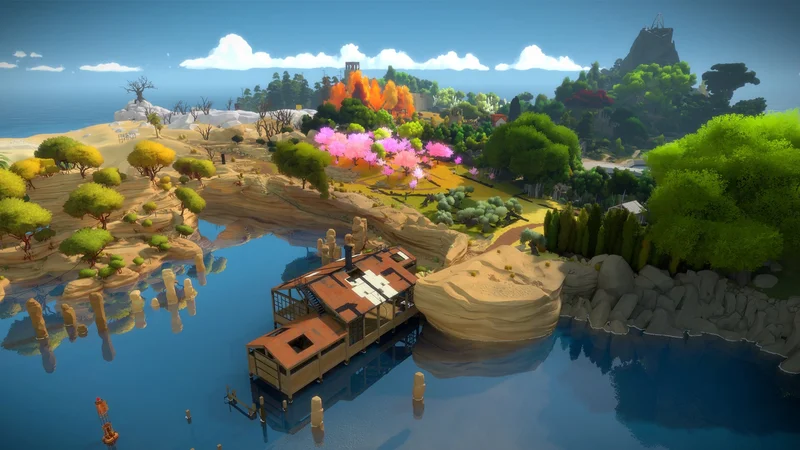
10 years ago, a game almost broke me. A wide-eyed 24-year-old, as yet undecayed by nearly a decade in games media, I found myself enraptured by The Witness. Eager to eat up every one of the maze-like puzzles hidden around its island setting, I simply couldn’t get enough. That’s until I hit its final challenge. It was optional, but not for me. This brick wall of a bastard drained brainpower out of me each time I smashed my head against it. But the moment I finally broke through was a rush like little else — the kind hardened soulslike players get when finally striking down a boss after several hours of trying. It’s still the single most difficult trophy I’ve ever earned, and as such, my most prized PlayStation platinum. But while that digital achievement sits proudly in my account, it's nothing compared to how it made me feel in the moment, and I’ve been chasing the same sort of thrill ever since.
Indie developer Jonathan Blow’s 2016 masterpiece holds many secrets. The further you explore The Witness’s island setting, the more layers are revealed to you. At face value, it's a simple premise: complete the electronic-screen-bound digital mazes in each of its biomes to unlock the island’s central mystery. Each of these environments comes with its own ruleset, too. They’re all fundamentally about tracing a line between a start and an end point of a grid, but rarely, if ever, is it that simple. The clues to a successful route are always there, whether they be seen in the sun reflecting off the ocean or heard in recordings of wildlife chattering among the trees, making each of these main areas relatively manageable. Search beyond that beaten path, though, and things start to change.
It all gets very testing; there’s no doubt about that. But at least it’s somewhat relaxing. No music to distract you or imminent threats breathing down your neck make for a soothing setting to aid the inevitable headaches. Until you find its darkest secret and decide to embark on its fiendish final challenge, that is.
“Just like a legitimate puzzle is only a puzzle if you might never figure it out, a legitimate challenge is only a challenge if you might never beat it,” its creator, Jonathan Blow, told Kotaku in 2016. And it really did feel like that.
There’s no way of cheesing this final conundrum-filled-cavern. There is no way to look up the solutions, nor any way of taking shortcuts, as each of the challenge’s mazes is randomly generated. To unlock the tomb-like building at the end of this snaking cavern, you’ll have to solve puzzles that are freshly generated at the start of each attempt. But before you even begin to solve them, you have to actually find them; the first battle is to locate each and every maze that is scattered around the cave, with brainteasers hidden up high and wrapped around pillars. By this point in the game, at least you’ll know the type of puzzle and the rules dictating each’s solution. But putting that information into practice is a completely different proposition.
That would be hard enough to do when you have all the time in the world to think, but that would be far too easy. Instead, this challenge gives you just under 400 seconds — the time it takes for two classical compositions, In the Hall of the Mountain King and Anitra’s Dance, to play back-to-back on a gramophone in one final, pretentious cherry on the cake — to solve all 14 puzzles. That’s just under half a minute for each. And these aren’t rudimentary line traces from A to B, but labyrinths that contain some of the island’s most complex rulesets, featuring symbols, colours, and other tricks that simply can’t be brute-forced.
Oh, and pause your game to even have the audacity to think about taking notes, and you’ll have to start all over again.
It’s a brutal, yet brilliant final challenge of a bona fide masterpiece. The Witness allows you to take whatever level of depth you wish from it. You could follow its critical path and reach its main credits fully satisfied. Or you can look beyond the obvious, diverting your eyes away from the puzzle boards in front of you and into the larger world itself, tracing lines across architecture and into the sun itself. You could engage further in its loose story elements and uncover the allegorical messaging woven throughout. Then you can do what I and only 9.75% of players have done, and fully drain it for all that it’s worth: letting that final puzzle stretch your sanity to its limits while telling yourself it's all worth it for a hit of dopamine that comes with a digital platinum trophy popping up on your screen.
Ever since The Witness, I’ve been chasing a puzzle game of this caliber. I’ve enjoyed the likes of The Talos Principle, Manifold Garden, Lorelei and the Laser Eyes, and Blue Prince, to name just a few. But it’s the memories that the recently released Big Walk has been resurfacing that have set my synapses sparking most strongly. House House’s co-op adventure takes place on a similarly mysterious island, home to a population of puzzles. And while not seeming as testing as The Witness — I’m still in the early stages, so I may regret this assertion — it brings with it the same sensation of cerebral discovery.
More so, it takes me even further back to some of my formative video game memories. As a young kid, I’d spend weekend afternoons watching my dad play Myst, Riven, and its sequels on a chunky PC monitor, not knowing that it was the beginning of a road that would take me to the inside of The Witness’s mountain. I guess I should thank him. Incidentally, I was saddened to see Cyan World’s latest sequel project had been shelved, which looked great from the teaser trailer released by the developers. It’s a shame that it looks set to stay unreleased, but I would love to have played it and been able to get a copy over to my dad, a lapsed gamer, who I’m sure would have loved to have stepped back into the world of Myst once again.
Of course, since 2016, people have put my achievement to shame, with speedruns available to view that complete the challenge in just 80 seconds. Sickening, yes, but I’m still proud of my accomplishment, and value it as perhaps my most euphoric video game moment.
I did have small mental flashbacks to it last year when I subjected myself to Death Stranding 2’s most stressful test: a delivery around the whole circumference of Australia, which needs to be done in 40 minutes or under. The first time I attempted it, I got stuck on a rock halfway around and missed out by six seconds. I almost threw my PS5 out of the window. Luckily, half an hour later, I cracked it and secured that Platinum trophy alongside.
So, I ask you. What’s the biggest challenge you’ve ever overcome in a game? Have you been chasing that thrill ever since, or do you choose to bask in the glory of past triumphs? I’d like to think I’ve grown up and don’t have time for such things anymore. But deep within me, I know that if I stepped back onto that island, I’d do it all over again.
Simon Cardy is a Senior Editor at IGN who can mainly be found skulking around open world games, indulging in Korean cinema, or despairing at the state of Tottenham Hotspur and the New York Jets. Follow him on Bluesky at @cardy.bsky.social.