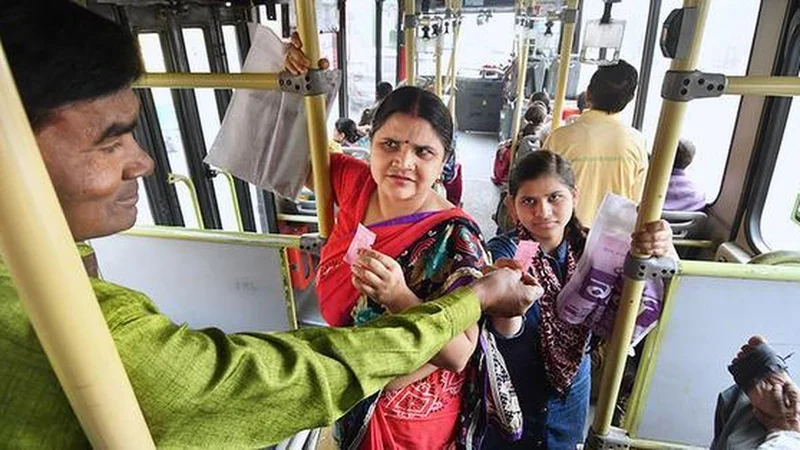
For thousands of women who navigate the chaotic capital every morning on a Delhi Transport Corporation (DTC) bus or cluster buses, the transition to the mandatory Pink Saheli smart card from September presents two very different sides. While the Aadhaar-linked card will offer a streamlined, modern experience for local residents, the new digital push creates a bureaucratic wall for thousands of migrant workers and outstation students as they now face the challenge of establishing a local domicile to travel free.
Launched in March this year, following its announcement in the Delhi budget the previous year, the Pink Saheli card, or the National Common Mobility Card (NCMC), replaces a flexible pink-ticket system and aims to provide free bus travel to women and transgender persons. Following an official order on Saturday (August 15), the Delhi government extended the current pink ticket facility until August 31, 2026, from the earlier deadline of August 16, providing a two-week window to boost public awareness through depot announcements, social media, and print media.
For locals, obtaining the card is a one-time chore handled through roughly 50 designated centres, including District Magistrate (DM) and Sub-Divisional Magistrate (SDM) offices, select DTC bus depots, or online via the transport portal. The core issue lies in the strict requirement for an Aadhaar Card with a Delhi address for registration. While about 18 lakh cards have already been issued successfully, the government is rushing to expand distribution before the August-end deadline. Yet, the systemic gaps remain evident. According to a report in The Hindu in June, transgender residents and non-locals have faced challenges in obtaining the card.
Aadhaar, metro hurdle
“I cannot get the card made even though I have worked here for a couple of years,” said Pooja, a domestic help from Haryana who goes by first name. She regularly takes a DTC bus around central Delhi. “I do not have an Aadhaar address from Delhi.”
Rekha Prajapati, another migrant worker from Madhya Pradesh said the documentation requirement did not reflect the uncertainty of their living arrangements. “Our work and places of residence are not always fixed. We cannot keep changing the address on our Aadhaar cards every time we move, especially when taking time off work itself is difficult,” the worker said.
The card can be recharged for paid metro travel, but the free-travel benefit currently applies to buses.
Anita Devi, a domestic worker and single mother of two, travels from Gurugram to Delhi for work and spends ₹43 each way, or ₹86 every day in the Delhi Metro. “Spending that much on travel puts a strain on my monthly expenses,” she said. Originally from Delhi, she said she has obtained the card. She is now temporarily living in Gurugram and is unable to use the card’s services on the metro. She said that if the benefits of the Pink Saheli Card were also available on the metro, it would make a big difference in reducing her travel expenses.
Impact on students
The exclusion extends beyond migrant workers to the capital’s vast outstation student population.
Antara Abhilasha, a Delhi University student from outside the capital, said many students live in rented flats or paying-guest accommodation without local address proof. “The card requires proof of Delhi residency, which excludes students like me,” she said. “The scheme could have been more inclusive for people in Delhi for work or educational purposes if, instead of requiring a local Aadhaar address, applicants were allowed to submit college fee receipts or proof of employment,” she said.
Aditi Chopra, another student from outside Delhi, said, “There are so many students like me who have moved here from different parts of the country. We rely on public transport every day just like permanent residents do.”
Awareness challenge
For permanent residents, the digital switchover has been simple. Ms. Shalvi Jaiswal, a resident of South Extension in south Delhi and a recent graduate from University of Delhi’s Kamala Nehru College, said, “The process was very easy for me. I went to the nearest SDM Office, scanned the QR code to receive a token, entered my basic details such as name, phone number, Aadhaar number, etc. I received an OTP and entered the OTP for verification...,” she said.
She heard about the card from her mother, online videos, and bus announcements. However, Ms. Jaiswal admits that awareness remains a challenge for the wider public.
Akshita Chhibber, a law student from Delhi, also believes minor policy shifts could easily bridge the gaps. “Provisional cards for long-term workers and students, alternative documents, metro integration and outreach through colleges could help ensure that women who rely on affordable public transport are not left out,” she said.
(Ekaa Kant Kohli contributed to the reporting of this story)
Published - August 17, 2026 06:22 pm IST