TechRadar Verdict
The DJI Mic Mini 2S takes nearly everything that makes the flagship Mic 3 appealing — internal recording, 32-bit float and AI noise cancellation — and delivers it at roughly half the cost. Its audio quality is superb, and noise cancelling is a step up over the regular Mic Mini 2. Yes, it's substantially more expensive than the Mini 2, but stacks up so many features and functions that it may end up eating into the Mic 3 sales.
Pros
- +Audio quality that rivals the pricier DJI Mic 3
- +Internal recording and 32-bit float included
- +AI noise cancelling is a step up from the Mic Mini 2
Cons
- -Considerably pricier than the standard Mic Mini 2
- -Still lacks the Mic 3's timecode, dual-file recording and touchscreen receiver
Why you can trust TechRadar
DJI Mic Mini 2S: two-minute review
Until now, DJI's compact wireless mic lineup has had a clear budget option in the Mic Mini series and a clear flagship in the Mic series, with a gulf of features and price separating the two. The Mic Mini 2S changes things, and slots right into that gulf. It's not quite a flagship-killer, but with this release, DJI now has three tiers of small wireless mic — and this middle one is very appealing.
Much of the flagship DJI Mic 3's DNA has trickled down into the Mic Mini 2S: internal recording, 32-bit float support, AI-driven noise cancellation, adaptive gain modes, fast file transfers. These were all things that, until now, meant paying a premium. The Mini 2S borrows them wholesale, wraps them in the same pocket-sized transmitter and case as the standard Mic Mini 2, and undercuts the Mic 3 comfortably on price.
Audio quality is superb. Whether I was recording via the receiver connected to a camera or going wireless direct to an OsmoAudio device, the results were clean, full-bodied and detailed. An impressive feat for a supposedly budget offering.
Noise cancellation is another highlight. The new AI-assisted system handled everything I threw at it, from a droning desk fan to a chatter-filled pub garden, with a level of polish that puts some real distance between the Mini 2S and its S-less little sibling. It's not quite at the level of the class-leading Insta360 Mic Pro, but it's a comfortable step up from the standard Mic Mini 2's basic noise reduction.
Having tested both the Mic Mini 2 and Mic 3 extensively as well as the Mini 2S, I'd say the average creator might struggle to justify paying the Mic 3 premium now. Those with more demanding needs still have reasons to look past the Mini 2S, though: the Mic 3 offers more than double the onboard storage per transmitter, a touchscreen receiver display for on-the-fly monitoring, dual-file recording, onboard timecode, and more granular gain control — stuff which probably matters for professional productions.
For everyone else, the Mini 2S is the new sweet spot in DJI's range. It's a tiny mic that really punches above its weight.
DJI Mic Mini 2S: price and release date
- Released August 4 2026, priced from £59 / AU$99 to £183 / AU$328
- Sold in four separate bundles, plus individual transmitters, charging cases and cover sets
- Available globally — aside from in the US
The Mic Mini 2S launched globally on August 4 2026, not long after the Mic Mini 2's April 2026 arrival. I say "globally", but as with every other DJI product released recently, it isn't officially available in the US, with the company blaming ongoing regulatory hurdles.
Sign up for breaking news, reviews, opinion, top tech deals, and more.
The Mini 2S comes in a wide range of configurations. At the low end, a single transmitter (TX) costs £59 / AU$99, while receivers (RX) add to the cost. The core bundles are the DJI Mic Mini 2S (1 TX + 1 RX) and the DJI Mic Mini 2S (1 TX + 1 Mobile RX + Charging Case), both priced at £79 / AU$149. Stepping up, the DJI Mic Mini 2S (2 TX + 1 RX + Charging Case) costs £169 / AU$279, while the priciest option, at £183 / AU$328, has 2 TX + 1 RX + Charging Case as well as a Mobile RX.
It's a big price jump over the Mic Mini 2, where equivalent bundles cost roughly half as much: £29 for a standalone transmitter and £89 for the full 2 TX + 1 RX + Charging Case kit. It also puts the Mini 2S's 2 TX + 1 RX + Charging Case at the same price as the entry-level Mic 3 bundle (£169 for 1 TX + 1 RX).
DJI Mic Mini 2S: specs
| Dimensions | TX: 28.6 x 28 x 13.5mm / RX: 46.5 x 29.6 x 19.3mm / Mobile RX: 39.3 x 27.3 x 9mm |
| Weight | TX: 0.4oz / 12g (with magnetic front cover, without clip or magnet) / RX: 19g / Mobile RX: 6.5g |
| Range | With standard RX: up to 400m / with mobile RX: up to 300m |
| Connectivity | RX: USB-C / Lightning, 3.5mm jack |
| Bluetooth | Yes (Bluetooth 6.0) |
| Battery | 11 hours (transmitter), 10 hours (receiver), up to 40 hours with fully charged case |
| Noise cancelling | Two-level, AI-powered |
DJI Mic Mini 2S: Design
- Looks nearly identical to the Mic Mini 2
- Features swappable magnetic covers in range of colors
- Redesigned charging case now fits the 3.5mm cable
If you've seen the Mic Mini 2, you already know what the Mini 2S looks like. DJI has barely touched the exterior: the transmitters are the same size with the same interchangeable magnetic front covers (available in the same range of colors, from timeless black to a fetching shade of magenta). The receiver, too, is essentially unchanged, which means there's no onboard display to keep an eye on gain or adjust settings; you'll need to open up the Mimo app on your smartphone to do that.
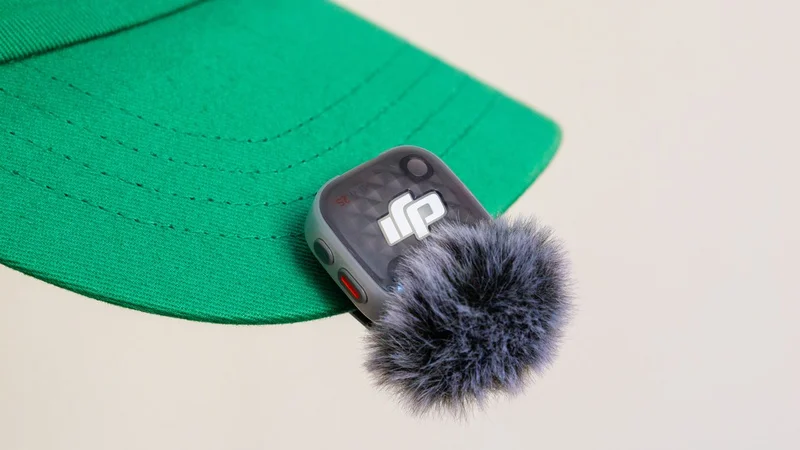
The family resemblance is generally no bad thing. At just 0.4oz / 12g with a cover attached, I barely noticed the transmitter magnet-attached to my shirt, and I couldn't feel it at all when clipped to the peak of a baseball cap. The detachable clip still rotates through 360 degrees (in 90-degree increments) so the mic capsule can be aimed correctly whichever way you've mounted it, and the magnet option remains handy for thinner fabrics where a clip might snag.
There is one small but positive design change: DJI has found room for the 3.5mm cable inside the charging case (something the Mic Mini 2's case couldn't manage) which means the entire two-transmitter setup, cables, windshields and mounting options included, now fits in one pocketable case. With portability being a huge part of the appeal for a mic like this, it's a step in the right direction.
DJI Mic Mini 2S: Performance
- Offers internal recording with 14.5GB of storage space on transmitters
- Includes AI noise cancelling, improving on the Mic Mini 2's system
- Transmitter battery life roughly in line with Mic Mini 2's, and better than Mic 3's
The Mic Mini 2S's marquee upgrade over the Mic Mini 2 is internal recording, which I think is a huge deal. Every previous Mic Mini had to transmit to something — either a receiver, or an OsmoAudio device — to be of any use, but the Mini 2S transmitter can function just fine all on its own. With around 14.5GB of usable storage on each transmitter, it can store up to 28 hours of 24-bit recordings, or around 22 hours of 32-bit float recordings.
For those who aren't familiar, 32-bit float (which is available on the DJI Mic 3 but not the Mic Mini or Mini 2) doesn't inherently make your recordings sound better, but rather dramatically widens the available dynamic range. If levels unexpectedly spike or dip during a recording, 32-bit float gives you far more room to correct for that in post without clipping or losing detail. It's less about raw quality and more about insuring you're covered when recording in unpredictable environments.
Another upgrade over the Mic Mini 2 is 4TX + 1RX support, meaning you can record from four separate transmitters onto a single receiver. I'd say this is a much more situational addition: handy if you're recording podcasts, panel discussions or similar, but not something most solo creators will need day to day.
File transfers are roughly twice as fast as the Mic Mini 2's when pulling recordings off the transmitter via the charging case. If you're regularly transferring lengthy 32-bit float recordings, those saved minutes might add up — but again, it's a situational improvement.
Noise canceling is where I noticed the clearest real-world improvement over the Mic Mini 2. The Mini 2S's AI-assisted system does a better job than the older mic's more basic noise reduction: it very nearly eliminated a loud desk fan running in my office, and noticeably cut through background chatter when I tested it in a busy pub garden so that my and my wife's voices remained nice and clear. For context, I still rate the Insta360 Mic Pro as the best noise-canceling wireless mic I've tested, but it also costs considerably more than this.
Alongside noise canceling, the Mini 2S also gets DJI's adaptive gain features, Clipping Control and Loudness Balance (previously available on the DJI Mic 3 but not the Mic Mini 2). The former automatically pulls back gain to stop sudden loud moments from distorting, while the latter lifts quieter sounds to even out levels — useful if you're recording somewhere volume might swing unpredictably.
The Mic Mini 2S's audio quality is superb no matter how you use it. It supports quality up to 96kHz/24-bit with the receiver connected to a camera, or up to 48kHz/24-bit over a direct OsmoAudio connection, plus the aforementioned 32-bit float. Frankly, I don't think most people (myself definitely included) would be able to reliably pick a Mini 2S recording out from one made on the considerably pricier flagship Mic 3, which says a lot about how good this is for a supposedly budget microphone.
On the battery life front, things are roughly the same as they were on the Mic Mini 2: a transmitter can record for a round 11 hours on a full charge, while the receiver can keep going for around ten. With two transmitters, the receiver and a charging case, you can expect around 40 hours of combined use before needing to track down a power socket.
That's a bit worse than the Mic Mini 2 (which offers 11.5 hours, 10 hours and 48 hours across the transmitter, receiver and charging case), but much better than the Mic 3 (8 hours, 10 hours and 28 hours respectively).
Should I buy the DJI Mic Mini 2S?
Buy it if…
You want DJI Mic 3-esque performance without the Mic 3 price
With AI noise canceling, 32-bit float support and internal recording, the Mini 2S closes the gap to DJI's flagship mic very effectively – and at around half the cost.
You want reliable recording receiver-free
Internal recording means the Mini 2S transmitter can capture audio on its own, giving you a safety net if your wireless connection drops or you don't want to carry a receiver at all.
Don’t buy it if…
You're on a tight budget
The Mini 2S is roughly double the price of the standard Mic Mini 2, and the Mini 2 still does a perfectly good job for creators who don't need internal recording or AI noise canceling.
You want advanced pro-level features
Onboard timecode, dual-file recording, precise gain control and a touchscreen receiver display are still DJI Mic 3 exclusives.
DJI Mic Mini 2S: also consider
Insta360 Mic Pro
Insta360's flagship costs a lot more than even the priciest Mini 2S bundle. It justifies that gap with noise cancelling that's a step above anything currently offered in a DJI-made mic, plus party pieces like a customizable E-ink display and switchable polar patterns.
Read our Insta360 Mic Pro review
DJI Mic Mini 2
If the Mini 2S's price compared to its predecessor gives you pause, it's worth remembering the standard Mic Mini 2 remains a very capable mic in its own right — albeit one with no internal recording, 32-bit float or AI noise canceling. For creators who don't need those, it's fantastic value for money.
Read our DJI Mic Mini 2 review
How I tested the DJI Mic Mini 2S
- Two weeks of testing indoors and outdoors
- Connected to Panasonic Lumix GH6, iPhone 13, OnePlus Pad and DJI Osmo Action 6
- Also tested using internal recording without a receiver or camera
I was sent a review sample of the DJI Mic Mini 2S (2 TX + 1 RX + Charging Case) kit, and tested it for a couple of weeks, putting it through its paces in a range of indoor and outdoor conditions from quiet offices to windy walks and busy public spaces. I paired it with my Panasonic Lumix GH6 mirrorless camera, my iPhone 13, a OnePlus Pad tablet and the DJI Osmo Action 6 via OsmoAudio, testing both wireless transmission and manual connections. I also tested the Mini 2S's headline new feature directly, using the transmitter as a standalone recorder with no receiver or camera involved at all.
- First reviewed: August 2026
- Read more about how we test
Sam has been writing about tech and digital culture for over 20 years, starting off in video games journalism before branching out into the wonderful worlds of consumer electronics, streaming entertainment and photography. Over the years he has written for Wired, Stuff, GQ, T3, Trusted Reviews and PC Zone, and now lives on the Kent coast in the UK – the ideal place for a camera reviewer to ply their trade.