Violence against paramedics: Inside rising assaults on ambulance crews
The officer was later found to be covered in glass and bruised – he’ll have a shiner.
Gavin, a Hato Hone St John area operations manager in Hamilton, raises his eyebrows.
The expression carries no surprise or shock and simply implies “that’s what it’s like out there”.
Hato Hone St John area operations manager Adrian Gavin says almost every shift has some violent incident towards staff. Photo / Mike Scott
Violence against ambulance crews, both professional and volunteer, is a growing issue.
As Gavin drives through the city’s hospitality centre, gauging the night’s mood, he explains the menu of violence his teams face – from verbal abuse and sexual assault, to punching, spitting, and even biting.
There is also frequent vandalism of vehicles and equipment.
“I’ve been in the role now 32 years, and certainly in the first 20 years, assaults and aggression were relatively uncommon.
“But now there’s hardly a shift goes by where there isn’t a report of some form of abuse or an assault.”
Violence against Hato Hone St John staff rose 10% from 2024 to 2025. Photo / Mike Scott
The disturbing video sent from Thames backs up Gavin’s claim.
One officer doing his job is punched, bruised and shaken. The critical tool - the ambulance – is left damaged and out of action.
Why is violence toward paramedics on the rise?
“There’s probably a whole multitude of reasons why it’s happening but to actually put your finger on one particular cause is probably not possible,” says Gavin.
“But it’s quite sad to see that society seems to see us as a target when we’re trying to help people.”
Hamilton-based paramedic Stella, 27, is a recent victim of a violent attack which left her bruised and concussed. Photo / Mike Scott
Stella, 27, is back at work after a break.
The time away wasn’t a holiday. She had flown home to Alice Springs to be with her mum after being beaten on the job and suffering a concussion.
Stella and another female ambulance officer had been attending a “mental health incident” where a man had taken an overdose.
The man’s partner was on edge, and her agitation grew as Stella asked the questions she needed to help him.
“I was noticing that she was getting upset and I was trying to diffuse the situation as much as I could, it never crossed my mind that anyone would ever actually lay a hand on me until it happened.”
The woman then threatened to punch her.
“And then she ran at me, grabbed me by my hair, threw me into the wall and then onto the ground.”
Stunned, Stella managed to crawl behind a door into an adjoining room, and with her workmate, they were able to barricade themselves as the wildly angry woman wailed on the other side.
'You want to think that people are good, you know, and then something like this happens and it’s hard to believe that.' Photo / Mike Scott
“I think that if we didn’t get away from her, I think she would have really hurt me.”
The pair followed protocol and pressed the emergency button on their radio, alerting police.
Stella’s steady recount slips. Tears well, and she is asked whether the experience is still raw.
“No, no, I think ... I think it’s just disappointment, [I’m] just disappointed that someone can treat you that way.
“You want to think that people are good, you know, and then something like this happens and it’s hard to believe that.
“I think this is a job that people do ... because we have an innate love for helping people and having a positive impact in our community and improving people’s lives.
“And it’s not an easy job to get either, you know, you’ve got to go through three years of uni, you’ve got to accrue debt.
“I’ve moved away from my family and everyone that I love so I can do this job because it’s so important to me.
Hato Hone St John supports the Crimes Amendment Act, which would increase penalties for attacks on paramedics. Photo / Mike Scott
It’s getting to 7.30pm, and apart from viewing the violent video, the shift is uneventful.
Fluorescent lights now light the mess room. A muted siren signals callouts, but they are minor or in private residences where media do not have automatic access.
This is the second attempt at a “ride-along” with Hato Hone St John. The first, a week earlier, was a non-event – a victim of the old jinx: when a journalist turns up to witness the action, there isn’t any.
“You should’ve been here last night,” is the usual quip.
In the week between, Hato Hone St John gave an oral submission to a Parliamentary select committee hearing of the Crimes Amendment Act. It would give paramedics greater legal protection and impose tougher penalties on those who assault them – similar to how violence against police is dealt with now.
Deputy chief executive Dan Ohs explained that in the past year staff had been exposed to 426 reported incidents of violence – a 10% increase from 2024.
The physical impact of the violence was actually less significant than the psychological impact, Ohs said.
Hato Hone St John national deputy chief executive of ambulance operations Dan Ohs. Photo / George Heard
“These are some of the toughest people I know that deal with things that most of us only watch on TV and they are fundamentally broken when they are assaulted by a patient.”
telling
The amendment would be “a signal that NZ Inc values them, supports them and backs them in the work that they do”, Ohs said.
On the frontline, paramedics are also being supported to be pragmatic, Gavin notes.
“We’re really encouraging our staff to use de-escalation measures and make sure they’ve got a good escape route from any patient that they’re dealing with,
“Quite often when our crews are dealing with a patient, quite often it’s a friend or a relative or a bystander who’s getting violent and aggressive.
“They’ll try and talk them down, but if they continue with it, our staff will just withdraw from the scene and if necessary, request police assistance.”
Paramedics are fully supported to leave a scene if they feel threatened, Adrian Gavin says. But violent attacks can happen with no warning. Photo / Mike Scott
Escape is not always possible and it is something Gavin knows from his years on the job.
“It’s very unnerving when you’re attacked, without notice, when you’re not expecting it, it can certainly catch you by surprise.”
He recalls being grabbed from behind as he radioed for police because, in the back of the ambulance, his female crew member was being punched by the woman they’d been treating.
The arms around his throat were the patient’s boyfriend, holding Gavin in a headlock. Despite the choking, Gavin got his call through.
“Thankfully, the police turned up very, very quickly, as they do when we put out an emergency call to them.
“It’s never nice going home afterwards to your family and telling them that you were assaulted and attacked at work.”
Gavin believes the public has a role to play.
“If they see us treating patients in a public place and we’re getting abused or assaulted, we’re really hopeful the public will step in and help us.
“And we just want the public to let us do our job, and let us do it safely.”
Paramedics file in and out of the kitchen area, dressed in ambo green, taking food breaks when they can – completing paperwork and catching up.
There is a mix of young and older staff, female and male.
The subject of sexual abuse has come up in conversation. Female paramedics are subject to it, and it is becoming more common, Gavin said.
According to Hato Hone St John data, almost 60% of staff are female, and many are young – in their 20s – like the four eating dinner at the end of the table. (The Herald is not using their names for safety reasons.)
Mild sexual harassment – mostly verbal comments – occurs on every four-day shift rotation, the 23‑year‑old says.
“I think being a young female in this job, you get a lot of it, and we normalise it because it’s just so common.”
Efforts are underway to address and mitigate these incidents to protect paramedics. Photo / Mike Scott
The 21‑year‑old chimes in.
“I feel like people are much more comfortable making verbal comments, thinking that it’ll go under the rug, and then you go to the people who are taking it that step further and like making physical advances.”
The 29-year-old speaks up.
“That’s where you’ve got to draw a line. It took me a really long time to be able to do that. I’ve had people grab my thigh, rub their hand up my thigh, and I said, ‘don’t f...ing touch me’.
“You need to cut that shit, otherwise it’ll keep happening.”
At the other end of the table, Gavin monitors the calls.
A motorcycle accident on the outskirts of Hamilton was categorised orange because the patient was initially talking, but now they are not.
It has escalated to code purple – immediately life‑threatening.
The sort of violence paramedics face during their work includes verbal abuse, sexual assault, punching, spitting, and even biting. Photo / Mike Scott
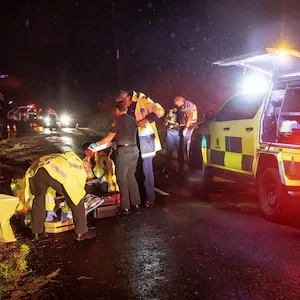
Rain peppers the windscreen as the ambulance speeds toward Hamilton’s edge.
The siren fires when needed to pass cars, while the paramedics calmly work through their checklist.
Turning into a rural road, there’s a long line of emergency vehicles with lights flashing across the dark countryside.
At the end of the column is a huddle of high-vis staff working furiously to save a life.
The effort is unsuccessful.
Many of the paramedics who had filed in and out of the mess room earlier are here now. A bit downcast but still professional, completing their work around the body lying on the road.
Earlier in the evening, Stella said being a paramedic was a tough gig.
She also admitted she had thought of quitting after the attack that left her concussed.
“You sacrifice so much just because you love helping people and then people turn around and treat you that way and cause physical and emotional trauma to you. I just think it’s really disappointing and really hard.
“But, I really love this job, so I’m back.”
Mike Scott is an award-winning visual journalist with more than two decades of experience telling stories across multiple media platforms.
Sign up to The Daily H, a free newsletter curated by our editors and delivered straight to your inbox every weekday.