In many ways, the sunfish could not have been better-designed as an orca's chew toy. The largest species, the oceanic sunfish Mola mola, can grow up to 10 feet long and weigh up to 6,000 pounds. And yet it is almost unfathomably helpless. Its body resembles a serving platter. It has no tail fin, just a tall dorsal and anal fin, which it flaps in unison to get around. A sunfish often spends its time lounging on its side at the surface of the water, basking in the sun and allowing seabirds to nibble on the parasites that riddle its skin. It has no venom or spines; its only real defense is somewhat thick skin. It's not even a very good swimmer. While a sunfish can reach top speeds of around two miles per hour, an orca can rocket through the water as fast as 35 mph.
So it's no surprise that such a large and lumbering fish might offer a wandering pack of orcas some welcome entertainment as they cruise in the clear waters off the Gulf of California. Of course, what is amusing for an orca is terrifying for any non-orca witnesses. Something that might make an orca click and whistle with glee will certainly make an adult woman go "Oh my god! Oh my god! Oh my god! Holy shit!" Relatedly, please enjoy the video below.
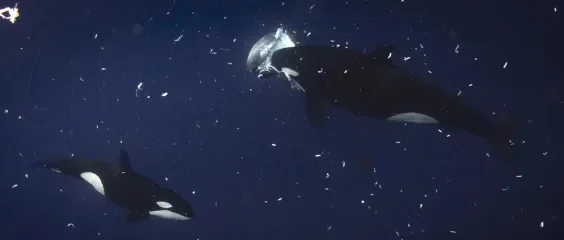
That is an orca headbutting a sharptail sunfish so hard that it explodes into a blizzard of flesh and guts. Kathryn Ayres, a scientist at the nonprofit Beneath The Waves, recorded the video, and Ayres and her colleagues subsequently analyzed the behavior in a new paper in Frontiers in Ethology. It is probably not surprising that such intelligent, social, and perverse creatures as orcas, which are famous for playing with their prey, would devise a newly horrifying way of interacting with their food. And yet this particular practice strikes me as especially intelligent, social, and perverse.
Ayres and colleagues have dubbed this new behavior "ram-to-fragment." In it, one orca holds a sharptail sunfish in their teeth while a second orca accelerates towards the fish. The first orca releases the sunfish just before impact so that the second orca can ram it at high speed, producing a loud pop and instantly detonating the sunfish. After the sunfish has shattered, the orcas frolic in and feed on the fragments of its flesh. Fortunately, perhaps, for the sunfish, it is already dead when it is exploded, suggesting the ramming behavior is not intended to kill prey, but rather to process the carcass.
Now that you understand the play-by-play, please enjoy a second video of another group of orcas exploding a different sharptail sunfish.
This high-level coordination, while impressive, is old hat for an orca. The whales are well-known for cooperative hunting. They synchronize their attacks on mobula rays, seals, penguins, and even fearsome white sharks. They can even take on a whale shark, the largest fish on the planet, and a blue whale, the largest animal on the planet. In this way, hunting something as clunking as a sunfish might seem underwhelming.
But perhaps it is the sunfish's sedate disposition that makes it a perfect plaything. A 2023 paper published in Biodiversity Journal documented a wide range of interactions between orcas and sunfishes, broken down into predation and non-predation. The latter category was more interesting to me, divided even further into the following categories: no reaction, interest, disturb, play/harass, persecute. "Persecute" was the most perverse of the bunch, including records of orcas hitting, head-butting, body-slamming, maiming, or biting the sunfish, as well as knocking a sunfish out of the water or sending it hurtling through the air with a slap of a fluke. "Disturb" was also a delight, documenting orcas blowing bubbles at the sunfish, rushing at them for no apparent purpose, or startling them by opening their mouths and baring their teeth. The paper has many great photos of these interactions, including a charming photo of a young female orca wearing a sunfish as a hat and two young orcas trapping a sunfish out of the water between their faces.
The researchers behind the Biodiversity Journal review were confused why so many of the encounters between orcas and sunfish did not result in predation. A captive orca must consume 3.6 percent of its body weight per day, suggesting that a wild orca must eat even more. So why would an orca go through all that trouble to wear a sunfish as a hat or yeet it in the air and not even bother to eat it? The most obvious answer, the researchers suggest, is that orcas simply like to have a good time. Sometimes this means playing with their food—thwacking jellyfish, seals, and birds through the air before devouring them—and sometimes it's simply play. As the ramming behavior has only been observed with one sunfish species, the sharptail sunfish, the researchers speculated if there is something special about this sunfish that lends itself to explosion.
So are the orcas in the Gulf of California torpedoing sharptail sunfish for shits and giggles? It's plausible, but hard to say for sure. Both of the sharptail sunfish explosion videos analyzed in the new paper involve predation. Although the researchers do not know if any of the same orcas appear in both videos, both groups included a juvenile whale that fed on the smaller fragments of the blasted sunfish. As such, the authors speculate the high-speed ramming could be an act of good parenting, the orca equivalent of cutting up your baby's food into smaller pieces. But exploding a meal before you eat it does mean lots of perfectly good food goes to waste.
The orcas' intentions make little difference to a sharptail sunfish unlucky enough to be smashed into pelagic smithereens. Such is the life of such a big, defenseless fish. On good days, you might become a hat. On bad days, you might become confetti.