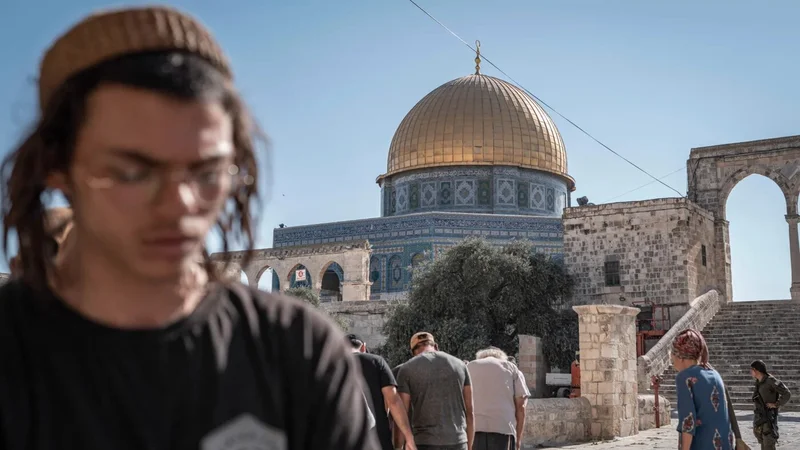
Israel formally allows Jewish prayer at Al-Aqsa Mosque in violation of status quo
Israeli authorities have formally allowed Jewish prayer for the first time inside Al-Aqsa Mosque in occupied East Jerusalem, in the latest violation of the site’s decades-old status quo.
Israeli police allowed settlers raiding the site on Sunday to bring in siddurim, or Jewish prayer books, and perform group prayers, according to a Palestinian source from the Jerusalem Islamic Waqf.
While such practices have occurred in the past, they have largely been carried out without official approval. The decision to officially permit them marks a significant shift.
The source, who requested anonymity, said the move represented the latest breach of the site’s status quo.
“There is an important distinction between coming to visit the site and coming to pray there,” the source said.
“When I come to your place as a visitor, you impose your rules on me. But today, they come with their own rules. When the police officially allow that, it means, in one way or another, that you are allowing them to establish their own rules in the space,” he added.
“This is an official breach of the status quo.”
The status quo is a decades-old, internationally recognised arrangement governing access to and management of Al-Aqsa Mosque.
Under the arrangement, the entire 144-dunam (14.4 hectares) complex is recognised as an exclusively Islamic holy site.
Responsibility for access, prayer arrangements, maintenance and excavations falls to the Jerusalem Islamic Waqf, the religious trust that administers the mosque.
'Jewish prayer at Al-Aqsa Mosque is becoming an organised practice'
- Palestinian source
But since occupying East Jerusalem in 1967, Israel has steadily eroded the status quo, with the formal permission for Jewish prayer representing the latest step.
For years, Israeli forces have turned a blind eye to Israelis praying at Al-Aqsa during daily raids on the site.
The source said the latest development transformed what were previously silent, individual acts of prayer into organised group worship, with religious texts now permitted inside the complex.
“Jewish prayer at Al-Aqsa Mosque is becoming an organised practice, rather than merely an isolated individual act.”
Wider restrictions
The source said the latest move was part of a wider campaign of restrictions on Palestinian access to and administration of Al-Aqsa, which has accelerated since October 2023.
“The pace of developments at Al-Aqsa Mosque since 7 October is staggering,” he said. “Things are changing at an incredible speed, almost daily. We have essentially lost control.”
According to Haaretz, the drive to permit Jewish worshippers to bring prayer sheets into Al-Aqsa Mosque began in January. Police have also allowed prayers, dancing and singing in the mosque’s courtyard.
The daily newspaper added that police said their enforcement policies at Al-Aqsa were “in accordance with directives from the political leadership”.
Last month, ministers and lawmakers led a mass raid on Al-Aqsa by ultranationalist Israelis, with more than 3,500 participants taking part.
Among them was Itamar Ben Gvir, Israel’s national security minister, who oversees the police.
Ben Gvir, a settler, has long called for what he describes as the imposition of “Israeli sovereignty” over Al-Aqsa Mosque.
During July’s raid, he said: “Look at what is happening here – Jews praying, feeling like they are the owners here.”
Mustafa Abu Sway, a member of the Islamic Waqf Council in Jerusalem, said the violations were part of a government plan rather than isolated acts.
“This desecration, including the introduction of prayer books inside the mosque, forms part of the systematic dismantling of what remains of the historic status quo at the blessed Al-Aqsa Mosque, with Itamar Ben Gvir determining what happens on the ground, with the approval of Prime Minister Benjamin Netanyahu,” Abu Sway told MEE.
He added that, alongside the expanding Jewish presence at the site, the government continued to impose heavy restrictions on Palestinian access and the work of the Waqf, which administers the complex.
“Muslim worshippers are prevented from entering in a manner that appears arbitrary on the surface but in fact reflects a systematic policy,” he added.