In recent years, Oslo’s Øya Festival has faced opprobrium. It was sold to private equity firm KKR in 2024, which also holds some unrelated investments in Israeli companies. In a country that prides itself on humanitarianism – in which corruption and scandal are vanishingly rare – this was a fairly sustained controversy that peaked last summer, with calls to boycott the festival. This year the mood has cooled somewhat, and the wealthy petro-state’s citizens seem content to fly Palestine flags.
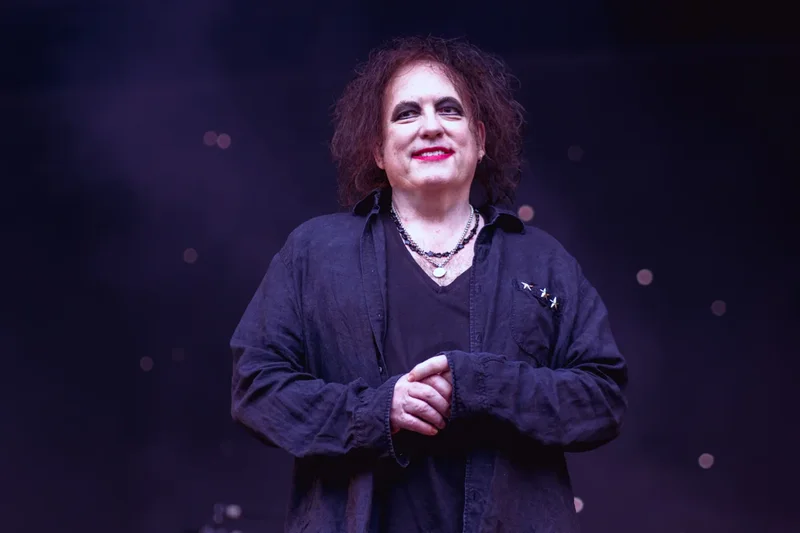
For a festival often punctuated by storms, it’s apt that the line-up is stuffed full of moody, dramatic acts. On Wednesday night, The Cure, those emperors of goth and pop, headline the main stage. The Crawley group have an incomparable catalogue of hits to play with, and deliver a sprawling set that even sees Robert Smith shed a tear during a captivating rendition of “Just Like Heaven”. Their set lasts two-and-a-half hours and spans more than four decades, including their early post-punk era, a stint as funereal doomsayers, and the synth-pop of their commercial peak. They save most of the bangers for the 10-song encore: “Lovesong”, “Lullaby”, “The Lovecats”, “Friday I’m in Love” and “Boys Don’t Cry” all ensue. Eschewing tight jeans these days for roomy combat trousers, Smith is leaning into his late sixties, but what remains constant is that voice: crystalline and pained and cracked only when he allows it. Seldom have I seen him more joyous.
Come Thursday evening, it is Nick Cave’s doom-laden sermons that bellow out across the fields, sending the normally polite crowd into a state of bedlam. Opener “Get Ready For Love“ gives way to a career-spanning set that veers from the chaotic, strangled guitar of “From Her To Eternity” to “The Mercy Seat”. Alongside music steeped in biblical imagery, rainfall feels like an accompaniment – as if this besuited preacher had summoned the heavens himself. “Eighty per cent of my songs are about the rain,” he says, having marched through “O Children” and “Train Long-Suffering”, with Warren Ellis pogoing across the stage, violin perched under his chin. By turns apocalyptic and poignant, flowing as it is with meditations on grief, the set ends on “Into My Arms”, a song that targets the tear ducts with laser-guided precision.
On the Circus stage, in a frustrating partial clash with Cave, Dev Hynes aka Blood Orange commands the space with the band’s nocturnal tangle of Prince-adjacent funk, saxophone and bruised falsetto. A Norwegian warehouse is an incongruous setting for songs that feel more at home in the latter hours of a clammy afters, but somehow the music blooms. There’s a soporific quality – on tracks such as the sublime “You’re Not Good Enough” and “Charcoal Baby” – with synths gliding over honeyed vocals. The immaculate coda of “Uncle ACE” drifts over the crowd. Hynes flits between guitar and keys with diffident grace. Melancholy, sensual and unexpectedly communal, this set whispers seductively.
Earlier in the day, Jalen Ngonda goes down a storm. Channelling Jackson Five through Sam Cooke into Otis Redding and Marvin Gaye, the Liverpool-based US singer is a proper throwback. Even his outfit – a purple jacquard jacket with metallic gold geometric threading, and sharp red undershirt bleeding through at collar and cuff – is from another time. And what a voice he has, somersaulting effortlessly through the octaves: rasp one moment, creamy melisma the next.
Later on, festivalgoers flock to Geese, a sprawling post-punk outfit massive right now after the release of their debut album Getting Killed. Theirs is a ramshackle din lent ballast by surreal, acerbic lyrics and frontman Cameron Winter’s vocals, which move between velvety croons and strained shrieks.
A more dulcet counterpoint is provided by Hannah Storm, an exceptionally talented Norwegian singer whose atmospheric piano melodies and retro-pop sensibilities, underpinned by an exquisite and versatile voice, have established her as a commanding presence in her native country.
Girl Group, another home-grown stand-out, arrives on Saturday. Four Norwegians and a Yorkshire musician who met in Liverpool, they dissect the reality of being a woman in 2026 with astuteness and sardonic humour, taking in, among other things, boozy nights out and sexual taboos. Towards the end of their set, they passionately urge Øya to end affiliations with Pepsi and KKR.
After a characteristically flamboyant and galvanising set from Irish powerhouse CMAT, Lily Allen effectively turns the festival stage into a theatre. Playing her recent album West End Girl in full, Allen arrives in a shimmering gold metallic bow-finished dress. The set recreates her former Brooklyn townhouse: pink-carpeted bedroom with a Made bed, a Smeg fridge stocked with all manner of things, and a velvet chaise longue, all of which render the audience voyeurs, privy to the high-profile collapse of her marriage to David Harbour. She sounds great, and her acting is on point too, as she inhabits the domestic mise-en-scène with a tragicomedy that blends tears with dark humour. While UK audiences complained that the 55-minute runtime and lack of crowd interaction didn’t justify the cost, at a festival, in a field no less, such a novel performance is extra bang for your buck.
Headlining Saturday is Tromsø-born Dagny Sandvik, who stomps her way through a set warmed up by pyrotechnics and pulsing tunes, moving a swooning crowd. I watch for 30 minutes before heading to Underworld, those electronic experimentalists who’ve spent decades pushing the boundaries of sound into territories both dancey and introspective. Everyone’s arms are aloft as they close with “Born Slippy”, with its hammering kick drum, distorted vocals and iconic refrain of “lager, lager, lager”. A sonic shot of adrenaline, it’s the perfect ending to the festival.